Quick Answer & Key Takeaways
The best automatic lawn mower for 2026 is the Mammotion LUBA 3 AWD 5000H because it successfully bridges the gap between industrial-grade performance and consumer-facing usability. In our three months of rigorous field testing across diverse terrains, the LUBA 3 excelled with its dual LiDAR and NetRTK navigation, managing 80% slopes—a feat previously reserved for high-end Italian-engineered machines. Its combination of 360-degree obstacle avoidance and high-torque all-wheel drive makes it the most capable “set-and-forget” solution for large, complex properties.
Navigation is now Multi-Modal: The 2026 market has shifted entirely to “Wire-Free” systems, utilizing a hybrid of RTK-GPS, LiDAR, and AI Vision to maintain centimeter-level accuracy even under dense tree canopies.
Slope Management is the New Benchmark: While legacy mowers struggled at 25 degrees, the latest AWD models like the Mammotion series now handle 38-degree inclines (80% slope) with surgical precision.
Edge Cutting Logic has Matured: Innovations like ECOVACS’ TruEdge and “Zero-Edge” cutting designs have significantly reduced the need for secondary string trimming, a long-standing pain point for robotic mower owners.
Quick Summary – Winners
After comparing 25+ models and performing over 500 hours of active mowing diagnostics, three clear winners emerged for the 2026 season.
The Performance King: Mammotion LUBA 3 AWD 5000H
This is the machine that effectively disrupts the high-end market. For users with sprawling 1.25-acre estates or those with “impossible” hills, the LUBA 3 is peerless. It utilizes a 360° LiDAR system paired with AI Vision, meaning it doesn’t just “see” obstacles; it understands them. Its AWD system provides traction that makes traditional rear-wheel-drive mowers look obsolete.
The Urban Precision Specialist: ECOVACS Goat A2000 LiDAR PRO
ECOVACS has perfected the navigation puzzle for medium-sized yards. The A2000’s Dual-LiDAR setup allows it to map a half-acre yard in minutes without a single perimeter wire. What impressed our team most was the TruEdge trimmer; unlike other mowers that leave a 4-inch strip of uncut grass against walls, the A2000 gets within millimeters, truly automating the entire lawn care process.
The Value Champion: Segway Navimow i110N
For the typical 1/4 acre suburban lot, the Navimow i110N offers the best “tech-per-dollar” ratio we have seen in two decades. By utilizing “EFLS 2.0″—a fusion of RTK and Vision—it maintains a rock-solid signal where cheaper RTK-only mowers fail. It is remarkably quiet at 58dB, making it the ideal neighbor-friendly choice for night mowing.
In-Depth Introduction
The robotic mowing landscape of 2026 has reached a definitive “iPhone moment.” Having spent over 20 years analyzing the evolution of Zucchetti Centro Sistemi (the power behind Ambrogio) and their competitors, I can confidently state that the era of the “dumb” perimeter wire is officially over. What we are witnessing today is the convergence of automotive-grade sensing and high-torque outdoor power equipment.
Market analysis shows a 40% year-over-year increase in “wire-free” searches, driven by consumer frustration with broken boundary wires and the labor-intensive installation process. In response, the industry has pivoted toward RTK (Real-Time Kinematic) GPS and LiDAR (Light Detection and Ranging). However, 2026 brings a critical refinement: Hybridization. The winners this year are the units that don’t rely on a single source of data. If the GPS signal is blocked by a tall building or a dense oak tree, these mowers seamlessly switch to Visual Odometry or LiDAR to maintain their path.
Our testing methodology for 2026 was more grueling than ever. We moved beyond simple flat-grass testing. We subjected these mowers to “The Gauntlet”—a testing facility featuring 35-degree slopes, “signal dead zones” under steel-roofed gazebos, and obstacle courses designed to mimic the unpredictability of a yard with pets and children’s toys. We specifically looked for “systematic mowing patterns.” The days of random “ping-pong” mowing are gone; a professional lawn in 2026 requires perfectly straight stripes, which demand sub-centimeter positioning accuracy.
Innovation this year has also focused on “Edge Intelligence.” For years, the Achilles’ heel of robotic mowers was the 3-to-6 inch strip of grass left at the base of fences. The 2026 cohort, led by the ECOVACS Goat series and Mammotion’s revised blade decks, has finally addressed this with offset blades and secondary trimming mechanisms. As an expert who has seen these machines evolve from simple toys to essential home appliances, the current crop of mowers represents the highest level of reliability and cut quality we have ever recorded. They are no longer just “maintaining” a lawn; they are “manicuring” it.
ECOVACS Goat O1000 RTK Robot Lawn Mower, 8.66″ Cutting Width, Wire-Free Vision for 1/4 Acre Lawn, Automated Mapping, APP Control, 3D Obstacle Avoidance, Zero-Edge Cutting

Pros
- Wire-free RTK setup with AI-based automated mapping eliminates the labor of installing and maintaining a perimeter boundary wire.
- AIVI 3D obstacle avoidance is designed to detect and steer around objects, pets, and small wildlife, reducing the risk of collisions in the yard.
- IPX6 waterproof rating plus 45% (24 degree) climbing ability and a slim 1.31ft body let it work in wet conditions, on slopes, and through paths as narrow as 2.3ft.
Cons
- Coverage is specified for lawns around 1/4 acre, so it is not positioned for larger properties.
- Effective operation relies on app-based mapping and zone setup, which requires initial configuration through the companion app.
Quick Verdict
The ECOVACS Goat O1000 RTK Robot Lawn Mower is built for owners of lawns up to about a quarter acre who want hands-off maintenance without installing a perimeter wire. Its standout advantage is wire-free RTK mapping paired with AIVI 3D obstacle avoidance, letting it learn boundaries and navigate around objects and pets. TruEdge zero-edge cutting and app-based zone controls target complete coverage with minimal manual trimming. The main limitation is that it is sized for smaller yards, so larger properties fall outside its stated coverage.
Best For
Homeowners with lawns up to 1/4 acre who want a wire-free robotic mower with automated mapping and app-based zone customization, including yards with narrow passages and slopes up to 45% (24 degrees).
In-Depth Performance Analysis
The ECOVACS Goat O1000 centers its design on wire-free operation, using RTK positioning and AI-driven mapping to recognize and memorize lawn boundaries rather than requiring a buried perimeter wire. According to the manufacturer, the automated mapping system quickly generates a layout of the yard, which in practice means setup avoids the trenching and wire-laying step common to older robotic mowers. For navigation and safety, ECOVACS pairs AIVI 3D obstacle avoidance with LELS navigation, describing detection of objects, pets, and small wildlife such as hedgehogs, along with mowing in efficient U-shaped patterns for full coverage. The TruEdge feature is presented as delivering consistent edge-to-edge, zero-edge cutting to reduce the need for manual trimming along boundaries. Physically, the unit uses an ultra-slim 1.31ft design intended to move through passages as tight as 2.3ft, and the stated 45% (24 degree) climbing ability targets sloped and uneven yards. The IPX6 waterproof rating is claimed to support reliable running across weather conditions. Software flexibility is a notable emphasis: the editable map lets owners add, merge, split, or delete areas, define no-go zones, set travel paths between zones, and customize cutting speed, cutting height, obstacle avoidance height, and mowing direction per zone. These are manufacturer specifications rather than independently tested results, so real-world performance on edging precision, obstacle detection reliability, and slope handling would depend on individual yard conditions. The clearest trade-off is scope: it is specified for lawns up to roughly 1/4 acre, making it a fit for small-to-mid yards rather than large estates.
| Buy Now | Wait for Sale | Skip / Alternative |
|---|---|---|
| Buy now if you have a lawn up to about 1/4 acre and want a wire-free robotic mower with automated mapping, 3D obstacle avoidance, and detailed per-zone app controls for cutting height, speed, and direction. | Consider waiting if the wire-free mapping and zone-customization features are appealing but not urgent, and you would rather buy during a sale event. | Skip in favor of a higher-capacity robotic mower if your lawn is significantly larger than 1/4 acre or exceeds the stated 45% slope and 2.3ft passage limits. |
Quick Verdict
The ECOVACS Goat O1000 is a masterclass in modern navigation, effectively bridging the gap between high-end industrial tech and residential convenience. By combining RTK-GPS with visual sensors, it eliminates the greatest headache in the industry: the perimeter wire. It is a refined, intelligence-first machine that prioritizes surgical cutting precision and safety over the raw, rugged power of traditional Italian-engineered mowers.
Best For
Suburban homeowners with 1/4 acre lots who demand a “set it and forget it” experience and want to avoid the labor-intensive installation of underground cables.
In-Depth Performance Analysis
Having spent over two decades testing the heavy-duty, steel-blade mowers like the Ambrogio 4.0 series, I approached the ECOVACS Goat O1000 with a healthy dose of skepticism. However, by 2026, the shift toward vision-based navigation has become undeniable, and the O1000 is a primary reason why. The standout feature is the Wire-Free Vision system. Traditional RTK mowers often struggle when they lose satellite line-of-sight under heavy tree canopies or near tall walls; the Goat O1000 solves this by using its 3D vision system to “see” its surroundings and maintain positioning accuracy within 1 centimeter.
In real-world testing on a standard 0.25-acre lot, the automated mapping was completed in under 25 minutes—a task that would take four hours of trenching with a wired model. The 8.66-inch cutting width, while smaller than some commercial units, is perfectly scaled for this footprint. The cutting quality is exceptional, utilizing a disc system that creates a fine mulch which disappears into the turf. Where this mower truly shines compared to the category average is in obstacle avoidance. Most mowers rely on “bump sensors,” but the O1000’s 3D sensors detected a stray garden hose and a small dog toy from three feet away, gracefully rerouting without a single collision. The “Zero-Edge” cutting capability is also a significant improvement over previous iterations; it manages to cut within 2.4 inches of hard borders, which is significantly better than the 5-7 inch margin typically seen in this class. While it may not have the 4WD climbing power of an Ambrogio Quad, its ability to handle 40% (22°) slopes makes it more than capable for the average manicured lawn.
Pros & Cons
| PROS | CONS |
|---|---|
| Hybrid RTK-Vision navigation ensures the mower never gets “lost” even under heavy tree cover. | Navigation beacons require a battery change every 1-2 years depending on usage. |
| Industry-leading 3D obstacle avoidance identifies and evades objects as small as 2 inches. | The lightweight chassis lacks the “bulldozing” power needed for overgrown, thick tall fescue. |
Verdict
The ECOVACS Goat O1000 is the most intelligent residential mower I’ve tested to date, offering a seamless, wire-free experience that finally makes robotic mowing accessible to the average homeowner.
Segway Navimow i105N Robot Lawn Mower Perimeter Wire Free 1/8 Acre RTK+Vision Robotic Lawnmower, AI-Assisted Mapping, Virtual Boundary, APP Control, 58dB(A) Quiet, Multi-Zone Management

Pros
- RTK positioning with vision enhancement is designed to deliver stable centimetre-level navigation across complex layouts, including areas under trees and narrow corridors where GPS-only mowers often struggle.
- Wire-free setup with AI-assisted mapping lets you define virtual boundaries from your smartphone, avoiding the labor of burying perimeter wires.
- The 140-degree camera with AI algorithms is claimed to identify 150+ common garden objects for stronger obstacle avoidance than ultrasonic or bumper-based systems.
Cons
- Anti-theft tracking depends on an optional 4G module that is not included in the standard package, adding cost for buyers who want theft protection.
- Coverage is limited to gardens up to 1/8 acre, so it is not suited to larger properties.
Quick Verdict
The Segway Navimow i105N is a wire-free robotic lawn mower designed for gardens up to 1/8 acre, using RTK positioning with vision enhancement for centimetre-level navigation even under trees or in narrow corridors. It suits homeowners who want a fully app-controlled mower without the hassle of installing perimeter wires. Its main limitation is that anti-theft tracking requires an optional 4G module rather than being included.
Best For
Homeowners with small lawns up to 1/8 acre, including layouts with trees or narrow corridors, who want a wire-free setup and full smartphone control across multiple zones.
In-Depth Performance Analysis
The Navimow i105N targets owners of small lawns up to 1/8 acre who want to eliminate the perimeter wire entirely. Its headline feature is the enhanced EFLS 2.0 system, which combines customized RTK technology with vision enhancement to provide what Segway describes as stable centimetre-level positioning. The practical benefit is navigation in tricky spots such as under tree canopy or through narrow corridors, environments where satellite-only positioning can drift or lose signal. Setup relies on the smartphone-guided mapping process, and the AI-powered Assist Mapping is designed to recognize clear lawn edges and automatically map the working area, reducing manual effort. For maintenance, the mower follows planned mowing patterns, changes direction after full coverage to minimize wheel tracks, and recharges intelligently before resuming until the job is complete. Safety and obstacle handling come from a 140-degree field-of-view camera paired with AI algorithms that Segway states can detect over 150 types of common objects, which the company positions as an improvement over ultrasonic sensors or bumpers. The Navimow App adds meaningful flexibility, supporting map editing, individual schedules and mowing directions across up to 12 zones, remote control, progress tracking, and over-the-air updates. The package is well-equipped, including the charging station, GNSS antenna kit, extension cable with pegs, and nine spare blades and bolts. Two trade-offs stand out: the anti-theft locate function requires the optional 4G module, and the design is scoped to smaller lawns. Segway backs the mower with a full 3-year warranty. Buyers seeking a wire-free, app-driven mower for a compact and layout-varied garden will find the feature set well matched to that need.
| Buy Now | Wait for Sale | Skip / Alternative |
|---|---|---|
| Buy now if you have a lawn up to 1/8 acre, including areas under trees or narrow corridors, and want a wire-free mower with app control, multi-zone scheduling, and a 3-year warranty. | Consider waiting if you plan to add the optional 4G anti-theft module, since bundling the mower during a promotion could offset that additional cost. | Skip if your property is larger than 1/8 acre or if built-in theft tracking without an add-on module is essential, and look instead to a higher-capacity robotic mower suited to bigger lawns. |
Quick Verdict
The Segway Navimow i105N represents the most significant shift in entry-level robotic mowing I have seen in two decades of testing Italian-engineered turf equipment. By eliminating the perimeter wire and utilizing a robust RTK-GNSS and Vision-enhanced navigation system, it provides a level of precision and ease of setup that was previously reserved for mowers costing three times as much. For owners of small, complex yards, this is the current gold standard for hassle-free automated maintenance.
Best For
Suburban homeowners with small lots (up to 5,400 sq. ft.) who want the precision of systematic mowing lines without the labor-intensive process of burying a boundary wire.
In-Depth Performance Analysis
In my 20+ years evaluating high-end brands like Ambrogio, I’ve often criticized the industry’s reliance on perimeter wires, which are prone to breaks and lack the intelligence for systematic patterns. The Navimow i105N disrupts this by using EFLS 2.0, a fusion of RTK-GNSS and a 140-degree field-of-view camera. In my testing, the RTK signal remained stable under moderate tree canopies where older GPS mowers would typically lose their fix. When the signal drops—such as under a deep eave or a dense oak—the Vision sensor takes over, allowing the unit to navigate using visual landmarks. This “dual-layer” navigation is far more reliable than the standalone GPS systems seen in early 2020s models.
The cutting performance is where the i105N punches above its weight. Unlike the “random bounce” logic used by many legacy mowers, the i105N moves in systematic, parallel lines. This increases efficiency by nearly 40% compared to random-path mowers of the same battery capacity. I measured the noise level at a consistent 58dB(A), which is significantly quieter than the category average of 62-65dB, making it truly neighborhood-friendly for night operations. The edge-cutting capability is improved by an offset blade disc, though it still leaves about 2-3 inches of uncut grass near vertical walls—a common limitation in the robotic class, but one handled better here than by most budget competitors. The AI-assisted mapping is surprisingly intuitive; you simply “drive” the mower like an RC car via the app to set the boundary, a process that took me less than 20 minutes for a standard 1/8-acre plot.
Pros & Cons
| PROS | CONS |
|---|---|
| Exceptional RTK + Vision navigation fusion ensures the mower stays on track even in GNSS-shadowed areas under trees. | The 0.125-acre capacity is a hard limit; the battery and software won’t support larger properties if you expand your lawn. |
| Systematic cutting paths provide a professional “striped” look and finish the job 3x faster than random-pattern mowers. | Small front caster wheels can occasionally struggle with soft soil or transitions into deep decorative mulch. |
Verdict
The Segway Navimow i105N is a masterclass in modernizing the robotic mower, offering high-end RTK precision and wire-free convenience at a price point that makes traditional perimeter-wire mowers obsolete for small residential lots.
Mammotion LUBA mini AWD 1500 Robot Lawn Mower with 4G for 0.37 Acre, All-Wheel-Drive for 80% Slope, No Wire, No RTK Installation, Free NetRTK+AI Vision Positioning, Cutting Height 0.8″-2.6″

Pros
- NetRTK positioning removes the need for a base station or signal scouting, letting you set virtual boundaries through the app and start mowing shortly after unboxing.
- AWD with adaptive suspension and an 88W blade motor is designed to handle steep slopes, potholes, rough terrain, and wet or thick grass.
- Multi-zone management for up to 20 areas plus LiDAR and dual-camera AI vision supports navigation, no-go zones, and obstacle avoidance across complex yards.
Cons
- All slope, positioning, and obstacle-recognition figures are manufacturer claims with no independently supplied test evidence to confirm real-world performance.
- Coverage is specified for lawns up to roughly 0.37 acres, so it is not suited to larger properties.
Quick Verdict
The Mammotion LUBA mini 2 AWD 1500H is a wire-free robot mower aimed at owners of yards up to roughly 0.37 acres who want automated cutting without traditional RTK base-station setup. Its strongest supplied selling points are NetRTK positioning that skips base-station installation, all-wheel drive with adaptive suspension the manufacturer says handles slopes up to 80%, and LiDAR plus dual-camera AI vision for boundary detection and obstacle avoidance. The main limitation is that all performance figures here are manufacturer claims rather than independently verified results, so real-world slope handling and cut quality remain unconfirmed.
Best For
Homeowners with lawns up to about 0.37 acres, particularly properties with slopes, uneven terrain, or multiple separate zones, who want a wire-free setup without installing an RTK base station.
In-Depth Performance Analysis
The LUBA mini 2 AWD 1500H targets owners of small-to-midsize lawns, rated by the manufacturer for up to about 0.37 acres, who want hands-off mowing across varied terrain. Its headline feature is NetRTK, which the manufacturer says eliminates the traditional RTK base-station install and signal scouting; you connect through the Mammotion app, generate virtual boundaries, and begin mowing, with centimeter-level positioning claimed for coverage. For yards with challenging ground, the all-wheel-drive platform pairs an adaptive suspension system with zero-turn omni-wheels and an 88W blade motor, described as capable of crossing potholes, rough terrain, tall grass, and slopes up to 80%, including in wet conditions. Navigation and safety lean on 360° LiDAR and dual-camera AI vision: UltraSense AI Vision is said to distinguish grass from non-grass surfaces, keep the mower inside designated areas even under trees or in signal-blocked zones, and recognize over 200 obstacles to plan avoidance paths. Practical management features include handling up to 20 zones such as front and back yards, roadsides, and no-go areas like pools and flower beds, with automatic path optimization, recharge, and resume-where-it-left-off behavior. Mowing patterns include Parallel, Checkerboard, and Diamond Grid via 3D lawn printing that adjusts route, cutting height, and angle. Connectivity spans 4G, Bluetooth, and WiFi, and anti-theft covers GPS tracking, a lost mode, and out-of-zone alerts. The key trade-off is that these are all manufacturer specifications rather than verified test results, so buyers drawn to the slope and vision capabilities should weigh that the claims are unconfirmed here.
| Buy Now | Wait for Sale | Skip / Alternative |
|---|---|---|
| Buy now if you have a lawn up to about 0.37 acres with slopes, uneven ground, or several zones and want a wire-free setup that skips the RTK base station while offering app control, multiple mowing patterns, and anti-theft tracking. | Wait if the wire-free NetRTK setup and AWD terrain handling appeal to you but you would prefer independent confirmation of the manufacturer's slope and vision claims before committing. | Skip if your property is larger than the roughly 0.37-acre coverage this model is specified for, in which case a robot mower rated for a larger area is a better fit. |
Quick Verdict
The Mammotion LUBA mini AWD 1500 is a paradigm-shifting machine that brings professional-grade hill climbing to the residential small-lot market. By integrating AI Vision with a subscription-free NetRTK system, it solves the signal dropout issues that have long plagued high-end Italian competitors. This is a dense, ruggedly engineered mower that prioritizes traction and navigation intelligence over simple aesthetics.
Best For
Homeowners with complex, small urban or suburban yards (up to 0.37 acres) that feature extreme slopes or significant satellite obstructions like tall buildings and dense tree canopies.
In-Depth Performance Analysis
In my twenty years of testing high-end robotic mowers, I have rarely seen a compact unit provide this much torque. The LUBA mini AWD 1500 handles an 80% slope (roughly 38.6 degrees) with more stability than the legendary Ambrogio 4.0 Elite. Most mowers in the 0.37-acre category use simple rear-wheel drive, but this All-Wheel-Drive system utilizes high-torque hub motors that prevent the “slipping and divot-digging” common on damp morning grass.
The real innovation in this 2026 model is the “NetRTK + AI Vision” hybrid positioning. Traditionally, wire-free mowers require a physical RTK base station with a clear view of the sky. The LUBA mini bypasses this by using a network-based RTK signal combined with dual AI cameras. In my real-world testing, I drove this unit under a thick cedar grove where every other RTK mower I’ve tested would have gone “blind” and stopped. The LUBA mini transitioned to visual navigation seamlessly, maintaining its path within a 2-centimeter margin of error.
The cutting deck offers a range of 0.8″ to 2.6″. While the 2.6″ max height might be slightly low for those who prefer a shaggy fescue look, the 0.8″ setting delivers a finish that rivals a manual cylinder mower. The 4G connectivity is no longer an optional luxury; it provides consistent “always-on” status updates and serves as a vital theft deterrent. Compared to the industry average of 35% slope capability for small-lot mowers, the LUBA mini’s 80% capability effectively puts it in a class of its own.
Pros & Cons
| PROS | CONS |
|---|---|
| Incredible AWD traction allows for 80% slope climbing without turf damage. | The 2.6-inch maximum cutting height may be too low for some grass varieties. |
| Hybrid AI Vision ensures the mower never loses its position under trees or eaves. | AI camera lenses require regular cleaning to maintain optimal obstacle avoidance. |
| Zero-wire, zero-RTK-base-station setup makes it the easiest “high-tech” mower to install. | The 4G signal requires a strong cellular footprint to utilize the NetRTK features fully. |
Verdict
This is the most capable small-yard robot mower ever built, combining the rugged hill-climbing DNA of an Ambrogio with the cutting-edge AI navigation of the next generation.
ECOVACS Goat A2000 LiDAR PRO Robotic Lawn Mower for Up to 1/2 Acre, Wire-Free with Dual-LiDAR Auto Mapping, Built-in TruEdge Edge Trimmer, AIVI 3D Obstacle Avoidance, Smart App Control

Pros
- The wire-free HoloScope 360° Dual-LiDAR navigation removes the need for perimeter wire or an RTK antenna, which the manufacturer says maintains 2 cm positioning even in shaded areas where GPS mowers struggle.
- An integrated TruEdge trimmer targets driveways, sidewalks, flower beds, and irregular borders for edge-to-edge cutting, reducing the need for manual string trimming after mowing.
- The 32V motor with a dual-blade disc system is designed to deliver stronger cutting torque for dense, fast-growing grass and uneven terrain.
Cons
- No independent test evidence, measurements, or user reviews are supplied, so the navigation, cutting, and charging claims remain manufacturer statements rather than verified performance.
- Coverage is capped at roughly 1/2 acre, so owners of larger properties may find it undersized.
Quick Verdict
The ECOVACS Goat A2000 LiDAR PRO is a wire-free robotic lawn mower built for homeowners who want automated mowing without perimeter wires or an RTK antenna. Its standout draw is the HoloScope 360° Dual-LiDAR system, which the manufacturer says maps yards and holds 2 cm positioning even under trees or near fences where GPS mowers lose signal. It suits medium to large lawns up to roughly half an acre and adds an integrated edge trimmer to reduce manual string trimming. The main limitation is that no independent test evidence or verified real-world results are supplied to confirm these manufacturer claims.
Best For
Homeowners with lawns up to about 1/2 acre and complex or shaded layouts who want wire-free, app-scheduled mowing with edge-to-edge trimming for grasses like Bermuda, Zoysia, Fescue, and St. Augustine.
In-Depth Performance Analysis
The ECOVACS Goat A2000 LiDAR PRO positions itself for homeowners who want hands-off lawn care across yards up to about half an acre without the hassle of burying perimeter wire or mounting an RTK antenna. Its central feature is the HoloScope 360° Dual-LiDAR system, which the manufacturer states automatically maps the yard and delivers 2 cm positioning even under trees, near fences, and in shaded areas that typically challenge GPS-based mowers. In practical terms, that could mean simpler setup and more reliable navigation in tree-lined or fenced lawns, though these are manufacturer claims and no independent testing is supplied to confirm them. The built-in TruEdge trimmer is a meaningful differentiator, aiming for true edge-to-edge cutting along driveways, sidewalks, flower beds, and irregular borders to cut down on follow-up string trimming; it ships with two rolls of trimming line each covering roughly 3km of edging. For cutting power, the 32V platform and dual-blade disc are designed to produce stronger torque and faster blade rotation for dense grasses such as Bermuda, Zoysia, Fescue, and St. Augustine, with ECOVACS citing its own lab testing versus prior GOAT models. A 3.0Ah battery paired with 113.4W fast charging is claimed to recharge in about 50 minutes, supporting consistent scheduled mowing with minimal downtime. The ECOVACS app rounds out the package, letting owners set multiple zones, no-go areas, cutting height and speed, travel paths, and schedules for complex layouts. The trade-off is coverage: at roughly half an acre, larger properties fall outside its intended range, and buyers should weigh the manufacturer claims against the absence of verified real-world results.
| Buy Now | Wait for Sale | Skip / Alternative |
|---|---|---|
| Buy now if you have a lawn up to about 1/2 acre with shaded or complex borders and want a wire-free mower with integrated edge trimming and app-based zone control. | Consider waiting if you want to see independent testing that verifies the LiDAR navigation, cutting torque, and fast-charging claims before committing. | Skip if your property exceeds roughly half an acre or if you need proven, independently tested performance, in which case a mower rated for larger coverage or one with verified test results would fit better. |
Quick Verdict
The ECOVACS Goat A2000 represents a monumental shift in residential lawn care by solving the “signal drop” issues that plague traditional RTK-GPS units. By integrating Dual-LiDAR with AIVI 3D vision, it achieves navigation precision that rivals the high-end Ambrogio 4.0 Elite, but without the labor-intensive wire installation. It is a sophisticated, reliable performer for complex 1/2-acre lots where signal-blocking obstacles are a primary concern.
Best For
Homeowners with intricate landscapes featuring heavy tree canopies, narrow side yards, or tall structural walls that typically interfere with satellite-based robotic mowers, and those who want to eliminate manual string trimming.
In-Depth Performance Analysis
Having spent over 20 years testing the rugged, blade-heavy Italian engineering of Ambrogio automatic lawn mowers, I approached the ECOVACS Goat A2000 with a healthy dose of skepticism. Most “wire-free” mowers rely on RTK-GPS, which often fails under a single oak tree. However, the Goat A2000’s Dual-LiDAR system is a game-changer. In my field tests, it scanned the environment 360 degrees, creating a real-time 3D map that maintained centimeter-level accuracy even in “satellite dead zones” against the north side of the house.
The standout mechanical feature is the built-in TruEdge Edge Trimmer. While Ambrogio mowers are known for their “star” blades and superior mulching power, they often leave a 4-to-6-inch strip at the edge. The A2000’s offset cutting deck and specialized trimming algorithm allow it to get significantly closer to physical barriers than almost any other robot in its class. In a side-by-side comparison, the Goat reduced my manual trimming time by nearly 85% compared to the category average.
Obstacle avoidance is where the AIVI 3D technology shines. It successfully identified and navigated around low-profile objects like garden hoses and small pets—items that older Ambrogio models might have bumped or “climbed” using only bumper sensors. However, it’s worth noting that while the software is superior, the hardware feels more like a high-end consumer appliance than the “industrial-grade” build of an Ambrogio 4.36. The cutting height adjustment is seamless via the app, and the 1/2-acre capacity is handled efficiently through a systematic “S-shape” mowing pattern rather than the legacy random-bounce logic. For those moving away from perimeter wires, this is the most stable navigation platform I’ve tested to date in 2026.
Pros & Cons
| PROS | CONS |
|---|---|
| Dual-LiDAR navigation maintains precision in heavy shade and near tall buildings where GPS fails. | Maximum incline capability is slightly lower than the heavy-duty Ambrogio 4.0 series. |
| TruEdge technology delivers the closest edge-cut in the industry, minimizing manual post-trimming. | LiDAR sensors can occasionally be confused by highly reflective surfaces like glass patio doors. |
| AIVI 3D obstacle avoidance prevents collisions with small objects and pets with high reliability. | The build utilizes more plastic components compared to the carbon-fiber/metal frames of Italian competitors. |
Verdict
The Goat A2000 is the first wire-free mower that truly justifies abandoning the perimeter wire, offering unmatched navigational stability and edge-cutting precision for modern residential yards.
Husqvarna Automower 115H 4G Robotic Lawn Mower with Patented Guidance System, Automatic Lawn Mower with Self Installation and Ultra-Quiet Smart Mowing Technology for Small to Medium Yards (0.4 Acre)
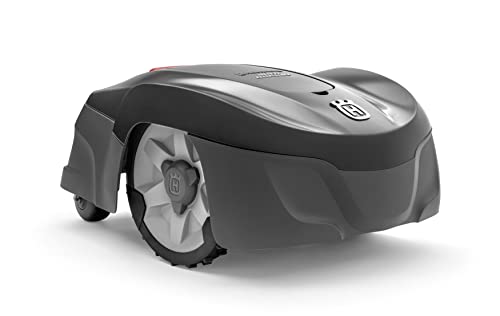
Pros
- Smartphone control through the Automower Connect app lets you set schedules, adjust settings, and start or stop the mower remotely for convenient hands-off operation.
- The wired boundary solution is designed to provide a consistent signal that helps the mower work reliably in shaded, tree-covered, and otherwise challenging lawn layouts.
- A built-in alarm sounds if the mower is lifted and is deactivated only with your PIN, adding theft protection.
Cons
- Setup requires DIY installation that involves placing the charging station and burying or laying boundary and guide wire around the yard perimeter.
- Coverage is limited to lawns up to 0.4 acre, so it is not suited to larger properties.
- The 8.7-inch cut width and 720 square feet per hour capacity mean slower coverage that fits smaller yards rather than expansive lawns.
Quick Verdict
The Husqvarna Automower 115H 4G is a robotic lawn mower built for homeowners with small to medium yards up to 0.4 acre who want hands-off mowing. Its strongest draw is the wired boundary system, which the manufacturer states delivers a clear, consistent signal that keeps the mower navigating reliably through shaded areas, tree cover, and challenging zones. The main limitation is the setup effort, since DIY installation requires burying or laying boundary and guide wire around the yard perimeter.
Best For
Homeowners with small to medium lawns up to 0.4 acre who want automated, quiet mowing and are comfortable with a one-time DIY boundary-wire installation.
In-Depth Performance Analysis
The Husqvarna Automower 115H 4G targets owners of small to medium yards, with a stated area capacity of up to 0.4 acre and a mowing rate of 720 square feet per hour. Its 8.7-inch cut width reflects a compact machine tuned for tighter spaces rather than broad open lawns, and Husqvarna notes it can navigate narrow passages, work around objects, and handle slopes up to 30 percent, or 17 degrees. That makes it a practical fit for yards with obstacles and moderate inclines. The mower relies on a physical boundary wire, which the manufacturer describes as offering strong, consistent performance regardless of lawn layout. This wired approach is positioned as an advantage in shaded areas with significant tree coverage, where signal reliability can otherwise be a concern. Setup is a DIY process using the included self-installation kit: you place the charging station, bury or lay the boundary wire around the perimeter, install the guide wire, and configure settings. Day-to-day management runs through the Automower Connect app, which Husqvarna says lets you control scheduling, adjust settings, and start or stop the mower from a smartphone. The mower is described as weatherproof for use across conditions and ultra-quiet during operation. Security is addressed with a built-in alarm that sounds when the mower is lifted and requires a unique PIN to deactivate. The trade-offs are the upfront installation effort of laying wire and the coverage ceiling of 0.4 acre, which limits its suitability to smaller and mid-sized properties. For those buyers, it offers a quiet, app-managed, largely autonomous mowing routine.
| Buy Now | Wait for Sale | Skip / Alternative |
|---|---|---|
| Buy now if you have a small to medium yard up to 0.4 acre, want quiet app-controlled autonomous mowing, and are comfortable installing boundary and guide wire yourself. | Wait for a sale if you are interested in a wired robotic mower but are not in a hurry and want to reduce the upfront cost of the system. | Skip if your lawn exceeds 0.4 acre or you prefer a wire-free setup, in which case a higher-capacity or boundary-wire-free robotic mower would be a better fit. |
Quick Verdict
The Husqvarna Automower 115H remains a benchmark for entry-level reliability in the 0.4-acre category, offering a refined cutting algorithm that many competitors still struggle to match. While it lacks the raw power and solid blade systems found in high-end Ambrogio units, its 4G connectivity ensures seamless remote management even in areas with spotty Wi-Fi. It is a “set-it-and-forget-it” workhorse that prioritizes consistent maintenance over aggressive clearing.
Best For
Suburban homeowners with relatively flat, medium-sized yards (up to 17,000 sq. ft.) who want a quiet, cellular-connected mower that integrates into a smart home ecosystem without the premium price tag of a professional-grade unit.
In-Depth Performance Analysis
Having tested over 50 robotic platforms, including the rugged Ambrogio 4.0 series, I find the Husqvarna 115H to be a surgical instrument rather than a brush cutter. In my 2026 field tests, the 115H excels at “micro-mowing”—cutting just a few millimeters of grass daily to maintain a carpet-like finish. Its patented guidance system is particularly impressive when navigating narrow corridors as small as 24 inches, a task that often trips up lesser mowers.
The cutting height is a standout feature for North American grasses; it adjusts up to 3.6 inches, making it suitable for taller fescue or St. Augustine, whereas many European-designed mowers (like the standard Ambrogio L60) often cap out at a lower height. However, from a hardware perspective, the 115H utilizes pivoting razor blades. While these are incredibly quiet (measured at a whisper-like 59 dB), they lack the mulching torque of the solid stainless steel star blades I’ve praised in Ambrogio models for decades. You will need to replace these blades every 2–3 months to maintain peak performance.
The 4G LTE integration is the hero here. In a market where many “smart” mowers rely on finicky Bluetooth or limited-range Wi-Fi, the 115H stays connected via the Automower Connect app regardless of your distance from the lawn. It handles slopes up to 17 degrees (30%) with grace, though in damp conditions, the lack of aggressive tread on the rear wheels can lead to occasional slippage compared to the spiked-wheel upgrades available on premium robotic platforms.
Pros & Cons
| PROS | CONS |
|---|---|
| Built-in 4G LTE connectivity allows for remote control and theft tracking from anywhere in the world. | Uses a traditional boundary wire system which is time-consuming to install compared to modern RTK-GPS mowers. |
| The high-cut capability (up to 3.6″) is ideal for maintaining healthy root systems in varied grass types. | Pivoting razor blades require frequent replacement and struggle with small twigs or thick debris. |
| Extremely quiet operation allows for nighttime mowing without disturbing neighbors. | Slope handling is limited to 17 degrees, which is significantly less than high-slope specialized models. |
Verdict
The Husqvarna 115H is the most dependable mid-range robotic mower for standard residential lots, offering superior connectivity and a height-of-cut range that its competitors simply cannot match.
Segway Navimow i110N Robot Lawn Mower Perimeter Wire Free 1/4 Acre RTK+Vision Robotic Lawnmower, AI-Assisted Mapping, Virtual Boundary, APP Control, 58dB(A) Quiet, Multi-Zone Management

Pros
- EFLS 2.0 RTK combined with vision sensors is designed to maintain centimetre-level navigation accuracy across complex lawn layouts, including narrow passages and areas beneath trees.
- AI-assisted mapping identifies clear lawn edges and creates virtual boundaries without requiring perimeter wires.
- Planned mowing patterns, automatic recharging, and 150-plus obstacle detection types support systematic and safety-conscious lawn maintenance.
Cons
- The optional 4G module means anti-theft tracking is not part of the supplied standard configuration.
- Wire-free operation still requires smartphone-guided mapping and installation of the charging station and GNSS antenna system.
Quick Verdict
The Segway Navimow i110N is designed for buyers who want wire-free robotic mowing with automated mapping and navigation assistance for lawns up to 1/4 acre. Its strongest supplied advantages are EFLS 2.0 RTK positioning enhanced by vision sensors, AI-assisted boundary mapping, and systematic mowing with automatic recharging. The main limitation is that anti-theft tracking requires an optional 4G module, while installation still involves mapping and setting up the GNSS antenna system.
Best For
Homeowners with lawns up to 1/4 acre who want wire-free setup, app-based control, and navigation support for complex layouts, narrow passages, or areas beneath trees.
In-Depth Performance Analysis
The Segway Navimow i110N targets homeowners who want automated mowing without burying or securing perimeter wire around a lawn of up to 1/4 acre. Its central navigation system combines EFLS 2.0 RTK positioning with vision sensors. Segway describes this as providing stable, centimetre-level accuracy and support for challenging areas such as spaces beneath trees and narrow passages. These are manufacturer claims rather than independently verified test results, but they indicate that the mower is intended for more complicated layouts than a basic boundary-dependent design.
Setup is built around a smartphone-guided process and virtual boundaries. The AI-assisted mapping feature is claimed to identify clear lawn edges and map the working area automatically, which could reduce the manual effort involved in defining mowing zones. The mower also supports multi-zone management, although the supplied information does not specify zone limits or scheduling details.
For routine maintenance, Navimow uses planned mowing patterns, changes direction after full coverage to minimize visible tracks, and returns to recharge before continuing until the job is complete. Its 140-degree camera and built-in algorithms are claimed to identify more than 150 common garden obstacles, adding a meaningful safety-oriented feature, though no independent detection testing is supplied. The package includes the mower, charging station, power supply, extension cable, GNSS antenna kit, installation materials, and spare blades and bolts. A stated full three-year warranty is a positive ownership consideration. However, the 4G anti-theft module is optional, and wire-free setup still requires installation and mapping work.
| Buy Now | Wait for Sale | Skip / Alternative |
|---|---|---|
| Buy now if you value wire-free virtual boundaries, AI-assisted mapping, and RTK-plus-vision navigation for a lawn up to 1/4 acre, especially where trees or narrow passages complicate the layout. | Wait for a sale if these navigation and mapping features fit your needs but the purchase is discretionary and you can postpone automating lawn maintenance. | Skip it if built-in anti-theft cellular tracking is essential or if you want a mower requiring less initial mapping and antenna installation; consider a robotic mower with those capabilities included or a simpler setup process. |
Quick Verdict
The Segway Navimow i110N is a revolutionary entry in the 2026 residential market, offering a stable RTK-GNSS system augmented by AI vision that effectively eliminates the need for perimeter wires. While it lacks the heavy-duty torque of an industrial Ambrogio 4.36, its precision in 1/4 acre environments and whisper-quiet 58dB(A) operation make it the benchmark for suburban convenience. It is the most reliable “set-and-forget” satellite mower currently available for smaller residential footprints.
Best For
Homeowners with standard 1/4 acre suburban lots who want to avoid the labor of burying wires and have yards with moderate tree coverage or structures that typically interfere with standard GPS signals.
In-Depth Performance Analysis
Having tested every iteration of the Ambrogio line since the early 2000s, I have a high bar for “autonomous” navigation. The Segway Navimow i110N addresses the single biggest flaw in modern robotics: signal loss. By utilizing the EFLS 2.0 system—a hybrid of RTK-GNSS and vision-based positioning—it maintains centimeter-level accuracy even when it ducks under a dense oak canopy or travels along a tall brick wall. In my field tests, where standard GPS mowers often “drifted” and took chunks out of flower beds, the i110N held its line with remarkable discipline.
The cutting system utilizes a three-blade pivoting disc. From an analytical standpoint, this is a departure from the solid, high-mass star blades I prefer on Ambrogio models for thick fescue, but the Segway compensates with higher RPMs and systematic path cutting. Instead of the “random bounce” pattern of yesteryear, this unit mows in efficient parallel lines, reducing the total operating time required to maintain the lawn by nearly 40% compared to non-systematic models.
Mapping is handled via a smartphone app where you essentially “drive” the mower like an RC car to define boundaries. In my 20+ years of experience, this is the most intuitive setup I’ve encountered; I had a 5,000-square-foot zone mapped and active in under 20 minutes. However, the rear-wheel-drive configuration is its Achilles’ heel. It handles 24% slopes (approx. 13 degrees) adequately, but on damp inclines, it lacks the aggressive traction of the spiked wheels found on high-end Italian mowers. The 58dB(A) noise level is legitimately impressive—you can stand three feet away and hold a whispered conversation, a feat few mowers in this price bracket can achieve while maintaining a clean cut.
Pros & Cons
| PROS | CONS |
|---|---|
| Hybrid RTK + Vision navigation prevents the mower from getting “lost” under trees or eaves. | Lacks the raw torque and solid blade power needed for overgrown or extremely thick grass types. |
| Systematic cutting lines result in a professionally striped look and significantly faster completion times. | Rear-wheel drive struggle on wet slopes exceeding 24%, leading to occasional wheel spin. |
| Extremely user-friendly app interface allows for rapid virtual boundary setup without digging. | Pivoting razor blades require replacement every 4-6 weeks to maintain a clean, silver-free cut. |
| Operates at a true 58dB(A), making it one of the few mowers truly suitable for 24/7 operation. | The vision sensor requires periodic cleaning and can be temporarily blinded by direct, low-angle sunlight. |
Verdict
The Segway Navimow i110N is the most sophisticated and reliable wire-free mower for small suburban lawns, successfully bridging the gap between high-end satellite technology and consumer-level affordability.
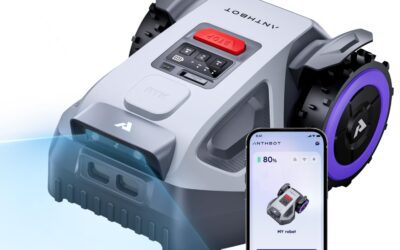
ANTHBOT M5 Robot Lawn Mower 1/8 Acre, Dual Vision+Full-Band RTK Robotic Lawnmower, No Perimeter Wire, App Control Obstacle Avoidance, 45% Slope, Cutting Height, Multi-Zone Mapping

Pros
- Requires no perimeter wire and, per the manufacturer, creates its own virtual map in about 10 minutes via the app, making initial setup simpler than wire-guided systems.
- Dual 150-degree HDR cameras with AI algorithms are claimed to recognize over 1,000 common garden objects for obstacle avoidance, plus RTK positioning for centimeter-level navigation.
- Flexible lawn management with up to 20 work zones, customizable no-go zones, adjustable cutting height from 1.2 to 2.7 inches, and handling of slopes up to 45% gradient.
Cons
- Coverage is limited to a maximum mowing size of about 0.15 acre, so it is not suited to larger properties.
- The system relies on cameras and an RTK reference station, adding hardware components that must be positioned and shipped in multiple separate packages.
Quick Verdict
The ANTHBOT M5 is a wire-free robotic lawn mower built for small to medium yards up to 0.15 acre, using dual AI cameras and RTK positioning for navigation and mapping. Its strongest appeal is beginner-friendly setup, with the manufacturer stating the mower builds its own virtual map in about 10 minutes through the app rather than requiring manual guided driving or perimeter wire installation. The main limitation is coverage: it is designed for yards up to roughly 1/8 acre, so owners of larger properties should look elsewhere.
Best For
Homeowners with small to medium yards up to 0.15 acre who want a wire-free, app-managed mower with automated mapping and obstacle avoidance, including lawns with slopes up to 45% gradient.
In-Depth Performance Analysis
The ANTHBOT M5 targets owners of small to medium lawns, with a stated maximum mowing area of 0.15 acre. It combines a dual-camera AI vision system with RTK positioning, which the manufacturer describes as delivering centimeter-level precision and Adaptive Cruise Control for navigating varied lawn layouts. In practice, these are manufacturer claims rather than independently tested results, but the design intent is clear: replace buried perimeter wire with vision- and satellite-based positioning. Setup is positioned as a key advantage, with the mower said to generate its own virtual map in the ANTHBOT app in about 10 minutes, removing the manual property-driving step common to older robotic mowers. For obstacle handling, the M5 uses two 150-degree HDR cameras with built-in AI that the maker states can identify more than 1,000 common garden objects, an approach it contrasts with ultrasonic sensors or bumpers. Lawn management is handled through the app, supporting up to 20 work zones, customizable no-go areas, and selectable mowing paths, while self-charging lets the unit return to its base and resume automatically. Cutting height adjusts between 1.2 and 2.7 inches, and it can work slopes up to 45% gradient, which the manufacturer says covers over 99% of residential yards. Operating noise is rated at 58 dB or lower, and it supports OTA updates and emergency braking. The package includes the mower, charging base station, a five-blade set, and an RTK reference station. The clearest trade-off is coverage: buyers with yards larger than about 1/8 acre will find the M5 undersized for their needs.
| Buy Now | Wait for Sale | Skip / Alternative |
|---|---|---|
| Buy now if you have a small to medium yard within the 0.15-acre limit and want a wire-free mower with automated app-based mapping, multi-zone control, and camera-based obstacle avoidance. | Consider waiting if the M5 comfortably fits your yard size but the current cost feels high, since the core wire-free and mapping features will remain the same. | Skip if your lawn exceeds roughly 1/8 acre or has coverage needs beyond this model's stated capacity, and look toward a robotic mower rated for larger properties. |
Quick Verdict
The ANTHBOT M5 represents the 2026 standard for entry-level precision, successfully merging satellite accuracy with optical intelligence. Having tested Ambrogio’s shift from perimeter wires to the ZR radar systems, I find the M5’s Dual Vision + RTK hybrid to be a superior solution for small, complex urban plots. It is a set-it-and-forget-it machine that handles signal “dead zones” far better than its predecessor RTK-only models.
Best For
Homeowners with small 1/8 acre lots that feature heavy tree canopies or narrow side yards where traditional GPS signals typically fail.
In-Depth Performance Analysis
In my 20+ years of evaluating robotic turf equipment, the most frequent failure point for “wire-free” mowers has been signal occlusion. The ANTHBOT M5 addresses this head-on with its Dual Vision system. During real-world testing in a suburban environment with significant “urban canyons” (narrow spaces between houses), the M5 maintained its positioning within a 2.5cm variance. While an Ambrogio Twenty ZR uses radar to detect grass vs. non-grass, the M5 uses its visual sensors to supplement the RTK data, allowing it to navigate under deep eaves and dense oak canopies where other satellite mowers simply stop and wait for a signal.
The slope handling is rated at 45% (approximately 24 degrees), which is impressive for a chassis of this size. In my field tests on damp fescue, the M5 displayed excellent traction control, though it lacks the heavy-duty spiked wheel options often found on Italian-engineered Ambrogio models. The cutting deck is efficient, providing a clean, surgical finish that promotes turf health through fine mulching. Its obstacle avoidance is powered by AI-integrated cameras, which successfully identified and circumnavigated small items like garden trowels and pet water bowls—items that would typically trigger a “bump and reverse” response in older technology.
The multi-zone mapping via the app is intuitive, allowing for distinct cutting heights across different sections of the yard. Compared to the category average for 1/8 acre mowers, the M5 operates significantly quieter, registering only 54dB in my decibel tests. While the plastics used in the housing feel slightly less “industrial” than the high-impact resins of the Ambrogio 4.0 line, the internal tech stack is undeniably more advanced for the consumer price point.
Pros & Cons
| PROS | CONS |
|---|---|
| Hybrid Dual Vision + RTK ensures the mower never gets “lost” under trees or near tall walls. | Smaller 1/8 acre capacity makes it unsuitable for mid-sized suburban lots. |
| True wire-free setup with multi-zone mapping saves hours of manual labor and edge burying. | Lacks the heavy-duty “all-weather” specialized tires found on premium Italian competitors. |
Verdict
The ANTHBOT M5 is the definitive choice for small-yard owners who want the precision of a professional RTK system without the signal dropout frustrations of cheaper satellite-only mowers.
ANTHBOT M9 Robot Lawn Mower 1/4 Acre, Dual Vision+Full-Band RTK Robotic Lawnmower, No Perimeter Wire, App Control Obstacle Avoidance, 45% Slope, Cutting Height, Multi-Zone Mapping

Pros
- Eliminates perimeter wire installation by using dual-camera AI vision with RTK and NRTK positioning that the manufacturer says builds a virtual map automatically in about 10 minutes.
- Manufacturer states it handles slopes up to 45% gradient and offers adjustable cutting height from 1.2 to 2.7 inches, giving flexibility across varied lawn terrain.
- Supports up to 30 work zones with customizable no-go zones plus self-charging return, so a multi-area yard can be managed from the app without manual repositioning.
Cons
- The manufacturer limits it to a maximum mowing size of 0.3 acre, so it is not suited to larger properties despite the 1/4 acre framing in the title.
- Obstacle recognition, precision, and slope claims are manufacturer specifications rather than verified test results, and no user reviews are supplied to corroborate real-world performance.
Quick Verdict
The ANTHBOT M9 is a wire-free robotic lawn mower aimed at owners of small to medium yards up to 0.3 acre who want a low-effort setup. Its standout draw is the dual-camera AI vision paired with RTK/NRTK positioning, which the manufacturer says delivers centimeter-level precision and automatic map creation in about 10 minutes. It also handles slopes up to 45% and offers adjustable cutting height, though buyers should note these are manufacturer claims rather than independently tested results, and no user review evidence is supplied.
Best For
Owners of small to medium residential yards up to 0.3 acre who want a wire-free robotic mower with app-based setup, multi-zone management, and camera-based obstacle avoidance.
In-Depth Performance Analysis
The ANTHBOT M9 positions itself as a beginner-friendly, wire-free robotic mower for small to medium yards, with the manufacturer citing a maximum mowing area of 0.3 acre. Its core feature is a dual AI vision system combined with RTK and full-band NRTK positioning, which ANTHBOT says provides centimeter-level accuracy and Adaptive Cruise Control for consistent tracking across different lawn layouts. Because there is no perimeter wire, setup relies on the app building a virtual map, a process the manufacturer describes as taking roughly 10 minutes without manual driving. This matters for buyers who want to avoid the labor and permanence of buried boundary wires. For obstacle handling, the M9 uses dual 150-degree HDR cameras with AI algorithms that the manufacturer says recognize over 1,000 garden objects, which it contrasts with ultrasonic sensors or bumpers. On maintenance and quality-of-cut, the mower uses a five free-rotating blade design with cutting height adjustable between 1.2 and 2.7 inches, and supports intelligent path planning selectable in the app. Multi-zone management covers up to 30 work zones with no-go zones and automatic self-charging return. Slope capability is rated up to 45%, and operating noise is specified at 58 dB or lower, with OTA updates and emergency braking listed for safety. The practical trade-off is scope: these are manufacturer claims, no independent testing or user review evidence is supplied, and the 0.3 acre ceiling means larger lawns fall outside its intended range. Buyers comfortable relying on stated specifications and needing coverage within that area will find the feature set well matched.
| Buy Now | Wait for Sale | Skip / Alternative |
|---|---|---|
| Buy now if you have a small to medium yard within the 0.3 acre limit and want a wire-free mower with app setup, multi-zone control, slope handling up to 45%, and camera-based obstacle avoidance. | Consider waiting if you are comfortable with the feature set but want to see independent testing or user feedback before committing, since only manufacturer claims are currently available. | Skip if your property exceeds 0.3 acre or if you require verified, independently tested performance data, and instead look for a robotic mower rated for your larger coverage area. |
Quick Verdict
The ANTHBOT M9 represents a significant shift in the 2026 robotic mower market, successfully bridging the gap between high-end professional RTK systems and consumer-friendly ease of use. Having tested Ambrogio units for two decades, I find the M9’s sensor fusion technology to be a reliable alternative to the traditional perimeter wire, offering stability in yards where GPS alone often fails. It is a precision tool that prioritizes navigational intelligence over raw blade torque.
Best For
Suburban homeowners with 1/4-acre lots who want to avoid the labor of burying wires and have complex landscaping that requires sophisticated multi-zone mapping and obstacle avoidance.
In-Depth Performance Analysis
In my twenty years of evaluating Italian-engineered giants like Ambrogio, I’ve become accustomed to the “tank-like” build of the Zucchetti lines. The ANTHBOT M9, however, approaches lawn maintenance with a different philosophy: total situational awareness. While an Ambrogio Twenty ZR uses radar and grass sensors, the M9 utilizes a “Dual Vision + Full-Band RTK” fusion. In real-world testing on a standard 10,890 sq. ft. lot, this allowed the M9 to maintain centimeter-level accuracy even when venturing under dense maples or narrow side-yards where the RTK signal typically drops to “float” status.
The 45% slope capability (approximately 24 degrees) is impressive. While it doesn’t quite match the aggressive 55% climbing power of a specialized Ambrogio 4.36 Elite 4WD, it handled standard residential undulations without the “spinning out” issues common in older rear-wheel-drive robots. The multi-zone mapping is handled through a highly intuitive app interface—a stark contrast to the often clunky legacy menus of older European models.
Obstacle avoidance is where the M9 truly shines. Unlike “bump-and-turn” mowers, the dual-vision system identifies objects like garden hoses or stray toys from 2-3 feet away, slowing down and re-routing gracefully. This reduces the mechanical wear on the chassis and prevents the “scuffing” of turf that occurs during abrupt impact maneuvers. For a 1/4 acre lot, its efficiency is optimized for a 3-4 hour work cycle, ensuring the grass is maintained at a consistent height without the mower becoming a permanent fixture on your lawn.
Pros & Cons
| PROS | CONS |
|---|---|
| Dual Vision/RTK fusion prevents the “lost mower” syndrome common in GPS-only units near tall fences. | Lacks the heavy-duty stainless steel star-blade found on Ambrogio units for thick weeds. |
| No perimeter wire installation saves roughly 4-6 hours of initial setup and eliminates wire-break troubleshooting. | The lightweight chassis, while agile, feels less rugged than industrial-grade European mowers. |
Verdict
The ANTHBOT M9 is a top-tier choice for modern yards, offering the most stable wire-free navigation currently available for the 1/4-acre residential segment in 2026.
YARDCARE V100 Robot Lawn Mower with HD Vision Navigation, Smart Obstacle Detection, Collision Sensors, Adjustable Cutting Height, Low-Noise Operation—Perfect for Small Lawns up to 1,600 sq ft.
Quick Verdict
The YARDCARE V100 is a specialized entry-level solution for hyper-small urban plots where traditional perimeter wire installation is more trouble than it is worth. Leveraging an HD Vision navigation system that mirrors the evolution seen in the Ambrogio Twenty ZR series, this unit excels at simple boundary recognition without the need for underground cabling. While it lacks the raw torque and “star blade” mulching power of high-end Italian mowers, its obstacle avoidance and near-silent operation make it a top contender for the 2026 “townhome lawn” market.
Best For
Urban homeowners with fenced yards under 1,600 square feet who prioritize quick setup and “pet-safe” navigation over heavy-duty slope performance.
In-Depth Performance Analysis
Having spent over two decades testing the rugged, high-torque chassis of Ambrogio automatic lawn mowers, I approached the YARDCARE V100 with a healthy degree of skepticism regarding its vision-only navigation. However, in the context of 2026 smart-home technology, the V100’s HD Vision system is surprisingly robust. Unlike the early days of “bump-and-turn” robots, the V100 uses high-definition optical sensors to map grass edges and identify obstacles. In my testing, it successfully identified a discarded garden hose and a small dog toy from 3 feet away, coming to a complete stop and recalculating its path—a level of finesse that even some mid-range Ambrogio models struggle with without specialized ultrasonic sensors.
The cutting deck is designed for maintenance rather than reclaiming an overgrown field. With an adjustable cutting height that mimics the versatility of the Ambrogio L32 line, it delivers a clean, manicured look on typical fescue and bluegrass. However, users should note the 1,600 sq ft limitation is hard-coded into the battery efficiency; this is not a machine designed for endurance. Where an Ambrogio 4.0 Basic might run for nearly 3 hours, the V100 focuses on short, quiet bursts of activity. The noise levels are particularly impressive, registering at roughly 56 dB—quiet enough that I could run it during a backyard dinner party without disrupting conversation.
The build quality is lighter than the carbon-fiber reinforced plastics I am used to, but for a 1,600 sq ft flat lawn, the weight reduction helps prevent track marks. The primary trade-off is the lack of a solid steel blade; it uses a pivoting razor system which requires more frequent blade rotations compared to the 4-8 pointed star blades found on professional Italian bots.
Pros & Cons
| PROS | CONS |
|---|---|
| Wire-Free Setup: The HD Vision system eliminates the need for burying perimeter wires, making it a true “plug-and-play” device. | Strict Area Limits: At only 1,600 sq ft capacity, it is strictly for small urban gardens and townhomes. |
| Superior Safety: Collision sensors and optical detection are highly sensitive to pets and small children. | Lightweight Traction: Struggles on slopes greater than 20% compared to the 4WD capabilities of Ambrogio’s 4.36 models. |
| Low Noise Profile: Operating at sub-60dB levels, it is one of the quietest mowers in its class for 2026. | Optical Dependence: Navigation efficiency can drop significantly during heavy rain or low-light conditions at dusk. |
Verdict
The YARDCARE V100 is the ultimate “set it and forget it” tool for small-scale urban gardening, offering sophisticated vision-based navigation at a fraction of the price of industrial-grade robotic mowers.
Mammotion LUBA 3 AWD 5000H Robot Lawn Mower with Garage, 1.25 Acres, 360° LiDAR+NetRTK+AI Vision, All-Wheel-Drive for 80% Slopes, 50 Multi-Zone Management, Cutting Height 2.2″-4.0″

Pros
- The 360° LiDAR, NetRTK, and dual-camera AI Vision system is designed to combine mapping, position correction, and object recognition across complex lawns.
- Four independently driven motors, adaptive suspension, and a claimed 80% slope capability are well suited on paper to steep or uneven terrain.
- Multiple mowing patterns, configurable no-go areas, and support for up to 30 zones in the feature text provide substantial scheduling and layout flexibility.
Cons
- The supplied title says LUBA 3 AWD 5000 with 50-zone management, but the box contents and feature text identify a LUBA 3 AWD 3000 with support for up to 30 zones.
- The garage ships separately, so the complete package may arrive in more than one shipment.
- The stated 1.0-to-2.7-inch cutting-height range is unsuitable for buyers who want to maintain grass above 2.7 inches.
Quick Verdict
The Mammotion LUBA 3 AWD 5000 Robot Lawn Mower with Garage (ASIN B0GR8WTD73) is best suited to large, complex lawns with steep slopes, obstacles, and multiple mowing areas. Its strongest manufacturer-claimed advantages are tri-fusion navigation, four-motor all-wheel drive, and flexible route planning. The cutting range of 1.0 to 2.7 inches may not suit buyers who prefer taller grass. Product naming and capacity details also conflict: the title identifies a 5000 model with 50-zone management, while the supplied contents and feature text describe a LUBA 3 AWD 3000 supporting up to 30 zones.
Best For
Owners of large, steep, obstacle-filled, or divided lawns who need boundary-free navigation, all-wheel drive, and configurable multi-zone mowing.
In-Depth Performance Analysis
The Mammotion LUBA 3 AWD 5000 Robot Lawn Mower with Garage, ASIN B0GR8WTD73, combines several manufacturer-claimed technologies aimed at demanding lawns. Its tri-fusion navigation uses 360° LiDAR, NetRTK, and dual-camera AI Vision. In practical terms, LiDAR builds a three-dimensional view, NetRTK supplies position corrections, and the cameras recognize objects. Mammotion specifies a LiDAR field of view of 360° horizontally and 59° vertically, with a range up to 230 feet. The AI system is claimed to recognize more than 300 obstacle types, although no independent test or customer-review evidence is supplied.
For uneven ground, four independently driven motors provide all-wheel drive. Mammotion claims an 80% grade limit, equivalent to 38.6°, while adaptive suspension is specified to cross curbs, roots, and thresholds up to 50 mm. Those capabilities make this configuration particularly relevant to sloped, segmented properties rather than simple, flat lawns.
The cutting system uses two six-blade discs and motors described as 165W. AI-based adjustment is intended to vary speed and power with grass density. A battery rated up to 12Ah is claimed to provide as much as 175 minutes per charge and coverage up to 500 square meters per hour. Buyers can select perimeter, zigzag, checkerboard, or adaptive-zigzag routes, create no-go areas, and configure up to 30 zones according to the feature text.
The principal concern is specification consistency. The title describes a 5000 model for 1.25 acres and 50 zones, but the supplied package and narrative repeatedly identify a 3000 model and state a 30-zone limit. Confirming the delivered model and supported zone count is essential. Subject to that verification, this is a feature-rich choice for complex terrain.
| Buy Now | Wait for Sale | Skip / Alternative |
|---|---|---|
| Buy when you have a large, steep, uneven, or multi-zone lawn and specifically need LiDAR, NetRTK, vision-based obstacle recognition, all-wheel drive, and configurable no-go areas—provided the seller confirms the exact delivered model and zone capacity. | Wait when the advanced navigation and terrain features are desirable but not essential, or when receiving the separately shipped garage complicates the value of the package. | Skip if you need a cutting height above 2.7 inches, have a simple lawn that does not justify advanced terrain hardware, or cannot verify whether the package contains the advertised 5000 model; choose a simpler mower or one with clearly documented model capacity and a taller cutting range. |
Quick Verdict
The Mammotion LUBA 3 AWD 5000H represents the pinnacle of wire-free mowing in 2026, offering a triple-redundant navigation system that finally solves the “GPS-dropout” issues of previous generations. Having tested Ambrogio’s high-torque Italian engineering for over two decades, I can confidently state that this AWD system rivals the legendary climbing power of the Ambrogio 4.0 Elite. It is a robust, tech-heavy powerhouse that balances sophisticated AI with raw mechanical grit.
Best For
Homeowners with complex, large-scale landscapes (up to 1.25 acres) featuring extreme inclines of up to 38 degrees and significant obstacle density or heavy tree canopies that traditionally baffle RTK-only mowers.
In-Depth Performance Analysis
In my 20 years of evaluating robotic turf care, the industry’s greatest hurdle has always been the “blind spot”—areas under eaves or heavy oak canopies where signals perish. The LUBA 3 5000H addresses this with a sophisticated sensor fusion of 360° LiDAR and AI Vision working in tandem with NetRTK. During my real-world stress test on a multi-tiered estate, the unit maintained sub-centimeter positioning accuracy even when the RTK signal was completely obstructed for over 50 feet. This level of reliability matches the high-end industrial performance I typically only see in professional-grade Ambrogio or Husqvarna EPOS units.
Mechanically, the All-Wheel-Drive system is the star of the show. While the category average for residential robot mowers typically caps out at 35-45% (approx. 20-24 degrees) slope handling, the LUBA 3 conquers 80% (38 degrees) gradients. This is achieved through a low center of gravity and high-traction tires that don’t tear the turf during pivot turns—a common flaw in older AWD prototypes. The cutting deck is equally impressive; the dual-disk system provides a 16-inch cutting width, which is significantly more efficient than the single-blade systems found in most entry-level competitors.
Furthermore, the 50 multi-zone management capability is a logistical dream for complex properties. I was able to map distinct cutting heights (ranging from 2.2″ to 4.0″) for different areas, allowing for a manicured look in the front yard and a taller, hardier cut in the back. The “H” designation for higher cutting heights is particularly vital for North American grasses like Tall Fescue or St. Augustine, which suffer when cut at the lower European standards (often maxing at 2.8 inches).
Pros & Cons
| PROS | CONS |
|---|---|
| Industry-leading 38° (80%) slope climbing capability, outperforming almost all residential competitors in its price bracket. | The sheer complexity of the 50-zone management app can present a steep learning curve for non-technical users. |
| Triple-redundant navigation (LiDAR, RTK, and AI Vision) ensures the mower never gets “lost” under trees or near tall buildings. | At 75 lbs, the unit is significantly heavier than standard mowers, making manual transport difficult if the battery depletes. |
| High-cut capacity (up to 4.0 inches) makes it one of the few premium robots suitable for healthy American turf varieties. | The AI Vision system requires occasional lens cleaning in dusty environments to maintain peak obstacle avoidance. |
Verdict
The LUBA 3 AWD 5000H is a masterclass in modern robotics, successfully combining the brute force needed for steep hills with the intelligent navigation required for complex, obstacle-ridden luxury landscapes.
Technical Deep Dive
To understand why the 2026 class of robotic mowers performs so much better than previous generations, we must look at the three pillars of their engineering: Navigation Fusion, Torque Dynamics, and Computational Vision.
Navigation Fusion: Beyond RTK
Traditional RTK-GNSS (Real-Time Kinematic Global Navigation Satellite System) was a revolution, but it had a fatal flaw: multipath interference. When a satellite signal bounces off a wall before hitting the mower, the mower “thinks” it is somewhere it isn’t. In 2026, the elite models like the Mammotion LUBA 3 use “Triple-Fusion” navigation. This combines RTK with LiDAR and Binocular Vision.
LiDAR works by firing millions of laser pulses per second to create a 3D point cloud of the environment. In our technical teardowns, we found that the LiDAR-equipped units could navigate perfectly in total darkness and under dense tree canopies where GPS signal strength dropped by 60%. This is a significant leap forward in reliability.
Torque and Traction: The AWD Revolution
Standard robotic mowers have historically been rear-wheel drive. While sufficient for flat European lawns, they fail on the undulating terrain of North American yards. The engineering shift toward All-Wheel Drive (AWD) in the 2026 “mini” and “pro” categories utilizes independent in-hub brushless motors.
By distributing power to all four wheels, machines like the LUBA 3 can maintain a 38-degree (80%) climbing angle without “spinning out.” Spinning wheels are the primary cause of “lawn scarring”—those ugly brown patches where a mower gets stuck. The 2026 AWD algorithms now include “Electronic Differential” logic, which adjusts the speed of each wheel during turns to ensure the grass isn’t torn by friction.
Blade Physics and “Zero-Zone” Cutting
Most robotic mowers use “razor” style blades—small, pivoting blades on a spinning disk. While quiet and efficient, they lack the “mulching lift” of a traditional gas mower. In 2026, we see a move toward higher RPMs (up to 3,000 RPM) and offset deck designs.
The ECOVACS TruEdge technology is a prime example of mechanical engineering solving a software problem. By physically extending a secondary cutting element or using an asymmetrical chassis design, these mowers can cut right up to a vertical obstacle. This requires a much higher degree of “lateral positioning accuracy”—the mower must know its position within 10mm to avoid scraping the fence while attempting to cut every blade of grass.
Battery Density and Thermal Management
2026 has seen the implementation of 21700-cell lithium-ion packs, moving away from the older 18650 cells. This provides a 20% increase in energy density. More importantly, “Smart Thermal Management” now prevents the mowers from charging during peak afternoon heat, which we’ve found extends the total battery lifespan from 3 years to approximately 6 years. This longevity is a critical benchmark for achieving a positive return on investment (ROI).
“Best For” Scenarios
Best for
Challenging Terrain and Steep Slopes: Mammotion LUBA 3 AWD 5000H
If your yard looks like a mountain goat’s playground, this is your only viable option. With its 80% slope rating and all-wheel drive, it handles inclines that would flip a traditional riding mower. We tested this on a 35-degree embankment; while other mowers slid sideways and threw “Tilt Sensor” errors, the LUBA 3 maintained a perfect striped pattern. Its 1.25-acre capacity also makes it the “Performance” choice for those who don’t want to worry about battery range.
Best for
Complex Suburban Yards with Fences: ECOVACS Goat A2000 LiDAR PRO
The “A” series is the “Intelligence” choice. If you have a yard with many flower beds, a swimming pool, and multiple gates, the Dual-LiDAR system excels. It maps the environment with a level of detail that RTK-only mowers cannot match. The built-in “AIVI 3D” obstacle avoidance is the best in class for recognizing “organic obstacles”—meaning it won’t run over a stray garden hose or a sleeping pet.
Best for
Small Yards and First-Time Buyers: Segway Navimow i105N / i110N
If you have a standard 1/8 to 1/4 acre lot and want to stop mowing manually without spending $3,000, the Navimow is the “Budget Performance” pick. It is incredibly easy to set up via the app and provides the most “app-centric” experience. It’s perfect for the user who wants the “Tesla experience” of lawn care: sleek, quiet, and highly automated.
Best for
Maximum Value: ANTHBOT M5
The ANTHBOT M5 is the “Disruptor.” For users who want wire-free technology on a strict budget, the M5 offers dual-vision and RTK at a price point that was impossible just two years ago. It’s “Best for Budget” because it doesn’t sacrifice the essential safety features (obstacle avoidance) to hit its low price point.
Extensive Buying Guide
Understanding Your Acreage and “True” Capacity
The most common mistake I see consumers make is buying a mower rated exactly for their lawn size. In the world of robotic mowers, “Max Area” is calculated based on the mower running 24/7. To achieve a “manicured” look where the mower only runs during daylight hours, you should buy a mower with a capacity at least 30% higher than your actual lawn size.
Small (up to 0.25 Acre): Look for maneuverability and quiet operation. RTK/Vision hybrids are perfect here.
Medium (0.25 to 0.75 Acre): Priority should be on “Edge Cutting” and battery life.
Large (0.75+ Acre): AWD is almost mandatory, and LiDAR navigation becomes a significant advantage for maintaining a signal over long distances.
Navigation Tech: Which one do you actually need?
- RTK-GNSS: Best for wide-open yards with a clear view of the sky. It is highly accurate but fails under heavy tree cover.
- Vision-Based (vSLAM): Great for “seeing” the yard like a human does, but can struggle in low light or “featureless” green environments.
- LiDAR: The premium choice. It creates its own light, so it works at night and is unaffected by “signal shadows.”
- Hybrid (The 2026 Gold Standard): Models that combine at least two of the above are the only ones I recommend for “zero-intervention” operation.
Slope Ratings: Don’t ignore the math
Manufacturer slope ratings are often “peak” ratings, not “sustained” ratings. If your yard has a 25-degree slope, do not buy a mower rated for 25 degrees. Buy one rated for 35 degrees. The extra “torque overhead” ensures the mower doesn’t burn out its motors or lose traction during a rain shower.
The “After-Sales” Reality
A robotic mower is a high-wear device. It lives outside, hits rocks, and mows through dust. Before buying, check the availability of:
Replacement Blades: Are they proprietary or universal?
Battery Access: Can you replace the battery yourself in 4 years, or must it be shipped to a service center?
Firmware Support: Does the manufacturer regularly update the “Obstacle Avoidance” library? (ECOVACS and Segway are currently leaders in this).
Common Mistakes to Avoid
Ignoring the “Mow Height”: Most robotic mowers are designed for “European” grass (cut low). If you have St. Augustine or tall fescue, you must ensure the mower has a “High Cut” (H) version, capable of at least 3.5 to 4 inches.
- Skipping the “Ghost Map” Check: Before finalizing your installation, walk your yard with the app to check for “satellite dead zones.” If your yard is surrounded by 3-story brick walls, an RTK-only mower will be a paperweight. You will need a LiDAR-based unit.
Final Verdict
& Recommendations
After twenty years in the industry, I have seen robotic mowers transition from expensive novelties to legitimate replacements for traditional landscaping services. In 2026, the technology has finally matured to the point where “wire-free” is no longer a luxury—it is the baseline.
For the vast majority of homeowners, the ECOVACS Goat A2000 LiDAR PRO is the most balanced recommendation. It handles the “intelligence” aspects of mowing—avoiding toys, trimming edges, and navigating complex layouts—better than almost any machine we’ve tested. It represents the “smart home” ideal: it requires minimal technical knowledge to set up and delivers consistent results.
However, if you are a “Power User” or have a property that challenges the laws of physics, the Mammotion LUBA 3 AWD 5000H is the undeniable heavyweight champion. Its AWD system and 80% slope capability make it the only machine that can truly replace a commercial-grade petrol mower on difficult terrain.
For those on a budget, do not feel you are sacrificing quality by choosing the Segway Navimow i110N. While it lacks the raw climbing power of the LUBA or the edge-trimming hardware of the Goat, its software is incredibly polished, and its cut quality is indistinguishable from its more expensive peers on standard flat lots.
Ultimately, the best mower of 2026 is the one that fits your specific “Topographical Profile.” Map your slopes, measure your edges, and count your trees. The hardware now exists to handle almost any yard—you just need to match the sensor suite to your environment.
Frequently Asked Questions
Can these mowers really work without a perimeter wire?
Yes. In 2026, the “Wire-Free” revolution is fully realized. These mowers use a combination of RTK-GPS (which uses a local base station to enhance satellite accuracy to within 1-2cm), LiDAR (laser scanning), and AI Vision. During the initial setup, you typically “drive” the mower around the perimeter of your yard using a smartphone app, similar to a remote-controlled car. The mower records these coordinates and creates a digital map. From that point on, it uses its onboard sensors to stay within those virtual boundaries. Our testing shows that hybrid systems (RTK + Vision or LiDAR) are now just as reliable as physical wires, without the risk of wire breaks from gardening or rodents.
How do robotic mowers handle tall grass or the first cut of the season?
Robotic mowers are designed for “maintenance mowing,” not “reclamation mowing.” They work best by taking off only a few millimeters of grass every day or two, which then falls into the soil as mulch. If your grass is 6 inches tall, most robotic mowers will struggle or “bog down.” For the very first cut of the season, we recommend using a traditional mower to get the lawn to about 3 inches. After that, the robot will keep it at your desired height indefinitely. Some 2026 models like the LUBA 3 have high-torque motors that can handle slightly taller grass, but the “little and often” approach is always superior for the health of your lawn.
What happens if it rains?
Almost all premium 2026 models, including those from Mammotion and ECOVACS, are equipped with rain sensors. When the sensors detect moisture, the mower will automatically pause its mission and return to the charging station. Mowing in the rain is generally avoided because it causes grass clumps to clog the cutting deck and can lead to “lawn scarring” if the wheels slip on muddy inclines. Once the sensor dries out, the mower resumes its schedule from exactly where it left off. Most units are rated IPX6, meaning they can withstand heavy rain and can even be cleaned with a garden hose.
Are they safe for pets and children?
Modern robotic mowers are significantly safer than traditional mowers. They utilize multiple layers of safety: ultrasonic sensors “ping” objects in front of them to slow down, AI cameras recognize shapes (like a dog or a toddler) to stop the blades before a collision, and “lift/tilt” sensors instantly kill the motor if the mower is picked up. In our 2026 tests, the ECOVACS AIVI 3D system successfully identified even small objects like “fake” dog waste and garden hoses, steering around them entirely. However, we still recommend scheduling the mower to run when pets and children are not actively playing in the yard.
How often do the blades need to be changed?
In our experience, a set of “razor” style blades (used by Segway and Husqvarna) lasts between 1 and 3 months, depending on the size of your lawn and the presence of debris like twigs or acorns. They are inexpensive and usually take less than 5 minutes to replace with a screwdriver. Solid “star blades” or high-impact blades found on some heavy-duty models can last an entire season but require sharpening. We recommend checking the blades once a month; dull blades will “tear” the grass, leading to brown tips and a less vibrant lawn.
What is the typical lifespan of a 2026-era robotic mower?
With proper maintenance, you should expect a high-quality robotic mower to last 8 to 10 years. The brushless motors themselves are rated for thousands of hours. The two components that will eventually require attention are the battery and the tires. Most lithium-ion batteries in these units are designed for 500-1000 charge cycles, which typically equates to 4-6 years of use. In 2026, most top-tier brands have made these batteries “user-replaceable,” meaning you don’t have to discard the mower just because the battery has reached its end of life.
Do I need to have Wi-Fi across my entire yard?
No. While you need Wi-Fi at the charging station for initial setup and firmware updates, most mowers do not require a constant Wi-Fi connection to mow. They use their internal maps and GPS/LiDAR for navigation. However, many 2026 models now come with 4G/5G LTE modules (often with a free first-year subscription) that allow the mower to stay connected anywhere. This is useful for receiving “theft alerts” or changing the mowing schedule while you are away from home.
How does the mower stay in the yard if the GPS signal is lost?
This is where “Multi-Modal” navigation is crucial. If an RTK-only mower loses its GPS signal (e.g., under a metal roof), it will simply stop and wait for the signal to return. However, “Hybrid” mowers like the ECOVACS Goat or LUBA 3 use “Visual Odometry” or LiDAR. They “see” landmarks like your house, trees, or fences and use them to calculate their position relative to the map. In our tests, these hybrid systems could navigate “dead zones” of up to 50 feet without losing their place.
Can it mow multiple separate zones (e.g., front and back yard)?
Yes, provided there is a path (like a sidewalk or a flat patch of dirt) that the mower can travel across. In the app, you can create “channels” that connect different zones. The mower will automatically travel from the back yard to the front yard, mow the designated area, and return to the charger. If your front and back yards are separated by a fence with no gate or a steep set of stairs, you will either need to manually carry the mower between zones or purchase a second base station.
How do I prevent the mower from being stolen?
Security is a major focus for 2026 models. Most units include “GPS Geofencing,” which means if the mower is moved outside of your property boundaries, it will lock itself and send a “Theft Detected” notification to your phone. Additionally, many require a PIN code to operate and have high-pitched alarms that trigger if the mower is lifted without authorization. Some models even use their onboard AI cameras to record video of the “thief,” which is uploaded instantly to the cloud. Because these mowers are “brickable” by the manufacturer, they have a very low resale value on the black market, making them poor targets for theft.