AirTag vs GPS Tracker: What’s the Difference (And When Each Wins)
Apple AirTag is the better fit for locating everyday belongings, while the Trak-4 GPS Tracker is the stronger choice for vehicles, equipment, and assets where GPS tracking is the primary need.
Quick Verdict
Apple AirTag (2nd Generation) is a compact item-tracking option designed for common possessions such as keys and wallets. Its $79.99 price covers a four-pack, making it useful when you want to keep track of several personal items at once. With a 4.5 rating, it also has a slightly higher customer score than the Trak-4 GPS Tracker.
The Trak-4 GPS Tracker costs $13.99 and is marketed for vehicles, assets, and equipment. It is the more specialized choice for people comparing an AirTag with a GPS tracker, particularly when the item being monitored is larger, more valuable, or associated with a vehicle or work equipment. Its rating is 4.4.
| Category | Apple AirTag (2nd Generation) | Trak-4 GPS Tracker |
|---|---|---|
| Price | $79.99 for a 4-pack | $13.99 |
| Key spec | Tracker for keychains, wallets, and more | GPS tracker for vehicles, assets, and equipment; long battery life |
| Rating | 4.5 | 4.4 |
| Best For | Everyday personal belongings | Vehicles, assets, and equipment |
Pros
- Four-pack coverage lets one purchase track several keys, bags, wallets, or other valuables.
- One-tap setup with an iPhone or iPad can reduce pairing friction for Apple users.
- The louder speaker and new chime may make a nearby misplaced item easier to hear.
- Find My integration provides a familiar way to manage and locate attached items.
- Replaceable battery ownership is more convenient than replacing the entire tracker when the battery runs down.
Cons
- The best Precision Finding range and Apple Watch features require specific newer Apple devices, which limits value for owners of older hardware.
- Find My requires a compatible Apple device and Apple Account setup, so Android-only households are not a good fit.
- Battery life varies with usage, environmental conditions, and battery manufacturer, so the stated duration is not a guaranteed result for every owner.
Apple AirTag (2nd Generation) is best for iPhone and Apple Watch users who want a compact way to keep track of several everyday items. The four-pack covers keys, wallets, bags, or similar belongings through Find My, though advanced Precision Finding depends on compatible newer Apple hardware and regional availability.
The main practical upgrade is easier locating at close range because Apple lists a 50% louder speaker and a new chime. Compatible iPhones and Apple Watch models can also provide step-by-step directions through Precision Finding, while upgraded Ultra Wideband and Bluetooth chips are intended to extend finding range. These benefits matter most when an item is misplaced nearby, though actual results vary by device, region, and surroundings.
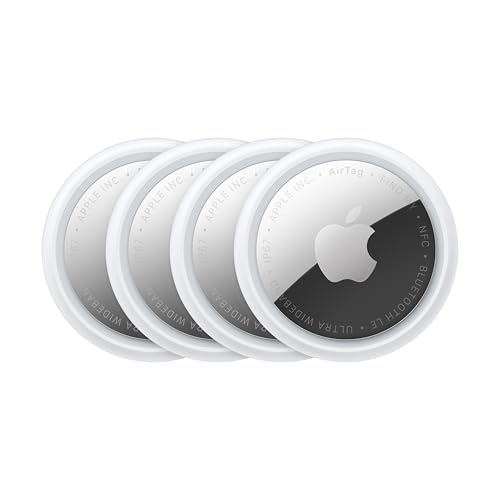
Setup is designed around a one-tap connection with an iPhone or iPad, and the tracker attaches to an item you manage in the Find My app. The small white unit measures 1.26 by 1.26 by 0.31 inches and weighs 0.09 pounds, so its size is suited to everyday carry. The pack includes four trackers, though the supplied data does not identify a key ring, wallet sleeve, or other attachment accessory.
The biggest limitation is compatibility rather than the tracker's size. Find My requires iOS 14, iPadOS, or macOS Catalina or later with an Apple Account, while improved Precision Finding requires an iPhone Air or iPhone 15 or later, excluding iPhone 16e. Apple Watch Precision Finding requires a Series 9 or later or Apple Watch Ultra 2 or later with watchOS 26.2.1, and feature availability varies by region.
Apple AirTag (2nd Generation) makes the most sense for Apple households that want four item trackers, louder nearby alerts, and replaceable-battery ownership. The main reason to hesitate is that the most advanced finding features are not universal across Apple devices, and battery life depends on usage and conditions. Android-only buyers or owners of unsupported Apple hardware should choose another tracker type.
Find My Integration: Find My gives Apple AirTag (2nd Generation) a central place for tracking attached belongings, which helps users manage several tagged items instead of searching manually. The feature benefits iPhone, iPad, and Mac users with a compatible Apple Account, though it is not a fit for buyers who do not use Apple devices or the required operating systems.
Precision Finding: Precision Finding provides step-by-step directions to a misplaced item on compatible iPhones and now supported Apple Watch models. That can be more useful than a sound alone when a tagged item is nearby but hidden, though improved range is limited to listed newer iPhone models and availability varies by region.
Enhanced Speaker: The speaker is described as 50% louder than the previous generation and uses a distinctive chime, helping users identify the sound of a nearby AirTag. This is most useful for keys, bags, and other items within hearing range, though a louder alert does not remove the need for a compatible device and Find My access.
Extended Finding Range: Upgraded Ultra Wideband and Bluetooth chips are intended to help locate items from farther away than the previous generation. The benefit is potentially more reach during a search, though the supplied data does not provide a fixed distance or guarantee identical results across phones, environments, and regions.
Temporary Location Sharing: Owners can share AirTag location access with trusted contacts, third parties, or more than 50 airline partners when an important item is lost. This can help with shared recovery efforts, though the supplied information does not specify how long each sharing arrangement lasts or whether every partner supports the feature in every region.
Replaceable Battery: Apple AirTag (2nd Generation) uses a standard battery that is designed to last more than a year under stated testing conditions and can be replaced. That reduces the need to discard the tracker after the battery expires, though Apple notes that usage, environmental conditions, and battery manufacturer affect actual life.
Apple AirTag (2nd Generation) is most suitable for people already using a compatible iPhone, iPad, Mac, or Apple Watch because Find My and its supported features depend on Apple hardware and software. Android-only buyers should not choose it based on the tracker hardware alone, since the supplied requirements center on Apple devices and an Apple Account.
Find My Requirements: Find My requires iOS 14, iPadOS, or macOS Catalina or later, and the device must be signed in to iCloud with an Apple Account. Buyers with older operating systems or no Apple Account should confirm compatibility before purchasing, because setup and item management may not work as expected.
Improved Precision Finding: The extended Precision Finding capability is listed for AirTag paired with iPhone Air or iPhone 15 or later, excluding iPhone 16e. This qualification matters to owners of older iPhones or the excluded model, who may not receive the advertised improvement even though basic AirTag functionality may remain available.
Apple Watch Support: Precision Finding on Apple Watch requires Apple Watch Series 9 or later or Apple Watch Ultra 2 or later with watchOS 26.2.1. Owners of earlier Apple Watch models should verify the feature requirements with Apple before treating watch-based directions as a purchase benefit.
Regional Availability: Apple states that some features are not available in every country or region. Buyers who depend on location sharing, airline support, or a particular Precision Finding function should confirm local availability before buying.
Apple AirTag (2nd Generation) is a lightweight white wireless item finder sold in a four-pack, with a compact body suited to attaching to everyday belongings.
ASIN: B0GJTXVN9Z
Brand: Apple
Category: Item Finders
Pack Size: 4 Pack
Color: White
Dimensions: 1.26 x 1.26 x 0.31 inches
Weight: 0.09 pounds
Product Group: Wireless
Binding: Electronics

Pros
- Long stated battery life benefits owners who cannot frequently access stored vehicles or equipment.
- Worldwide 4G LTE coverage with 2G fallback benefits users tracking assets across broad areas, though network availability is not detailed.
- Waterproof and durable construction benefits outdoor vehicle and equipment tracking, though durability testing is not supplied.
- Wi-Fi-based location technology benefits users needing location information inside buildings, though indoor precision is not quantified.
- Unlimited-distance tracking benefits owners monitoring assets beyond a local range, though the required subscription adds an ongoing cost.
Cons
- A low-cost subscription is required, which affects buyers seeking a one-time-purchase tracker.
- The 12 to 18 month battery estimate is tied to issuing reports daily, so different reporting behavior may change battery life.
- No specifications, review details, or exact waterproof rating are supplied, which limits comparison for buyers needing precise technical data.
Verdict: Trak-4 GPS Tracker suits owners of vehicles, equipment, and other assets who want infrequent charging, because the supplied description states that its rechargeable battery can operate for 12 to 18 months when issuing daily reports. The qualification is that a subscription is required, so the total ownership commitment is not limited to the device.
Tracking: Trak-4 GPS Tracker supports unlimited-distance tracking through worldwide 4G LTE coverage with 2G fallback, which is useful when an asset moves beyond a local area. The description also combines GPS with Wi-Fi-based location technology, though the data does not provide a measured accuracy range or a list of supported networks.
Daily Use: The waterproof, durable construction is intended for vehicle and equipment environments, while USB rechargeability makes battery upkeep possible without replacing the internal battery. Wi-Fi-based location can help when GPS signals are unavailable inside buildings, though the product data does not explain setup, charging time, mounting, controls, or alert options.
Trade-off: Trak-4 GPS Tracker is worth considering when long operating time and broad tracking coverage matter more than avoiding recurring service costs. Buyers who need a tracker with no subscription, documented dimensions, or detailed installation information should compare another product type because those details are not supplied here.
Best For: Vehicle, equipment, and asset owners who need long-duration location tracking between charges.
Why It Fits: Trak-4 GPS Tracker is described as lasting 12 to 18 months per charge with daily reports and supporting 4G LTE worldwide coverage with 2G fallback.
Think Twice If: You need a tracker without an ongoing subscription or require documented installation and charging specifications.
Bottom Line: Choose Trak-4 GPS Tracker for long battery operation and broad tracking coverage, provided the subscription requirement fits your budget.
Buy It If: You need vehicle or asset tracking and the stated long battery life matters to you.
Skip It If: You need tracking without a required subscription, which this product cannot deliver based on supplied data.
Battery: Trak-4 GPS Tracker is designed for extended operation because its internal rechargeable battery is stated to last 12 to 18 months with daily reports, though usage conditions can affect runtime.
Networks: 4G LTE worldwide coverage with 2G fallback supports broad tracking, though the supplied data does not identify specific carriers or regional limits.
Location: GPS and Wi-Fi-based location technology can support tracking when GPS is unavailable indoors, though indoor accuracy is not quantified.
Construction: Waterproof and durable construction is intended for vehicle and equipment use, though no formal ingress rating or test result is provided.
AirTag Overview
Apple AirTag (2nd Generation) is positioned as a personal-item tracker rather than a general-purpose vehicle or equipment tracker. The supplied product listing specifically describes it as a tracker for a keychain, wallet, and more. That makes its intended use easy to understand: attach or place it with the belongings you are most likely to misplace, then use it as part of a broader item-finding routine.
The price is $79.99 for a four-pack, which works out to multiple trackers in one purchase rather than a single $79.99 unit. That distinction matters when comparing the headline price with the Trak-4 GPS Tracker’s $13.99 listing price. Apple AirTag also has the higher rating in the supplied data, at 4.5 versus 4.4. If your main goal is covering several everyday possessions, the four-pack format may be more relevant than the individual dollar comparison.
The main limitation in this comparison is that the available listing data does not provide additional technical specifications for Apple AirTag (2nd Generation). Therefore, this review does not assign it battery, range, connectivity, or water-resistance claims beyond what is stated in the supplied product information. Buyers should review the current Amazon listing for those details before purchasing.
Tracki Overview
The Trak-4 GPS Tracker is presented as a dedicated GPS tracker for vehicles, assets, and equipment. Those categories give it a different role from Apple AirTag: instead of focusing primarily on small personal belongings, it is aimed at monitoring larger or more valuable items. That makes it the more natural candidate when the comparison centers on a vehicle, work equipment, or an asset that needs a tracker designed for that category.
The listed price is $13.99, considerably lower than the $79.99 price for the Apple AirTag four-pack. However, price alone does not make the Trak-4 the universal winner. The products are marketed for different jobs, so the practical value depends on what you need to monitor. The Trak-4 has a 4.4 rating, which is close to Apple AirTag’s 4.5 rating, and the listing also highlights long battery life.
The available data does not specify the Trak-4’s exact battery duration, tracking range, subscription requirements, mounting method, or included accessories. Those details can affect the total cost and convenience of ownership. For a vehicle or equipment purchase, check the current Amazon listing carefully to confirm what is included and how the GPS functionality works.
Head-to-Head Comparison
Performance
The key performance difference is the intended tracking category. Apple AirTag is described for keychains, wallets, and similar personal belongings, while the Trak-4 GPS Tracker is described for vehicles, assets, and equipment. In other words, AirTag is the more targeted everyday-item solution, and Trak-4 is the more targeted GPS-tracking solution for larger assets. The supplied data does not include enough information to make a precise claim about which has the better range, update frequency, location accuracy, or coverage. For that reason, the right performance winner depends on the object you want to track rather than on the ratings alone.
Design & Build
The available product information gives only a limited basis for comparing physical design. Apple AirTag is associated with keychains, wallets, and more, suggesting a personal-belonging use case. The Trak-4 is associated with vehicles, assets, and equipment, suggesting a different type of installation or placement. However, the supplied data does not state dimensions, weight, mounting hardware, construction materials, or durability ratings for either product. Buyers should avoid assuming that a tracker intended for a wallet will be equally suitable for equipment, or that a GPS tracker intended for assets will be as convenient for a keychain.
Price & Value
The price comparison is straightforward but needs context. Apple AirTag (2nd Generation) costs $79.99 for a four-pack, while the Trak-4 GPS Tracker is listed at $13.99. If you need several personal-item trackers, the AirTag package may offer useful coverage across multiple belongings. If you need one low-priced tracker marketed for vehicles, assets, or equipment, the Trak-4 has the lower entry price. Still, the available data does not identify any subscription charges, service fees, accessories, or ongoing costs, so the purchase price should not be treated as the complete ownership cost without checking the current listing.
Which One Should You Buy?
-
Buy Apple AirTag (2nd Generation) if you primarily want to track keys, a wallet, or other everyday personal belongings. Its product description is specifically oriented toward that kind of use.
-
Buy Apple AirTag (2nd Generation) if you want a four-pack for multiple items and prefer the convenience of purchasing several trackers together. The $79.99 listing is for four units, not one.
-
Buy the Trak-4 GPS Tracker if your main tracking need involves a vehicle, asset, or piece of equipment. Those are the use cases identified in its product listing.
-
Buy the Trak-4 GPS Tracker if the $13.99 listed price is your priority and you want a product marketed specifically as a GPS tracker with long battery life. Confirm any service or accessory requirements before ordering.
FAQ
Is Apple AirTag a GPS tracker?
The supplied product information describes Apple AirTag (2nd Generation) as a tracker for keychains, wallets, and more, but it does not identify it as a GPS tracker or provide detailed location technology specifications. In this comparison, it is best understood as an everyday-item tracker, while the Trak-4 is explicitly listed as a GPS tracker for vehicles, assets, and equipment. Review the current Apple product details if GPS functionality is essential to your decision.
Which is cheaper: Apple AirTag or Trak-4?
The Trak-4 GPS Tracker has the lower listed price at $13.99. Apple AirTag (2nd Generation) is listed at $79.99 for a four-pack. Because one price is for a four-pack and the other is shown as a single product listing, compare the package contents and any ongoing costs before deciding which offers better value for your situation.
Is Trak-4 better than Apple AirTag for a car?
Based only on the supplied product descriptions, Trak-4 is the more directly relevant option because it is marketed for vehicles, assets, and equipment. Apple AirTag is described for keychains, wallets, and more. That does not establish every technical advantage, since the available data does not provide detailed vehicle-tracking specifications, service requirements, or location performance. Confirm the current Trak-4 listing before using it for a vehicle.