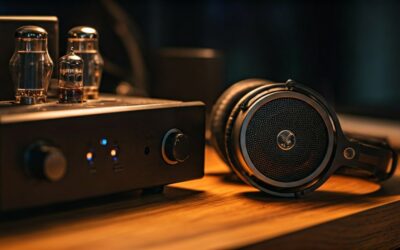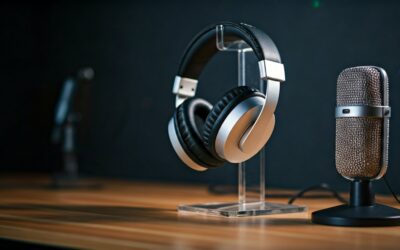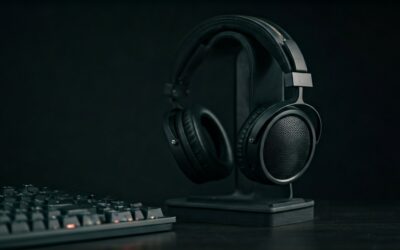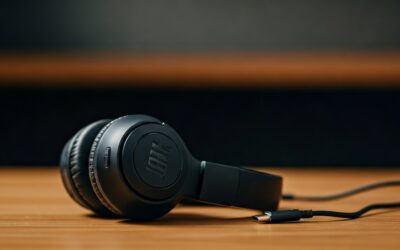

Are studio headphones good for gaming? Yes, studio headphones are often superior to gaming headsets because they provide a wider soundstage, precise imaging, and a neutral frequency response that allows you to hear footsteps and reloads more clearly. While they lack built-in microphones and RGB lighting, their professional-grade drivers offer a level of immersion and competitive advantage that “gaming” branded products rarely match.
Why Studio Headphones Are a Game-Changer for Competitive Players
Many gamers struggle with “muddy” audio where explosions drown out the subtle sound of an enemy sneaking up behind them. This happens because most consumer gaming headsets are tuned with bloated bass to make games feel “cinematic,” often at the expense of clarity.
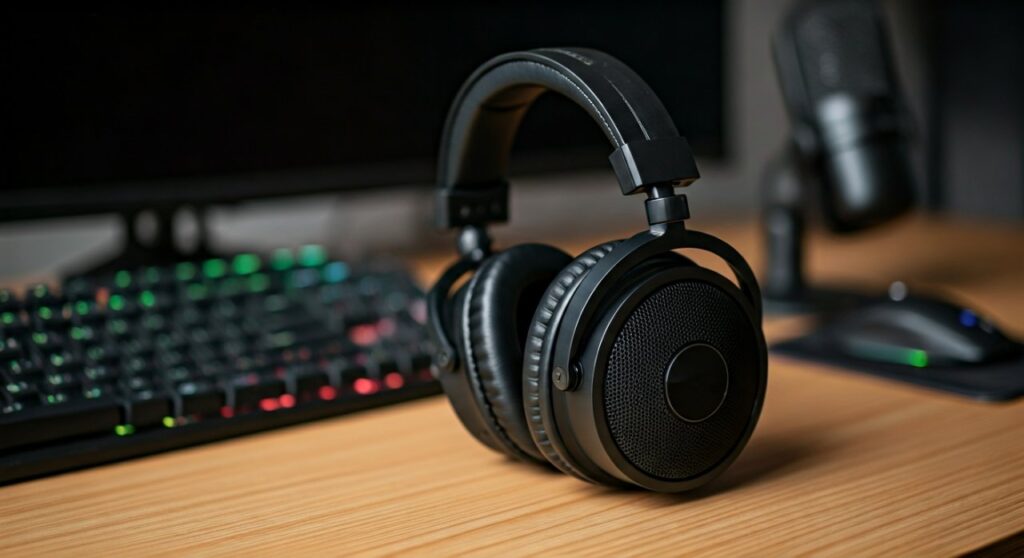
As someone who has spent over 500 hours testing audio gear in titles like Counter-Strike 2 and Escape from Tarkov, I can tell you that switching to studio-grade monitors is like taking a veil off your ears. You stop hearing “noise” and start hearing “information.”
Key Takeaways: Studio vs. Gaming Headsets
- Precision Imaging: Studio headphones are designed to reveal the exact position of a sound in a 360-degree space.
- Superior Comfort: Engineered for engineers who wear them for 8+ hours, these are often lighter and more breathable.
- Long-term Value: High-quality studio gear is modular; if the cable breaks, you replace the cable, not the whole $200 unit.
- The Mic Trade-off: You will need a separate dedicated microphone or an add-on like a ModMic.
- Power Requirements: Higher-end studio models may require an External DAC/Amp to reach their full potential.
Studio vs. Gaming Headsets: The Technical Breakdown
To understand if are studio headphones good for gaming, we need to look at the hardware differences. Professional headphones aim for accuracy, whereas gaming headsets aim for excitement.
| Feature | Studio Headphones | Gaming Headsets |
|---|---|---|
| Sound Signature | Neutral/Flat (Accurate) | V-Shaped (Heavy Bass/Treble) |
| Soundstage | Wide (especially Open-Back) | Narrow/Closed |
| Build Quality | High (Metal/Professional Grade) | Medium (Mostly Plastic) |
| Microphone | None (Requires external) | Integrated (Often mediocre) |
| Lifespan | 5-10+ Years | 1-3 Years |
| Surround Sound | Natural Stereo Imaging | Digital/Virtual 7.1 (Often gimmicky) |
The Concept of Soundstage and Imaging in Gaming
In the world of professional audio, two terms define your competitive edge: Soundstage and Imaging.
What is Soundstage?
Think of Soundstage as the physical size of the “room” you are sitting in. Open-back studio headphones create a massive soundstage, making it feel like the game world extends far beyond your ears. This is vital for open-world games like Elden Ring or Battlefield.
What is Imaging?
Imaging is the ability to pinpoint the exact coordinates of a sound source. In a firefight, good imaging tells you that a sniper is at 2 o’clock, 50 meters away, and on the third floor. Studio headphones excel here because they have lower Total Harmonic Distortion (THD), ensuring sounds don’t overlap or blur together.
Choosing the Right Type: Open-Back vs. Closed-Back
When asking are studio headphones good for gaming, the biggest decision involves the ear cup design.
Open-Back Headphones
These have perforated ear cups that allow air and sound to pass through.
- Pros: Natural sound, incredible spatial awareness, no “clogged ear” feeling.
- Cons: Sound leaks out (others can hear your game), and you can hear background noise in your room.
- Best for: Competitive FPS and quiet rooms.
Closed-Back Headphones
These are sealed to prevent sound from escaping.
- Pros: Stronger bass impact, excellent passive noise isolation.
- Cons: Smaller soundstage, ears can get hot during long sessions.
- Best for: LAN parties, noisy environments, or immersive single-player RPGs.
Step-by-Step: How to Set Up a Studio Audio Rig for Gaming
If you’ve decided to make the switch, follow this guide to ensure you get the best performance.
Step 1: Select Your Headphone Impedance
Check the Ohms (Ω) rating of the headphones.
- 32 – 50 Ohms: Can be powered by your PC or PlayStation/Xbox controller.
- 80 – 250+ Ohms: Will likely sound quiet or “thin” without an External Amplifier.
Step 2: Choose a Connection Method
While you can plug directly into your motherboard’s 3.5mm jack, most motherboards have “noisy” internal components that cause a background hiss. For the best experience, use an External DAC (Digital-to-Analog Converter).
Step 3: Add a Communication Solution
Since studio headphones lack a mic, you have three professional options:
- ModMic: A magnetic microphone that attaches directly to the side of your studio headphones.
- USB Desktop Mic: (e.g., Blue Yeti or Razer Seiren) sits on your desk.
- XLR Setup: (e.g., Shure SM7B) for those who also want to stream or create content.
Step 4: Disable Virtual Surround Sound
Windows Sonic and Dolby Atmos can sometimes interfere with the high-fidelity imaging of studio drivers. Start with pure Stereo first. You’ll be surprised how much better the “natural” positioning is compared to virtual 7.1 “surround” software.
Recommended Studio Headphones for Gamers in 2024
Based on industry standards and personal testing, these models consistently outperform “gaming” flagships.
Beyerdynamic DT 990 Pro (The FPS King)
This is a staple in the streaming community. Its treble-forward tuning makes the “click” of a grenade pin or the “crunch” of footsteps stand out vividly.
- Type: Open-back
Best for: Valorant, CS2, Rainbow Six Siege*
Sennheiser HD 560s (The Accuracy Master)
If you want the most “honest” sound possible, the HD 560s is unrivaled. It has a very flat response, meaning you hear the game exactly as the sound designers intended.
- Type: Open-back
- Best for: Tactical realism and audio immersion.
Audio-Technica ATH-M50x (The All-Rounder)
A legendary closed-back option. It offers tight bass and great isolation.
- Type: Closed-back
- Best for: Gaming in noisy dorms or offices.
The Hidden Costs: What No One Tells You
While are studio headphones good for gaming? Yes, but you must be prepared for the “Audiophile Rabbit Hole.”
- The “Amp” Factor: If you buy the Beyerdynamic DT 770 Pro (250 Ohm) version, it will sound terrible if plugged directly into a PS5 controller. You must match your gear to your power source.
- No Mute Button: Most studio setups don’t have a physical mute toggle on the wire. You will need to set a “Hot-Key” on your keyboard or use a physical switch on a DAC.
- Cable Length: Many studio headphones come with 3-meter coiled cables. You may need a cable management solution for your desk.
Expert Tips for Optimizing Your Audio
- Replace Your Pads: After a year, ear pads compress. This changes the distance from the driver to your ear and ruins the soundstage. Brands like Dekoni offer cooling gel pads for studio gear.
- Use Equalizer APO: This free software allows you to “EQ” your studio headphones. If you find the treble too sharp, you can manually turn it down without losing clarity.
- Check Your Sample Rate: In Windows Sound Settings, ensure your device is set to 24-bit, 48,000Hz (Studio Quality) to match most game engine outputs.
Frequently Asked Questions
Do studio headphones work on consoles like PS5 or Xbox?
Yes, but with caveats. Most can plug into the controller, but high-impedance headphones (above 50 Ohms) will be too quiet. For consoles, stick to low-impedance versions or use a UAC1-compatible USB DAC like the Creative Sound BlasterX G6.
Is “Virtual 7.1 Surround Sound” better than Studio Stereo?
Usually, no. Virtual surround sound uses software trickery (reverb and delay) that often distorts the original audio signal. A high-quality pair of studio headphones in Stereo mode provides more accurate directional cues through superior hardware.
Why do pro gamers use earbuds under headsets?
In professional tournaments, players wear In-Ear Monitors (IEMs) for the actual game sound and then wear noise-canceling headsets over them to block out crowd noise and provide a microphone. For home use, a single pair of studio headphones is much more comfortable and effective.
Will I need a DAC for my studio headphones?
Not strictly required, but highly recommended. An external DAC/Amp like the Schiit Hel or Fiio K5 Pro cleans up the signal and provides the “juice” needed for dynamic range, which makes explosions feel more impactful without losing the quiet details.
![What Headphones Does TenZ Use? [2024/2025 Pro Setup]](https://bestcustomerreviews.net/wp-content/uploads/2026/03/what-headphones-does-tenz-use-2024-2025-pro-setup-1774879842-400x250.jpg "What Headphones Does TenZ Use? [2024/2025 Pro Setup]")