
To protect your hearing while listening to music with headphones, you should strictly follow the 60/60 rule: listen at no more than 60% volume for a maximum of 60 minutes at a time. Additionally, utilizing Active Noise Cancellation (ANC) headphones helps prevent “volume creep” in noisy environments, while switching from earbuds to over-ear headphones increases the distance between the sound source and your eardrum, reducing direct pressure.
Key Takeaways for Ear Safety
If you are in a hurry, here are the essential steps to safeguard your auditory health immediately:
- The 60/60 Rule: Keep volume below 60% and limit sessions to 60 minutes.
- Gear Choice: Prefer Over-ear headphones over In-ear buds to reduce sound pressure.
- Technology: Use Active Noise Cancellation (ANC) to block background noise so you don’t feel the need to crank the volume.
- Monitoring: Enable Volume Limiters on your smartphone settings (iOS/Android).
- Recovery: Give your ears “quiet breaks” for at least 5-10 minutes every hour.
- Signs of Danger: If you experience Tinnitus (ringing) or muffled hearing, stop listening immediately and consult an audiologist.
The Biological Mechanics: Why Headphones Pose a Risk
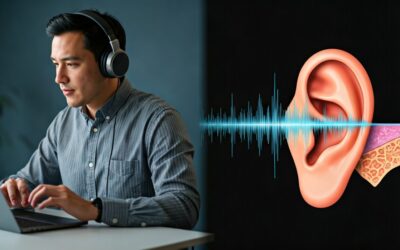
Understanding how to protect hearing while listening to music with headphones starts with the biology of the inner ear. Inside your cochlea are thousands of tiny hair cells (stereocilia) that vibrate in response to sound waves. These cells transform vibrations into electrical signals for your brain.
Unlike most cells in the human body, these hair cells do not regenerate. When you blast high-decibel audio directly into your ear canal, these cells can be bent, broken, or “burned out” by the sheer force of the sound pressure.
Listening via headphones is inherently riskier than using external speakers because the sound source is localized and much closer to the tympanic membrane (eardrum). This proximity creates higher Sound Pressure Levels (SPL), which can lead to Noise-Induced Hearing Loss (NIHL) over time.
The Decibel Danger Zone: A Safety Guide
The human ear can handle a lot, but volume is logarithmic, not linear. This means an increase from 80 dB to 90 dB isn’t just “10% louder”—it represents ten times the sound intensity.
Experts from the World Health Organization (WHO) and OSHA suggest that exposure to sounds above 85 decibels (dB) for extended periods is the primary cause of permanent damage.
| Decibel Level (dB) | Common Example | Safe Exposure Duration |
|---|---|---|
| 60 dB | Normal Conversation | Unlimited |
| 80 dB | Garbage Disposal / Loud Office | 8 Hours |
| 85 dB | Hearing Safety Threshold | 8 Hours |
| 90 dB | Hair Dryer / Lawnmower | 2 Hours |
| 100 dB | Max Volume on Smartphone | 15 Minutes |
| 110 dB | Rock Concert / Chainsaw | 1-2 Minutes |
| 120 dB | Jet Plane Takeoff | Immediate Damage |
Pro Tip: If someone standing three feet away from you can hear the music coming out of your headphones, you are likely in the 90+ dB range and causing damage.
How to Protect Hearing While Listening to Music with Headphones: Step-by-Step
Implement the 60/60 Protocol
This is the gold standard for casual listeners. By limiting your volume to 60% of the maximum slider, you usually stay below the 80-85 dB danger zone.
Coupling this with a 60-minute limit prevents “auditory fatigue.” After an hour, your ears need time to recover from the constant vibration. Set a timer on your phone if you tend to lose track of time during work or study sessions.
Invest in Active Noise Cancellation (ANC)
One of the biggest reasons people damage their hearing is background noise. If you are on a bus or in a noisy cafe, you naturally turn up your music to drown out the environment. This is known as masking.
ANC headphones (like the Sony WH-1000XM5 or Bose QuietComfort) use microphones to “cancel” external frequencies. This allows you to hear your music clearly at much lower, safer volumes. For frequent commuters, ANC is not a luxury; it is a vital tool for hearing protection.
Choose Over-Ear Models Over Earbuds
Not all headphones are created equal. In-ear monitors (IEMs) and earbuds sit deep in the ear canal. This focuses the sound pressure directly against the eardrum.
Over-ear (circumaural) headphones provide several advantages:
- They create a natural physical seal around the ear, providing passive isolation.
- The drivers are further away from the eardrum.
- The sound is distributed across the outer ear (pinna), which is how we are naturally designed to hear.
Use Built-In Software Limiters
Modern technology provides the tools to protect you from yourself. Both iOS and Android have robust health features designed specifically for how to protect hearing while listening to music with headphones.
For iPhone Users: Go to Settings > Sounds & Haptics > Headphone Safety*. Enable Reduce Loud Sounds and set the limit to 80 or 85 decibels.
- For Android Users: Most Android skins have a “Volume Warning” that triggers at 70%, but you can also find third-party apps like Volume Limiter to lock the maximum output.
Monitor Your “Sound Dose”
The Apple Health App and various Android equivalents now track your “Headphone Audio Levels” over a 7-day rolling period. It measures your exposure in A-weighted decibels (dBA).
Check this weekly. If the app shows you are consistently exceeding the recommended “dose,” it is time to recalibrate your listening habits.
Comparing Headphone Types for Ear Health
| Feature | Earbuds / In-Ear | Over-Ear (Closed Back) | Bone Conduction |
|---|---|---|---|
| Proximity to Eardrum | Very Close (High Risk) | Moderate (Lower Risk) | N/A (Bypasses Eardrum) |
| Noise Isolation | Moderate | Excellent | Poor |
| Sound Pressure | High | Medium | Low |
| Best For | Gym / Portability | Office / Home / Travel | Outdoor Running |
Bone conduction headphones (like Shokz) are a unique alternative. They bypass the eardrum entirely by sending vibrations through the cheekbones to the cochlea. While they don’t offer high-fidelity bass, they are excellent for maintaining situational awareness and reducing eardrum fatigue.
Recognizing the Warning Signs of Damage
Hearing loss is often “painless” and gradual. You might not realize it is happening until it is too late. Watch for these red flags:
- Tinnitus: A persistent ringing, buzzing, or hissing in the ears after you take your headphones off.
- Muffled Sound: Feeling like your ears are “clogged” or that people are mumbling.
- The “Cocktail Party Effect” Difficulty: Finding it hard to follow a conversation in a crowded room with background noise.
- Hyperacusis: Sensitivity to normal everyday sounds, which may now seem painfully loud.
If you experience these, the first step is a “Digital Detox.” Avoid all headphone use for at least 48 hours to let the hair cells rest. If symptoms persist, see an audiologist for a professional audiogram.
Practical Tips for Specific Environments
- At the Gym: Gyms are notoriously loud. Avoid the temptation to blast music to compete with the gym’s speakers. Use well-fitting silicone tips or foam tips (like Comply Foam) to seal out the noise.
- On Airplanes: The cabin drone is around 80-85 dB. Without ANC, you would need to pump your music to 95+ dB to hear it. Always use ANC on flights.
- During Sleep: Never sleep with earbuds in. The constant pressure and lack of airflow can lead to ear infections and accidental volume spikes during the night.
Expert Perspective: The Role of High-Fidelity Audio
As an expert in audio engineering, I have found that high-quality audio files (Lossless or High-Bitrate) can actually help protect your hearing.
Low-quality, highly compressed MP3s often sound “thin” or “muddy.” Listeners instinctively turn up the volume to catch the details that were lost in compression. By using high-quality sources (like Tidal, Apple Music Lossless, or Qobuz) and decent headphones, you can hear every detail at a lower volume.
Frequently Asked Questions
Are noise-canceling headphones safer for my ears?
Yes, absolutely. By reducing the ambient noise floor, they allow you to listen to your music at a lower, safer volume. They prevent the need to “overpower” the world around you with sheer decibel force.
Can I reverse hearing loss caused by headphones?
Unfortunately, Noise-Induced Hearing Loss (NIHL) is generally permanent. Once the hair cells in the cochlea are destroyed, they do not grow back. However, identifying it early can help you prevent further decline through lifestyle changes and protective measures.
Is 70% volume on an iPhone too loud?
For most headphones, 70% volume exceeds 85-90 dB. While it might feel “fine” for a short duration, listening at this level for several hours a day will likely lead to long-term hearing damage. It is safer to stay at or below 60%.
Do foam ear tips help protect hearing?
Yes. Foam tips (like those made by Comply) provide better passive noise isolation than standard silicone tips. By blocking more external noise, they help you keep your music volume at a lower setting.
How often should I get my hearing tested?
If you are a frequent headphone user, it is wise to get a professional baseline hearing test every 2-3 years. If you work in a loud environment or are a professional musician, an annual check-up is recommended.
![What Headphones Does TenZ Use? [2024/2025 Pro Setup]](https://bestcustomerreviews.net/wp-content/uploads/2026/03/what-headphones-does-tenz-use-2024-2025-pro-setup-1774879842-400x250.jpg "What Headphones Does TenZ Use? [2024/2025 Pro Setup]")