
To learn how to trace a photo onto canvas without a projector, you can use reliable manual techniques like graphite transfer paper, the pencil rubbing method, or the grid system. These methods offer high precision for capturing complex portraits or landscapes while remaining budget-friendly for artists of all skill levels.
Key Takeaways for Tracing Without a Projector
If you are looking for a quick summary of the best techniques, refer to the table below to choose the right method for your specific art project:
| Method | Best For | Difficulty | Materials Needed |
|---|---|---|---|
| Graphite Transfer Paper | High precision & clean lines | Easy | Saral paper, Stylus, Tape |
| Pencil Rubbing (DIY) | Last-minute projects | Beginner | 4B/6B Pencil, Printout |
| Grid Method | Scaling & learning proportions | Intermediate | Ruler, T-square, Pencil |
| Tracing Paper | Complex layering | Easy | Transparent paper, Soft lead |
| Window/Light Source | Small canvases/thin fabric | Easy | Natural sunlight, Tape |
Why Tracing is a Valid Tool for Professional Artists
Many beginners feel that tracing is “cheating,” but professional illustrators and muralists have used transfer techniques for centuries. By mastering how to trace a photo onto canvas without a projector, you save hours of structural sketching, allowing you to focus your energy on color theory, texture, and brushwork.
In my experience working with heavy-body acrylics, having a clean, accurate “road map” on the canvas prevents the common “muddying” that happens when you have to erase charcoal or lead multiple times. A clean transfer ensures your canvas tooth remains intact for better paint adhesion.
Method 1: Using Graphite Transfer Paper (The Gold Standard)
The most professional way to learn how to trace a photo onto canvas without a projector is by using specialized graphite transfer paper (often called Saral paper). Unlike old-fashioned carbon paper used for typewriters, graphite paper is wax-free and erasable.
Step-by-Step Graphite Transfer:
- Prepare your canvas: Ensure your canvas is primed with Gesso and completely dry.
- Position your photo: Tape your reference photo to the top edge of the canvas using low-tack painter’s tape.
- Insert the transfer sheet: Slide a sheet of graphite transfer paper (dark side down) between the photo and the canvas.
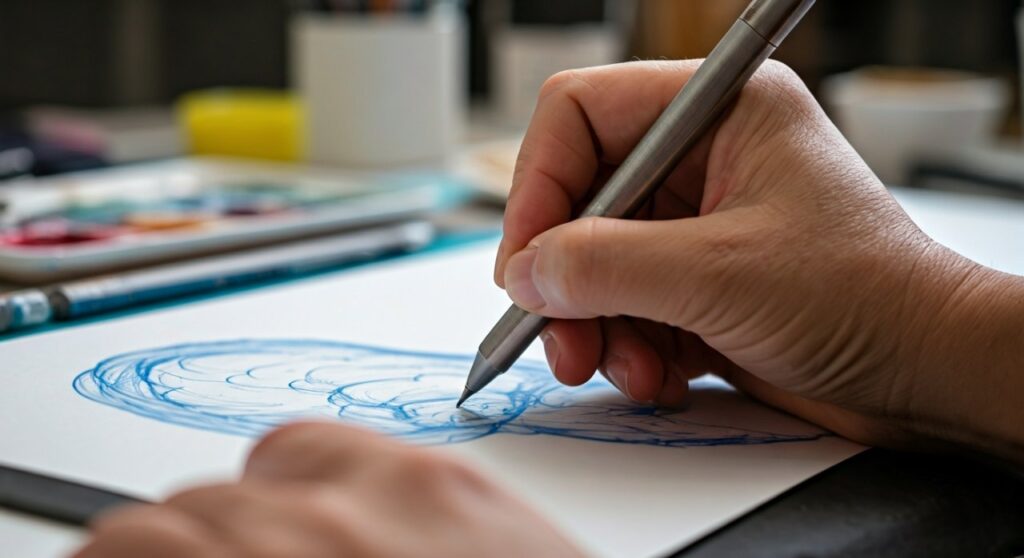
- Trace the outlines: Use a ballpoint pen or a metal stylus to trace the main contours. The pressure transfers the graphite onto the canvas.
- Check your progress: Periodically lift the bottom corner to ensure the lines are transferring clearly.
Expert Tip: Use a colored pen (like red or green) to trace your photo. This allows you to see exactly where you have already drawn, preventing missed lines in complex areas like hair or foliage.
Method 2: The DIY Pencil Rubbing Technique (The Budget Hack)
If you don’t have professional transfer paper, you can create your own using a standard graphite pencil. This is the most accessible way to solve the problem of how to trace a photo onto canvas without a projector using household items.
How to Create a DIY Transfer:
- Print your photo: Use standard printer paper.
- Coat the back: Flip the photo over. Use a soft lead pencil (ideally 4B, 6B, or 8B) to heavily shade the entire back of the paper where the image is located.
- Secure and trace: Tape the photo (shaded side down) onto your canvas.
- Transfer the image: Draw over your photo’s lines with firm pressure. The lead you applied to the back will press onto the canvas.
Pro Insight: Avoid using 2H or HB pencils for the rubbing. Harder leads do not transfer enough pigment, making the lines faint and difficult to see once you start painting with Liquitex or Golden acrylics.
Method 3: The Grid Method for Perfect Scaling
When you need to know how to trace a photo onto canvas without a projector while also enlarging the image, the Grid Method is the most mathematically accurate choice. It trains your eye to see shapes rather than objects.
Implementation Steps:
- Grid the photo: Draw a 1-inch square grid over your reference photo (or use a digital grid overlay app).
- Grid the canvas: Draw a proportional grid on your canvas. If you want to double the size, draw 2-inch squares.
- Transfer square-by-square: Focus only on what is inside “Square A1” and draw it in the corresponding square on the canvas.
- Refine the sketch: Once all squares are filled, lightly erase the grid lines using a kneaded eraser before painting.
Using a T-square ruler is vital here to ensure your lines are perfectly 90 degrees. Even a slight tilt in your grid can result in a skewed final portrait.
Method 4: Using a Window as a Natural Light Box
If you are working on a smaller, unmounted canvas sheet or a thin fabric, you can use a window. This is a brilliant “low-tech” answer for how to trace a photo onto canvas without a projector.
- Tape the photo: Tape your reference photo directly onto a bright, sunny window.
- Overlay the canvas: Tape your canvas paper or thin canvas over the photo.
- Trace: The sunlight acting as a backlight will project the image through the material, allowing you to trace directly onto the surface.
Essential Materials for High-Quality Tracing
To achieve professional results, I recommend the following specific tools:
- Saral Wax-Free Transfer Paper: Does not bleed through paint.
- Prismacolor Kneaded Eraser: Removes graphite without damaging canvas fibers.
- Blue Painter’s Tape: Securely holds photos without leaving sticky residue.
- Stylus Tool Set: Provides consistent pressure for transfers.
- Fixative Spray: A light coat of Krylon Workable Fixatif prevents your traced lines from smearing into your paint.
How to Prepare Your Canvas for a Successful Transfer
Before you even worry about how to trace a photo onto canvas without a projector, you must prepare the surface. A rough, unprimed canvas will “eat” your graphite and result in jagged lines.
- Sand the Gesso: If your canvas is too “toothy,” use fine-grit sandpaper (220 grit) to lightly smooth the surface.
- Toned Ground: Many artists prefer tracing onto a “toned” canvas (a thin wash of Burnt Sienna or Raw Umber). Ensure this layer is 100% dry; otherwise, the transfer paper will stick to the paint and ruin your work.
Troubleshooting Common Tracing Issues
The lines are too dark and show through the paint
If your graphite lines are too heavy, they can “bleed” into light colors like yellow or white. Use a kneaded eraser to “lift” the excess graphite until the lines are barely visible.
The transfer paper is slipping
Never rely on just one piece of tape. Use a “hinge method” by taping the top of your photo securely. This allows you to lift the photo to check the transfer and drop it back into the exact same spot.
The canvas is too large for the photo
If you are learning how to trace a photo onto canvas without a projector for a large-scale mural, use the “Doodle Grid” or “Squiggle” technique. Take a photo of your canvas covered in random marks, overlay your reference image digitally at low opacity, and use the marks as reference points.
Frequently Asked Questions (FAQs)
Can I use carbon paper instead of graphite paper?
You should avoid traditional carbon paper (blue or black) used for office work. Carbon paper contains wax that repels water-based paints like acrylics and watercolors, which will cause your paint to “bead up” and fail to stick to the canvas.
How do I trace a photo onto a black canvas?
To trace onto a dark or black primed canvas, use white graphite transfer paper or white charcoal/chalk on the back of your photo. This provides a high-contrast line that is easy to see against the dark background.
Will the traced lines smudge when I start painting?
Yes, graphite can smudge. To prevent this, spray a very thin layer of workable fixative over your traced sketch. Alternatively, you can “ink” your lines with a waterproof Pigma Micron pen or a thin wash of acrylic paint before starting your main layers.
Is the grid method better than transfer paper?
It depends on your goal. If you want to improve your drawing skills and need to scale an image up, the Grid Method is superior. If you want the fastest, most accurate 1:1 replica for a professional commission, Graphite Transfer Paper is the preferred choice.
Can I trace onto canvas using a tablet?
If your canvas is thin enough, you can turn the brightness to maximum on an iPad or tablet, place the canvas over it, and trace. However, for standard wooden-stretched canvases, this is not possible as the canvas is opaque and the frame creates too much distance from the screen.

![What Headphones Does TenZ Use? [2024/2025 Pro Setup]](https://bestcustomerreviews.net/wp-content/uploads/2026/03/what-headphones-does-tenz-use-2024-2025-pro-setup-1774879842-400x250.jpg "What Headphones Does TenZ Use? [2024/2025 Pro Setup]")