Why Projector Headlights Are the Superior Choice for Modern Drivers
Are projector headlights better than traditional reflector systems? The short answer is a definitive yes. Projector headlights offer a more focused beam, a sharper cutoff line to prevent blinding oncoming traffic, and significantly more even light distribution on the road.
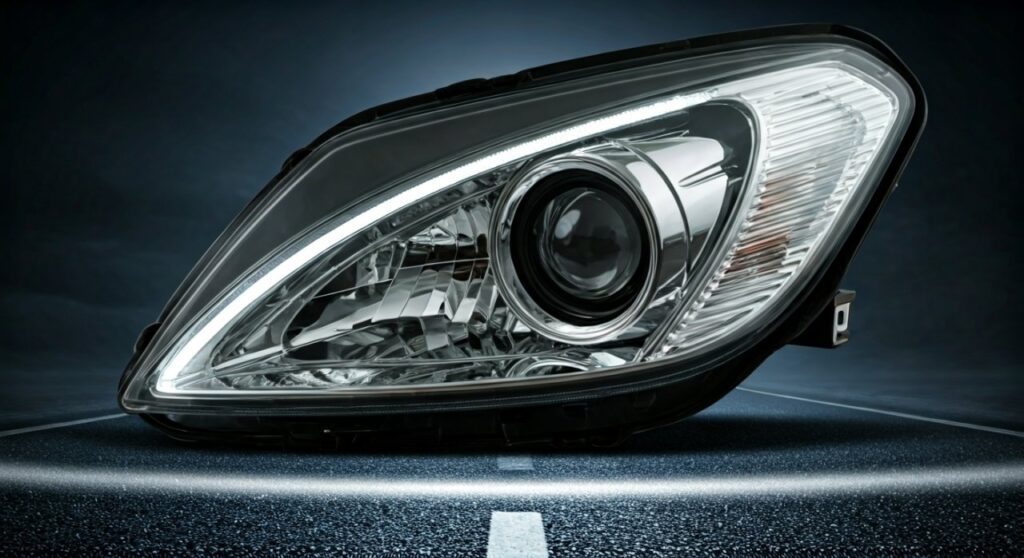
While older reflector headlights rely on a simple bulb and a chrome-painted bowl, projector headlights utilize a sophisticated elliptical lens and a cutoff shield. This combination ensures that more lumens are directed toward the asphalt rather than being wasted as “scattered light” in the trees or the eyes of other drivers. If you value safety, long-range visibility, and a modern aesthetic, projectors are the undisputed winner.
Key Takeaways: Why You Should Care About Projector Tech
- Superior Focus: Projectors use a magnifying lens to concentrate light into a dense, usable beam.
- Enhanced Safety: The cutoff shield creates a sharp horizontal line, keeping light below the eye level of oncoming motorists.
- Better Compatibility: They are the ideal housing for high-output LED and HID (Xenon) bulbs, which often perform poorly in reflector housings.
- No Hot Spots: Projectors provide a “full” field of vision without the dark patches common in older car models.
- Visual Appeal: Beyond performance, projector headlights are good for giving any vehicle a high-end, luxury appearance.
Understanding the Mechanics: How Projector Headlights Work
To truly answer if projector headlights are better, we must look at the internal components. A standard reflector headlight works like a flashlight; the bulb sits in the middle of a mirrored bowl that bounces light outward in a broad, often messy cone.
In contrast, a projector headlight consists of three main parts: the reflector bowl, the cutoff shield, and the convex lens. The bulb reflects light into the bowl, which then passes through the shield. This shield blocks the top half of the light, and the lens then magnifies and flips that light onto the road.
This process results in a beam that is intense and wide. In my experience testing various OEM and aftermarket kits, the difference in “throw” distance can be as much as 30% further than traditional reflectors. This extra distance gives you more time to react to hazards like deer or debris.
Reflector vs. Projector: A Direct Comparison
The following table breaks down the technical differences between these two lighting technologies:
| Feature | Reflector Headlights | Projector Headlights |
|---|---|---|
| Light Source | Halogen (Standard) | HID, LED, or Halogen |
| Light Focus | Low (Scattered) | High (Concentrated) |
| Cutoff Line | Soft/Fuzzy | Sharp/Defined |
| Efficiency | Lower (Wasted Light) | Higher (Directed Light) |
| Cost | Budget-Friendly | Premium/Expensive |
| Bulb Life | Shorter (Usually Halogen) | Longer (HID/LED compatible) |
| Aesthetics | Traditional/Dated | Modern/Aggressive |
Are Projector Headlights Better for Night Driving?
Nighttime visibility is where the projector headlight truly shines. One of the biggest complaints from drivers using reflectors is the presence of “hot spots” (areas where the light is too bright) and “dead zones” (areas where it is too dark).
Because projector headlights are good at distributing light evenly, your eyes don’t have to constantly adjust to different levels of brightness on the road. This reduces eye fatigue during long night hauls. According to IIHS (Insurance Institute for Highway Safety) data, vehicles equipped with high-quality projectors consistently score higher in safety tests compared to those with basic reflectors.
Furthermore, if you live in an area with frequent fog or heavy rain, the sharp cutoff line of a projector is a lifesaver. It prevents light from reflecting off the moisture in the air and bouncing back into your eyes, a phenomenon known as “glare back.”
Step-by-Step Guide: How to Choose the Right Projector Upgrade
If you’ve decided that projector headlights are better for your needs, you might be looking to upgrade. Follow these steps to ensure you get the best performance.
Step 1: Determine Your Current Housing Type
Examine your car’s headlights. If you see a simple bulb behind a clear or fluted plastic cover, you have reflector housings. If you see a glass “eye” or marble-like lens, you already have projector housings.
Step 2: Choose Between Bi-LED and Bi-Xenon
Bi-Xenon projectors use HID bulbs and a moving shield to provide both high and low beams from one lens. Bi-LED projectors have the light source built-in and offer instant-on brightness with less power draw. Both are excellent, but Bi-LED is becoming the modern industry standard for its reliability.
Step 3: Check for Fitment and Clearance
Not all projectors fit in all headlight housings. You need to measure the depth of your current headlight “bucket.” Popular brands like The Retrofit Source or Morimoto offer “mini” projectors designed specifically to fit into smaller reflector bowls without major cutting.
Step 4: Verify the Color Temperature
For the best visibility, look for bulbs or integrated LEDs in the 5000K to 6000K range. This produces a “Pure White” light that mimics daylight. Avoid 8000K or higher, as the light becomes too blue, which actually reduces your ability to see contrast on the road.
How to Install a Projector Retrofit (General Overview)
Upgrading your car to prove that projector headlights are better usually involves a process called “retrofitting.” While advanced, it is manageable for a DIY enthusiast.
- Remove the Headlight Assemblies: Unbolt the units from your vehicle.
- Open the Housings: Most headlights are sealed with butyl rubber. You may need to bake them in an oven at a low temperature (around 200°F) for 10 minutes to soften the glue and pry them apart.
- Mount the Projector: Insert the projector shaft through the existing bulb hole in your reflector bowl. Secure it with the provided mounting hardware.
- Align the Beam: Before resealing, plug the headlights back into the car. Project the beam onto a wall to ensure the cutoff line is perfectly horizontal.
- Reseal and Reinstall: Apply new butyl sealant, press the lens back on, and reheat to lock the seal. Reinstall the units onto your car.
Common Myths About Projector Headlights
Myth 1: Projectors are just for show.
This is false. While they do look better, the primary purpose of a projector is optical precision. They provide a safer driving environment for both you and others.
Myth 2: You can just put an LED bulb in a reflector and get the same result.
This is a dangerous misconception. Putting high-powered LEDs or HIDs in a reflector housing causes massive glare and “blinds” other drivers. You need the projector lens to control that extra power.
Myth 3: They are too expensive to maintain.
While the initial cost is higher, the bulbs used in projectors (like LEDs) often last 20,000+ hours. This is significantly longer than the 500-1,000 hours you get from a standard Halogen bulb.
Maintenance Tips for Peak Performance
To keep your projector headlights functioning at their best, follow these expert tips:
- Lens Clarity: If your outer plastic headlight lens becomes cloudy or yellowed, it will block the precise beam of the projector. Use a headlight restoration kit to keep them clear.
- Proper Aiming: Even the best projectors are useless if aimed too high or too low. Periodically check your aim against a garage door to ensure you aren’t blinding others.
- Check the Solenoid: If you have Bi-Xenon projectors, the internal shield moves for high beams. If your high beams stop working, it’s usually a wiring or solenoid issue.
- Heat Management: High-output projectors generate heat. Ensure your LED cooling fans or HID ballasts have plenty of airflow to prevent premature failure.
FAQs: Everything You Need to Know
Are projector headlights better for older cars?
Yes, they are one of the best upgrades for older vehicles. Older cars often have dim, yellowed reflector lights. Swapping them for a projector retrofit can make a 20-year-old car feel like a brand-new vehicle at night.
Do projector headlights require special bulbs?
Most factory projectors use specific bulbs like D1S, D2S, or D4S (HID). However, many aftermarket projectors are designed to work with standard H1 or H11 bulb sizes for easier compatibility.
Why are some projector headlights “blurry” at the edges?
A slight blue or purple tint at the very edge of the cutoff line is normal; it is caused by light refraction through the glass lens. However, if the entire beam is blurry, the projector may be low quality or the bulb may not be seated correctly.
Is it legal to upgrade to projector headlights?
In many regions, as long as the headlights are properly aimed and do not exceed certain brightness limits, they are legal. However, always check your local DOT (Department of Transportation) or ECE regulations regarding aftermarket lighting.
How much does it cost to switch to projectors?
A high-quality DIY projector retrofit kit typically costs between $150 and $500. Having a professional shop do the work can cost anywhere from $600 to $1,500 depending on the complexity of your vehicle.