Why Laser Technology is Reshaping Modern Home Cinema
Imagine sitting down for a movie night, only to realize your projector bulb has dimmed so much that the “black” scenes look like a muddy gray. Or worse, the cooling fan sounds like a jet engine taking off in your living room. These are the classic “pain points” of traditional lamp projectors that have led enthusiasts to ask: are laser projectors better for a modern setup?
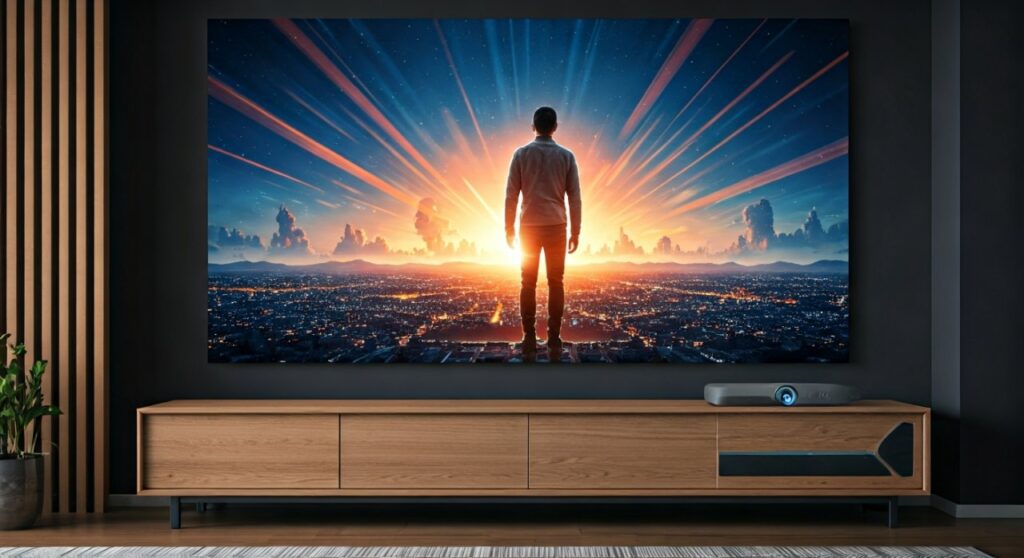
The short answer is a resounding yes. Laser projectors are better than traditional lamp models because they provide superior brightness consistency, wider color gamuts, and instant-on/off functionality. While the initial investment is higher, the 20,000-hour lifespan and lack of expensive replacement bulbs make them the more cost-effective and high-performing choice for serious viewers.
In this guide, we will break down the technical reasons why laser light sources are dominating the market and help you decide if the upgrade is worth your hard-earned money.
Key Takeaways: Is a Laser Projector Right for You?
If you are looking for a quick verdict, here is the essential data comparing Laser Light Sources to traditional UHP Lamps:
| Feature | Laser Projectors | Traditional Lamp Projectors |
|---|---|---|
| Lifespan | 20,000 to 30,000 hours | 3,000 to 6,000 hours |
| Brightness Decay | Very slow; stays bright for years | Rapid; loses 25% brightness in 500 hours |
| Startup Time | Instant On / Instant Off | 1-2 minute warm-up/cool-down |
| Color Accuracy | High (Covers DCI-P3 or BT.2020) | Moderate (Mostly Rec.709) |
| Maintenance | Virtually Zero (Filter cleaning only) | Frequent bulb replacements ($200-$500 each) |
| Best For | High-end Home Cinema, Gaming, Bright Rooms | Occasional use, Budget theaters |
Understanding the Technical Edge: Why Laser Light Sources Win
To understand why the industry is shifting, we have to look at the physics of light. Traditional projectors use a Ultra High Pressure (UHP) lamp, which is essentially a specialized light bulb that generates light by creating an electrical arc through pressurized mercury gas.
Consistent Brightness and “Lumen Longevity”
A major reason are laser projectors better is how they handle light over time. A traditional bulb starts losing its peak brightness the second you turn it on for the first time. By the time you reach 1,000 hours, the image is noticeably dimmer.
Laser engines, like those found in the Epson LS12000 or Sony VPL-XW5000ES, use solid-state laser diodes. These diodes are incredibly stable. You can run a laser projector for 10 years at 4 hours a day, and the brightness will still be nearly identical to day one.
The Power of “Instant-On”
We live in an age of instant gratification. Waiting two minutes for a lamp to warm up feels like an eternity. Because Laser Projectors don’t require a gas-filled bulb to reach a specific temperature, they turn on as fast as a modern LED TV. This makes them ideal for casual channel surfing or quick gaming sessions.
Superior Color Saturation
Lasers produce a very specific, narrow wavelength of light. This allows engineers to “tune” the light to achieve colors that are physically impossible for a standard bulb to replicate. High-end Triple Laser (RGB) projectors can cover the BT.2020 color space, which represents the widest range of colors available in consumer video today.
Are Laser Projectors Better for Specific Use Cases?
As a home theater consultant who has calibrated hundreds of units, I can tell you that the “best” projector depends entirely on your environment. Here is how laser technology stacks up in real-world scenarios.
For Bright Living Rooms (Media Rooms)
If you aren’t in a pitch-black “bat cave,” you need raw light output. Laser projectors excel here. Units like the Hisense L9G or Samsung The Premiere are designed as Ultra Short Throw (UST) laser projectors. When paired with an Ambient Light Rejecting (ALR) screen, they can replace a 100-inch TV even with the curtains open.
For Hardcore Gaming
Low latency is the name of the game. Modern laser projectors often feature HDMI 2.1 ports and support 4K at 120Hz. Because laser engines can be modulated (turned on and off) almost instantly, they facilitate better Dynamic Contrast, making it easier to see enemies lurking in the shadows of a dark game like Elden Ring.
For Dedicated Home Cinemas
In a dark room, black levels are king. While traditional high-end lamps (like JVC’s older D-ILA models) had amazing contrast, modern Laser Phoshor and RGB Laser units have finally caught up. The ability to dim the laser light source frame-by-frame (dynamic dimming) allows for “infinite” contrast during total black scenes.
Step-by-Step Guide: How to Choose and Set Up a Laser Projector
If you’ve decided that a laser unit is the way to go, follow these steps to ensure you get the best performance.
Step 1: Determine Your Throw Ratio
Before buying, measure the distance from your wall to where the projector will sit.
- Ultra Short Throw (UST): Sits inches away from the wall.
- Standard Throw: Sits 10-15 feet away (usually ceiling mounted).
Step 2: Choose Between Single Laser and Triple Laser
- Single Laser (Laser Phosphor): Uses a blue laser and a phosphor wheel. It is more affordable but has slightly less color depth.
- Triple Laser (RGB): Uses dedicated Red, Green, and Blue lasers. This offers the best colors but can sometimes suffer from “Laser Speckle” (a slight grainy texture) if the screen isn’t high quality.
Step 3: Match with the Right Screen
Do not use a laser projector on a bare wall! To get the most out of the high brightness, invest in a Fixed Frame Screen with a gain of 1.1 to 1.3 for dark rooms, or an ALR screen for bright rooms.
Step 4: Professional Calibration
Even though laser projectors are better out of the box, they often come with “cool” color temperatures. Use a calibration disc like Spears & Munsil or hire a professional to adjust the White Balance and CMS (Color Management System) to hit the D65 white point standard.
The Hidden Costs: Is the Premium Worth It?
One common objection is the price. A high-quality laser projector typically starts at $2,000, whereas a decent lamp projector can be found for $800.
However, consider the Total Cost of Ownership (TCO):
- Replacement Bulbs: A typical lamp lasts 3,000 hours. Over 20,000 hours, you would need roughly 6 bulbs. At $300 each, that is $1,800 in maintenance alone.
- Electricity: Lasers are generally more energy-efficient per lumen of light produced, leading to lower utility bills over time.
- Resale Value: Because laser engines don’t “wear out” like lamps, they hold their resale value much better on the secondary market.
Expert Insight: I always tell my clients, “If you plan to use this projector as your main TV (4+ hours a day), go Laser. If you only watch one movie a week, a lamp might save you money.”
Potential Downsides of Laser Projectors
No technology is perfect. While laser projectors are better in most categories, you should be aware of these minor trade-offs:
- Non-Replaceable Light Source: Unlike a lamp, you cannot simply swap the laser if it fails. However, with a 20,000-hour rating, the rest of the projector’s electronics will likely fail before the laser does.
- RROB (Rainbow Effect): On cheaper single-chip DLP laser projectors, some sensitive viewers might see “rainbows” in high-contrast scenes. Look for 3-LCD or LCoS laser models to avoid this.
- Initial Heat: While they run cooler than lamps overall, high-lumen lasers still generate heat that needs to be dissipated by fans.
Frequently Asked Questions
Can a laser projector be repaired if the laser dies?
Technically yes, but it is rarely cost-effective. Most manufacturers treat the laser module as a permanent component. However, the failure rate of laser diodes is statistically much lower than that of mechanical parts or traditional bulbs.
Are laser projectors safer for your eyes?
Yes, in one specific way: they are often used in Ultra Short Throw configurations where the light is projected upward at a steep angle, making it much less likely for someone to walk in front of the beam and look directly into the lens.
Do laser projectors lose brightness over time?
Yes, all light sources eventually dim. However, a laser loses brightness at a linear, predictable rate (about 20-30% over 20,000 hours), whereas a lamp loses brightness exponentially and much faster.
Is “4K Laser” better than “4K LED”?
Laser projectors are generally much brighter than LED projectors. While LED units offer great colors and even longer lifespans (30,000+ hours), they often struggle to produce enough light for screens larger than 100 inches.
Why are laser projectors so much heavier?
The cooling systems and robust power supplies required to drive high-wattage laser diodes require more physical space and heavier heat sinks than simple lamp housings.
Final Verdict: The Future is Coherent Light
If you are building a home theater today, the question isn’t just “are laser projectors better“—it’s whether you can afford to miss out on the reliability they offer.
For the average user, the peace of mind of never having to buy a replacement bulb, combined with the stunning HDR performance and instant usability, makes laser technology the clear winner. While lamp-based projectors will remain in the “budget” category for a few more years, the high-end and mid-range markets have already moved on to the laser revolution.
**
**
**
**