Why Are Projectors So Expensive? The Real Cost of Big-Screen Magic
Projectors are expensive because they integrate high-precision optical engineering, advanced light sources like lasers, and microscopic display chips that are significantly more complex to manufacture than standard TV panels. Unlike a static LED screen, a projector must manage extreme heat, utilize high-end glass lenses for clarity, and invest heavily in R&D to maintain color accuracy over long distances.
When you buy a premium projector, you aren’t just paying for a screen; you are paying for a sophisticated light engine capable of magnifying a tiny image to 150 inches or more without losing resolution or brightness.
Key Takeaways: Understanding the Price Tag
If you are looking for a quick breakdown of why the bill for a home theater setup is so high, here are the primary drivers of projector costs:
| Component/Factor | Impact on Price | Why It Costs More |
|---|---|---|
| Light Source | Extremely High | Laser engines and LED arrays last longer but cost thousands to develop. |
| Optics & Lenses | High | Premium all-glass lenses prevent chromatic aberration and blurring. |
| Imaging Chips | High | DLP, 3LCD, or LCoS chips require nanometer-scale precision. |
| Cooling Systems | Medium | High-intensity bulbs generate massive heat; silent, efficient cooling is pricey. |
| Market Volume | High | Projectors are a niche market; lower sales volume means higher per-unit R&D costs. |
Advanced Light Source Technology (Lasers vs. Bulbs)
The most significant factor in why are projectors so expensive is the light source. Traditional projectors used Ultra-High Pressure (UHP) lamps, which were relatively cheap but had short lifespans and lost brightness quickly.
Modern high-end projectors have shifted to Solid-State Illumination, specifically Lasers and LEDs. These technologies offer several expensive advantages:
- Longevity: A laser projector can last 20,000 to 30,000 hours, whereas a bulb might die after 3,000 hours.
- Instant On/Off: Unlike bulbs that need to “warm up,” lasers provide immediate peak brightness.
- Color Gamut: High-end Triple Laser (Tri-Chroma) systems can cover 100% of the BT.2020 color space, something most high-end TVs struggle to do.
Developing a laser light engine that stays cool and maintains color stability requires billions in investment from brands like Sony, JVC, and Epson.
The Precision of Optical Engineering
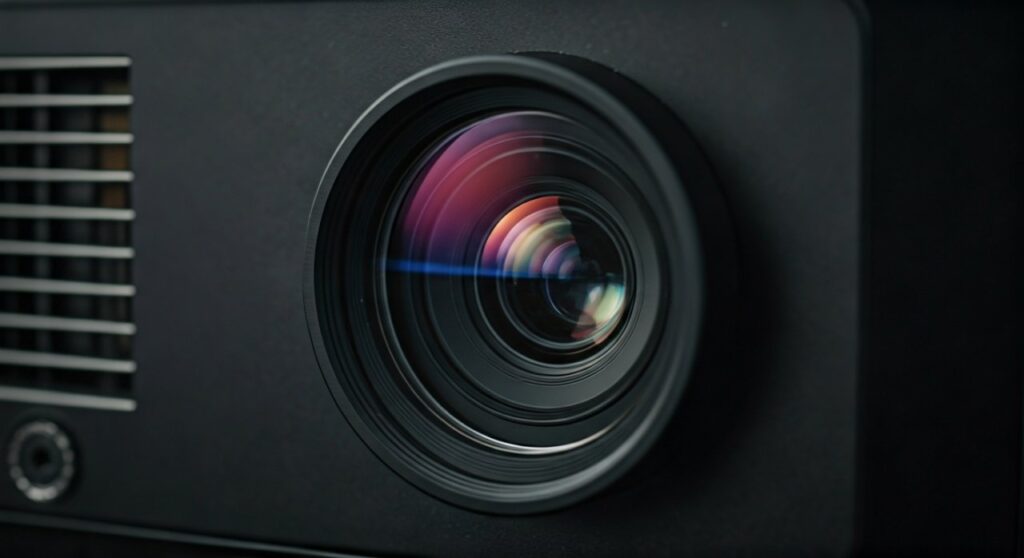
Think of a projector as a high-end camera working in reverse. To get a sharp image on a 120-inch screen, the light must pass through a series of highly polished glass lenses.
Cheap projectors use plastic lenses that warp under heat and cause “soft” edges. Professional-grade projectors use Extra-low Dispersion (ED) glass to ensure that every pixel is perfectly focused from the center to the very corners of the screen.
Why this adds to the cost:
- Lens Shift Mechanics: High-end units allow you to move the image up, down, or sideways without moving the projector. This requires complex internal motors and movable glass elements.
- Zoom Capabilities: Maintaining focus while changing the image size requires a motorized zoom assembly that must be calibrated to a fraction of a millimeter.
Micro-Display Chips: DLP, 3LCD, and LCoS
Inside every projector is a tiny chip that actually creates the image. This chip is often no larger than a postage stamp, yet it contains millions of pixels.
- DLP (Digital Light Processing): Uses millions of tiny mirrors that flip back and forth thousands of times per second. Companies like Texas Instruments charge a premium for these high-speed chips.
- 3LCD: Uses three separate panels (Red, Green, Blue) to create a vibrant image. Aligning these three panels perfectly (to avoid “fringing”) is a labor-intensive manufacturing process.
- LCoS (Liquid Crystal on Silicon): Found in Sony (SXRD) and JVC (D-ILA) projectors. This is the “gold standard” for black levels and contrast, but it is incredibly difficult to manufacture without defects, leading to higher retail prices.
Why are Projectors So Expensive Compared to TVs?
Many consumers ask why are projectors so expensive when they can buy an 85-inch 4K TV for under $1,000. The answer lies in the economies of scale.
Samsung, LG, and TCL sell tens of millions of TVs every year. This massive volume allows them to drive down the cost of components. Projectors are a “niche” enthusiast product. Because manufacturers sell fewer units, the Research and Development (R&D) costs are spread across a smaller number of buyers, keeping the individual unit price high.
Furthermore, a TV is a single panel. A projector requires an internal light source, a cooling system, a display chip, and an external lens system—effectively four different technologies working in a very small chassis.
The Hidden Cost of Image Processing and HDR
Achieving High Dynamic Range (HDR) on a projector is much harder than on a TV. Since projectors cannot “produce” black (they can only omit light), they rely on sophisticated Dynamic Iris systems and software algorithms to simulate high contrast.
Tone Mapping is the secret sauce that makes a $5,000 projector look better than a $500 one. Brands like Lumagen or MadVR sell external processors for thousands of dollars just to handle this task. High-end projector brands build this processing power directly into their hardware to ensure the image doesn’t look washed out.
How to Evaluate Projector Costs: A Step-by-Step Guide
If you are shopping for a projector and trying to justify the price, follow these steps to ensure you are getting value for your money.
Step 1: Identify the Light Source
Don’t just look at the price; look at the Total Cost of Ownership (TCO).
- If a projector costs $1,000 but needs a $300 bulb every two years, it might be more expensive than a $2,000 laser projector in the long run.
- Expert Tip: Choose Laser if you plan to use the projector as your main TV replacement.
Step 2: Check for “Native” vs. “Upscaled” Resolution
Many “cheap” 4K projectors use a technique called Pixel Shifting (XPR). While effective, it isn’t as sharp as Native 4K.
- Native 4K chips are physically larger and much more expensive to produce.
- If the specs say “4K Support,” it usually means it only accepts a 4K signal but outputs in 1080p. True 4K will always command a premium.
Step 3: Assess the Cooling and Noise Levels
Expensive projectors have larger chassis. Why? To accommodate larger, slower-spinning fans.
- Cheap projectors sound like a vacuum cleaner.
- Premium models (like the Sony VPL series) operate at under 25dB, making them nearly silent during quiet movie scenes.
Step 4: Look at the Lens Quality
Check if the lens is made of all-glass elements. Plastic lenses will “heat drift,” meaning the image will go out of focus as the projector warms up. High-end glass stays sharp regardless of temperature.
Common Questions About Projector Pricing (FAQs)
Are expensive projectors worth it for a living room?
It depends on your light control. In a bright living room, an expensive Ultra Short Throw (UST) projector with an Ambient Light Rejecting (ALR) screen is necessary to compete with a TV. If you can’t control the light, a high-end TV is often a better value.
Why is 4K so much more expensive in projectors?
In a TV, you just add more pixels to a large glass sheet. In a projector, you have to shrink 8.3 million pixels onto a 0.47-inch or 0.7-inch chip. This level of miniaturization requires extreme manufacturing precision, which drives up the cost.
Will projector prices go down soon?
Prices for entry-level 4K and LED projectors are dropping. However, high-end optics and laser engines involve raw material costs (like rare earth elements and precision glass) that are unlikely to decrease significantly in the near future.
Does a higher price mean better brightness?
Not always. A $500 “office” projector might be brighter (measured in ANSI Lumens) than a $5,000 home theater projector. However, the expensive projector will have better contrast, color accuracy, and black levels, which are more important for watching movies.
What is the “sweet spot” for projector pricing?
For a dedicated home theater, the “sweet spot” is typically between $2,500 and $5,000. In this range, you move away from “entry-level” compromises and gain access to high-quality lenses, laser light sources, and better image processing.