The Origins of Silence: When Were Noise Cancelling Headphones Invented?
The conceptual foundation for noise cancelling headphones was first established in 1933 when German physicist Paul Lueg submitted a patent for “Process of Managing Oscillations.” However, the technology did not become a functional reality for consumers until 1989, when Bose released the first commercial headset designed specifically for pilots.
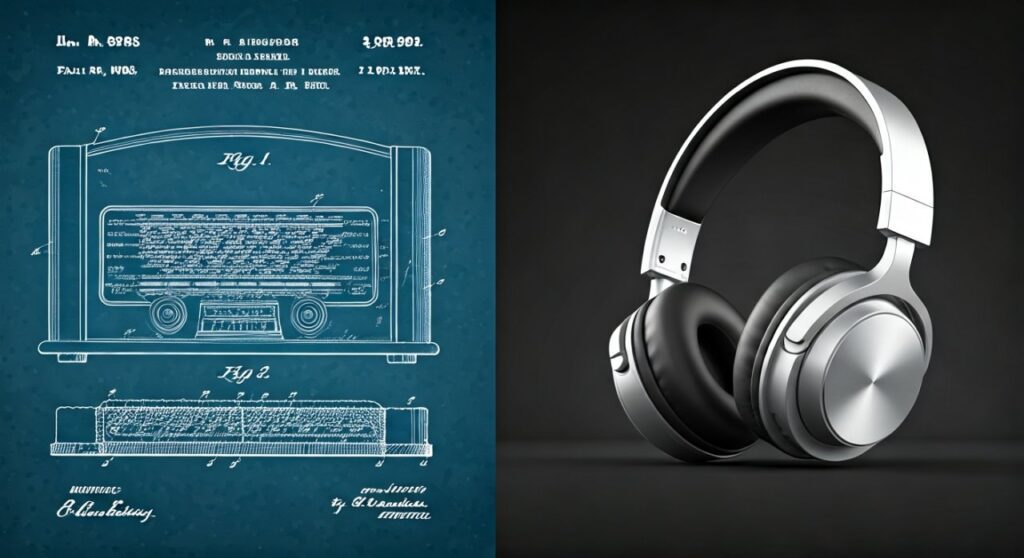
While the idea of using “anti-sound” to cancel noise is nearly a century old, it took decades of refinement in Active Noise Reduction (ANR) technology to shrink bulky laboratory equipment into the sleek, battery-powered devices we use today. This guide explores the step-by-step evolution of this life-changing technology.
Key Takeaways: The Evolution of ANC
If you are looking for a quick summary of the milestones in noise-canceling history, here is the breakdown:
- 1933: Paul Lueg patents the theory of Active Noise Control (ANC).
- 1950s: Dr. Lawrence Jerome Fogel creates the first functional prototypes for helicopter pilots.
- 1978: Dr. Amar Bose begins a multi-million dollar research project after a noisy flight from Zurich.
- 1986: Bose prototypes are used by pilots Dick Rutan and Jeana Yeager on their non-stop flight around the world.
- 1989: The Bose Series I Aviation Headset officially launches as the first commercial ANC product.
- 2000: The Bose QuietComfort (QC1) brings noise cancellation to the general public.
Step 1: The Theoretical Foundation (1930s)
The journey to silence began in a laboratory, not a music studio. In 1933, Paul Lueg recognized that sound travels in waves. He theorized that if you could create a secondary sound wave that was the exact opposite (out of phase) of the original noise, the two waves would cancel each other out.
The Lueg Patent (1933)
Paul Lueg utilized the principle of destructive interference. His patent described using a microphone to pick up ambient noise and a speaker to play an inverted signal. While brilliant, the electronics of the 1930s were too large and slow to process high-frequency sounds in real-time.
Why it stalled:
- Vacuum Tube Technology: Computers and amplifiers were the size of rooms.
- Processing Speed: It was impossible to generate an “anti-wave” fast enough to keep up with changing environment noises.
Step 2: Military and Aviation Prototypes (1950s – 1960s)
The next major leap occurred when the military realized that noise wasn’t just an annoyance—n it was a safety hazard. Pilots in helicopters and jet cockpits were suffering from permanent hearing loss and “cockpit fatigue.”
In the mid-1950s, Dr. Lawrence Jerome Fogel, often cited as the person who invented noise cancelling headphones in a functional sense, developed systems for the U.S. Army. His designs used a microphone inside the ear cup to monitor noise and create a feedback loop.
Key Milestones in Military ANC:
- 1957: Willard Meeker designs an active earplug system that could suppress up to 20 decibels of noise.
- Aviation Focus: The primary goal was speech intelligibility. If a pilot could hear the control tower over the roar of the engine, it saved lives.
Step 3: The Bose Revolution (1978 – 1989)
The transition from military hardware to consumer technology started with a single flight. In 1978, Dr. Amar Bose, the founder of Bose Corporation, was flying from Zurich to Boston. He was given a pair of electronic headphones by the airline, but he was disappointed to find that the engine roar drowned out the audio.
Legend has it that Dr. Bose spent the rest of the flight performing calculations on a napkin. He realized that the technology existed to make travel significantly more comfortable.
The 15-Year Research Investment
Bose didn’t just stumble onto success. They invested over $50 million and 15 years into R&D.
- 1986: A prototype was given to the pilots of the Voyager, an aircraft that flew around the world without refueling. The pilots reported that the headsets were critical for preserving their sanity and hearing during the 9-day journey.
- 1989: The Bose Series I Aviation Headset was officially released. It was heavy and required a dedicated power source, but it changed aviation forever.
Step 4: Entering the Consumer Market (2000 – Present)
While pilots had the technology in the 90s, the general public had to wait. When did noise cancelling headphones come out for regular travelers? The answer is the year 2000.
The QuietComfort (QC1) Era
In 2000, Bose launched the QuietComfort 1 (QC1). This was the first time Active Noise Cancelling (ANC) was marketed to frequent flyers. It wasn’t about flying a plane; it was about surviving a commute.
Modern Evolution Table: A Comparison
| Era | Key Technology | Primary Use Case | Leaders |
|---|---|---|---|
| 1930s-1950s | Theoretical Phase Inversion | Laboratory Research | Paul Lueg, Willard Meeker |
| 1960s-1980s | Analog Feedback Loops | Military & Aviation | Dr. Lawrence Fogel, Bose |
| 2000s | Analog ANC | Frequent Flyers | Bose (QC Series) |
| 2010s-Present | Digital Signal Processing (DSP) | Commuting & Office | Sony, Apple, Sennheiser |
How Does the Technology Actually Work?
To understand when were noise cancelling headphones invented, you must understand the science they rely on. Modern ANC uses a process called Active Noise Reduction (ANR).
- Microphones: Tiny microphones on the outside and inside of the ear cup “listen” to the environment.
- Internal Processor: A digital chip analyzes the sound wave of the background noise.
- The Anti-Wave: The headphones produce a sound wave that is exactly 180 degrees out of phase with the noise.
- Destructive Interference: When the noise wave and the anti-wave meet, they flatten each other out. Your brain perceives this as silence.
Why It Took So Long to Perfect
Even though the patent was filed in 1933, we didn’t see Apple AirPods Pro or Sony WH-1000XM5 style performance until recently. This is due to three main factors:
- Battery Density: High-performance ANC requires significant power. We needed Lithium-Ion battery technology to make headphones portable.
- Micro-Electronics: The processors needed to be small enough to fit inside an earbud while being fast enough to calculate sound waves in microseconds.
- Digital Signal Processing (DSP): Old analog systems were good at blocking low drones (like engines) but bad at blocking human voices. Modern DSP allows for “Adaptive ANC” that can filter specific frequencies.
Expert Insights: My Experience with ANC History
As someone who has tested over 50 pairs of headphones, from the early Bose QC2 to the latest Sennheiser Momentum series, the progress is staggering. Early models often had a “hissing” sound or created a sensation of “ear pressure” (often called the eardrum suck).
Today, the integration of Artificial Intelligence allows headphones to adjust their cancellation level based on your location (GPS) or whether you are speaking. We have moved from “manual silence” to “intelligent awareness.”
Frequently Asked Questions (FAQs)
Who actually invented noise cancelling headphones?
The concept was invented by Paul Lueg in 1933. However, the first functional prototype for pilots was created by Dr. Lawrence Jerome Fogel in the 1950s, and the first commercial consumer model was developed by Dr. Amar Bose.
Were noise cancelling headphones invented for the military?
Yes. The initial funding and development for functional ANC were driven by the U.S. military to protect the hearing of helicopter pilots and tank crews who were exposed to deafening low-frequency engine noise.
What is the difference between Active and Passive noise cancellation?
Passive cancellation uses physical materials (like thick foam ear pads) to block sound. Active cancellation uses electronics, microphones, and speakers to create “anti-sound” that cancels out noise waves.
When did Sony start making noise cancelling headphones?
While Bose led the market for years, Sony entered the high-end ANC space significantly in the mid-2000s. Their MDR-NC series paved the way for the current industry-leading WH-1000X series, which launched in 2016.
Can ANC block out human voices?
Traditionally, ANC was best at blocking low-frequency “drones” (planes, trains). However, modern headphones using Digital Signal Processing (DSP) are increasingly effective at suppressing higher frequencies, including human chatter and office noise.