Understanding Why Defendants Wear Headphones in Court
If you have ever watched a high-profile trial or a live stream of a courtroom proceeding, you might have noticed the defendant or other participants wearing bulky, black headphones. While it may look like they are listening to a podcast or music to pass the time, the reality is far more serious and legally significant. Defendants wear headphones in court primarily to receive simultaneous language interpretation or to assist with hearing impairments. This equipment ensures they can fully understand every word spoken during the trial, which is a fundamental requirement for a fair trial and due process.
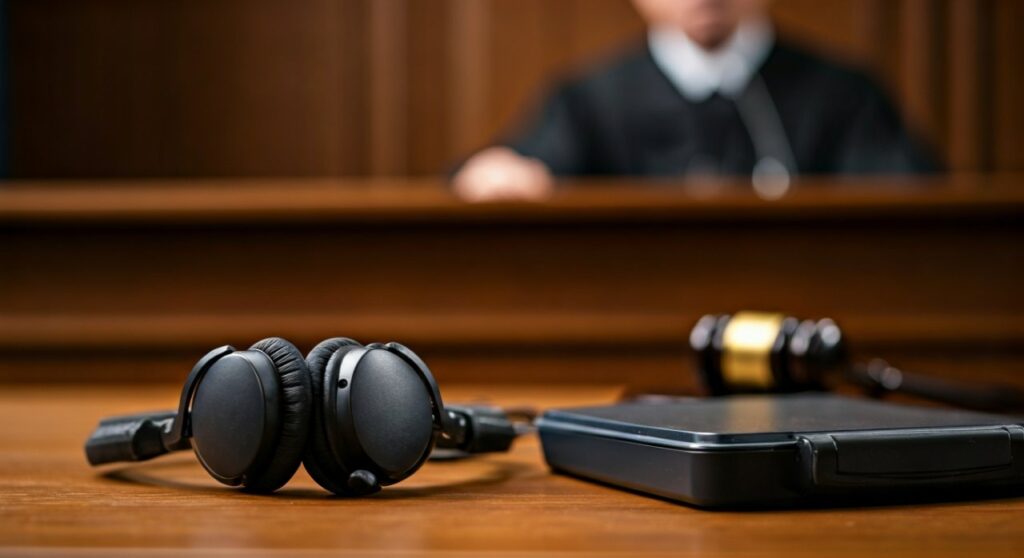
In most cases, these headphones are connected to a dedicated Assistive Listening System (ALS) or a transmitter used by a court-certified interpreter. Without this technology, a defendant who does not speak the primary language of the court or who suffers from hearing loss would be effectively “absent” from their own trial, leading to potential grounds for an appeal or a mistrial.
Key Takeaways: Why the Headphones are Necessary
Before diving into the legal and technical specifics, here is a quick summary of why you see headphones in the courtroom:
- Language Translation: The most common reason is simultaneous interpretation. An interpreter sits in a booth or at the back of the room, translating the proceedings into the defendant’s native language in real-time.
- Hearing Assistance: Defendants with hearing loss use headphones connected to the court’s sound system to amplify the voices of the judge, witnesses, and attorneys.
- Legal Constitutional Rights: In the United States, the Sixth Amendment guarantees a defendant the right to be “confronted with the witnesses against him” and to assist in their own defense. Understanding the language is the first step.
- Confidentiality: Headphones allow the defendant to hear the translation without the interpreter’s voice disrupting the judge or the jury.
- Technological Standards: Most modern courtrooms use Infrared (IR) or FM radio frequency systems to transmit clear, interference-free audio directly to the headsets.
The Legal Necessity: The Right to Understand
The primary reason why do defendants wear headphones in court is rooted in the concept of due process. For a trial to be considered fair, the defendant must be able to comprehend the charges, the evidence, and the testimony being presented against them.
The Sixth Amendment and “Meaningful Presence”
Under the Sixth Amendment of the U.S. Constitution, a defendant has the right to be “present” at their trial. Legal experts argue that “presence” is not just physical; it is mental and linguistic.
If a defendant speaks only Spanish or Mandarin and the trial is conducted in English, they are not truly “present” unless they understand the dialogue. The headphones provide a direct line to an interpreter, fulfilling this constitutional mandate.
The Court Interpreter Act
In 1978, the Court Interpreter Act was established to ensure that any individual involved in a federal judicial proceeding can understand the proceedings. This act mandated the use of certified interpreters and technical equipment, such as headphones, to facilitate communication.
Simultaneous vs. Consecutive Interpretation
When asking why do people wear headphones in court, it is important to distinguish between how interpretation happens. There are two main styles used in the legal system:
- Consecutive Interpretation: The speaker talks, pauses, and the interpreter translates. This is common during witness testimony but doubles the length of the trial.
- Simultaneous Interpretation: The interpreter translates while the speaker is talking. This is where headphones are essential.
The interpreter speaks into a microphone at a whisper, and the audio is transmitted instantly to the defendant’s headphones. This allows the trial to proceed at a natural pace without constant interruptions.
Comparison Table: Translation vs. Hearing Assistance
| Feature | Language Interpretation | Hearing Assistance (ADA) |
|---|---|---|
| Primary User | Non-English speakers / ESL defendants | Individuals with hearing loss or deafness |
| Audio Source | The voice of the Court Interpreter | The direct feed from the Judge/Witness Microphones |
| Legal Basis | Court Interpreter Act / 6th Amendment | Americans with Disabilities Act (ADA) |
| Device Type | Multi-channel receiver (tuned to a specific language) | Single-channel amplifier or loop system |
| Goal | To overcome a linguistic barrier | To overcome a physical/auditory barrier |
Accommodating Hearing Impairments (ADA Compliance)
Another significant reason why do defendants wear headphones involves the Americans with Disabilities Act (ADA). Courts are public entities required to provide “reasonable accommodations” for individuals with disabilities.
For a defendant with hearing loss, the natural acoustics of a large, high-ceilinged courtroom can be a nightmare. Echoes and background noise make it difficult to distinguish words. Assistive Listening Devices (ALDs), which include specialized headphones, filter out background noise and deliver “clean” audio directly to the ear.
Types of Assistive Technology Used
- Infrared Systems: These use light waves to transmit sound. They are highly secure because the signal cannot pass through walls, ensuring that the trial audio stays inside the courtroom.
- FM Systems: These work like a small radio station. They are portable and effective but can sometimes pick up interference from other electronics.
- Induction Loops: Some defendants use “neck loops” that sync directly with their Hearing Aids (using a T-coil), though over-ear headphones remain the standard for those without specialized hearing aids.
Why Do They Wear Headphones in Court During High-Profile Cases?
In televised trials, such as those involving international defendants or complex multi-lingual witnesses, the sight of headphones becomes even more common.
For example, in the trial of Joaquín “El Chapo” Guzmán, headphones were a permanent fixture. Because the proceedings were in English and the defendant’s primary language was Spanish, a team of interpreters worked in shifts to provide a constant stream of audio.
Expert Insight: I have observed that in many international tribunals, such as the International Criminal Court (ICC), almost every person in the room wears headphones. This is because these trials often involve three or four different languages being spoken simultaneously.
Technical Requirements for Courtroom Headphones
Not just any pair of headphones will do. The equipment used by the Department of Justice and state courts must meet specific standards:
- Sanitation: Headphones must be easy to clean or use disposable ear pads to prevent the spread of germs between users.
- Weight: They must be lightweight enough to be worn for 6 to 8 hours a day without causing fatigue.
- Clarity: The frequency response is usually tuned to the human voice (mid-range frequencies) rather than deep bass for music.
- Durability: Courtroom gear is “pro-grade” equipment, often from brands like Sennheiser, Williams AV, or Listen Technologies.
The Role of the Court Interpreter
The person on the other end of those headphones is a highly trained professional. Certified Court Interpreters do more than just swap words; they must convey the “legal weight” of phrases.
If a lawyer uses a complex legal term like “proffer” or “hearsay,” the interpreter must find the equivalent term in the target language that conveys the same legal nuance. This requires intense concentration, which is why interpreters usually switch every 20–30 minutes to prevent “cognitive fatigue.”
Can the Jury Hear What the Defendant Hears?
No. The system is designed to be a “closed loop.” The transmitter is set to a specific frequency that only the defendant’s receiver (connected to their headphones) can pick up. This prevents the jury from being distracted by a second voice speaking a different language.
Common Myths About Headphones in Court
Despite the practical reasons, several misconceptions persist about why do defendants wear headphones in court:
- Myth 1: They are listening to music. This is strictly prohibited. Court officers ensure the receivers are tuned only to the official court frequency.
- Myth 2: Their lawyer is whispering tips to them. While some systems allow for “attorney-client privileged” communication, the headphones seen in the gallery or at the defense table are typically for the official court record or translation.
- Myth 3: It’s a sign of guilt. Some worry that wearing headphones makes a defendant look “disconnected” or “robotic” to a jury. However, judges often give “curative instructions” to the jury, explaining that the headphones are a legal necessity and should not be factored into their verdict.
Step-by-Step: How a Defendant Obtains Headphones
If you or a loved one is facing a court date and requires assistance, here is the typical process:
- Request for Services: The defense attorney files a motion or notifies the clerk of the court that the defendant requires an interpreter or an Assistive Listening Device.
- Assessment: The court determines the primary language or the level of hearing impairment.
- Scheduling: The court coordinator schedules a certified interpreter for all “on-the-record” proceedings.
- Equipment Check: Before the judge enters, a bailiff or technician provides the defendant with a battery-powered receiver and a pair of headphones.
- Testing: The interpreter speaks a few test sentences to ensure the defendant can hear clearly and adjust the volume.
Conclusion: The Bridge to Justice
The answer to why do defendants wear headphones in court is simple: it is about clarity and fairness. Whether it is bridging a language gap or overcoming a physical hearing limitation, these devices ensure that the defendant is a conscious participant in the legal process.
In an era where technology is often seen as a distraction, the humble pair of headphones remains one of the most vital tools for upholding the Sixth Amendment and ensuring that justice is not just done, but understood.
Frequently Asked Questions (FAQs)
Does the defendant have to pay for the headphones and interpreter?
In criminal cases in the United States, the court is required to provide interpreters and assistive listening devices at no cost to the defendant, regardless of their ability to pay. This is part of the right to a fair trial.
Can the audience in the courtroom wear headphones too?
Generally, no. Headphones provided for interpretation or hearing assistance are reserved for the parties directly involved in the case (the defendant, the victim, or sometimes family members). However, some courts have a limited number of “public” receivers for high-profile multi-lingual cases.
What happens if the headphones stop working during the trial?
The defense attorney must immediately alert the judge. The proceedings will usually “stay” (pause) while a technician replaces the batteries or the headset. Any testimony given while the defendant cannot hear is a violation of their rights.
Can a defendant use their own Bluetooth headphones?
No. For security and technical reasons, defendants must use the wired headphones and receivers provided by the court. This prevents the possibility of the defendant receiving outside communication or recording the proceedings illegally.
Are the translations heard through the headphones recorded?
The official court record is based on what is said in English (the language of the court). While the interpreter’s voice is transmitted to the headphones, it is usually not the “official” record unless specifically requested for an appeal review.