Understanding Why Musicians Wear Headphones: The Expert Guide
Musicians wear headphones primarily to hear a precise monitor mix and a click track (metronome) while isolating themselves from external noise. This allows them to stay in perfect sync with the tempo and hear their own instrument or voice clearly without interference from the surrounding environment or other loud instruments.
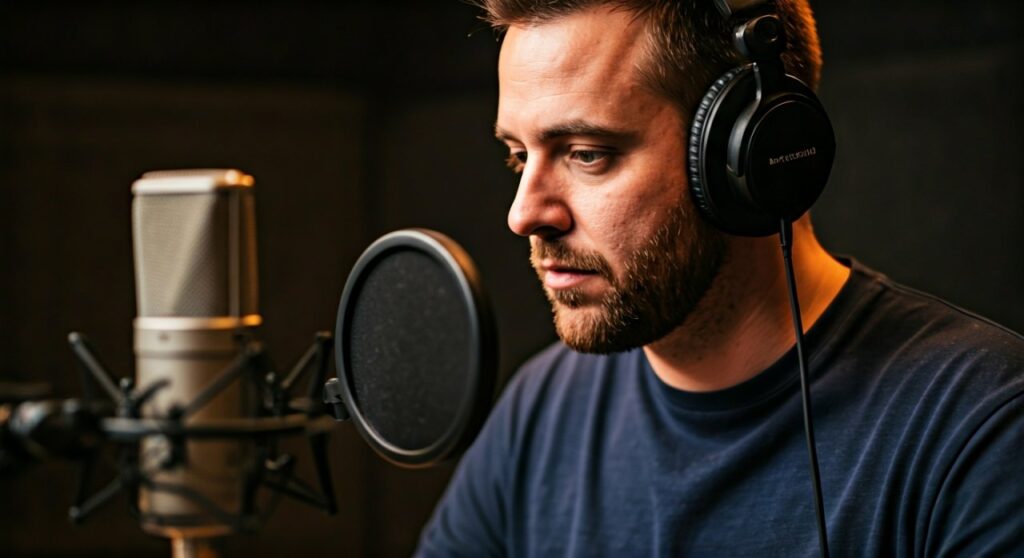
In a professional studio or live setting, the goal is total control. Without headphones, a drummer might drown out a vocalist, or a guitarist might lose the rhythm during a complex bridge. Headphones act as the bridge between the raw acoustic sound and the polished, synchronized performance required for modern music production.
Key Takeaways: Why Do Musicians Wear Headphones?
- Timing and Synchronization: Headphones provide a click track that keeps all band members at the exact same BPM (Beats Per Minute).
- Audio Isolation: They prevent “bleed,” ensuring that the sound from a backing track doesn’t leak into a live microphone.
- Personalized Monitoring: Each musician can receive a “More Me” mix, allowing them to turn up their own instrument without affecting others.
- Hearing Protection: High-quality In-Ear Monitors (IEMs) act as earplugs, reducing the dangerous decibel levels of live stages.
- Critical Listening: During mixing, headphones reveal micro-details like phase issues or subtle background noise that speakers might miss.
The Science of Sound Isolation and “Bleed” Prevention
When you are in a recording studio, the most critical factor is signal purity. If a singer is recording a vocal track while listening to the instrumental through floor speakers, that instrumental music will “bleed” into the vocal microphone.
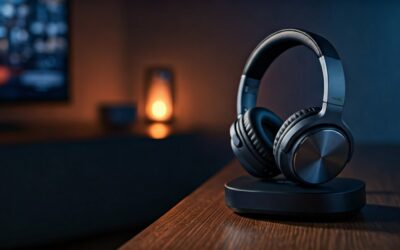
This makes it nearly impossible for an engineer to edit or mix the vocals later. By using closed-back headphones, the sound is trapped against the ears, allowing the performer to hear the music while the microphone captures only the “dry” vocal signal.
Expert engineers often prefer models like the Beyerdynamic DT 770 Pro for this exact reason. Its high isolation rating ensures that even at high volumes, the click track remains unheard by the sensitive large-diaphragm condenser microphones used for vocals.
The Role of the Click Track in Professional Performance
You might wonder how world-class bands stay so perfectly in time. The secret is the click track. This is a digital metronome sent directly to the musicians’ headphones.
- Consistency: It ensures the song doesn’t speed up during an energetic chorus or slow down during a mellow verse.
- Post-Production: Recording to a click allows engineers to easily copy, paste, and align tracks in a DAW (Digital Audio Workstation) like Pro Tools or Ableton Live.
- Backing Tracks: Many modern artists use pre-recorded loops or synths. The musicians must wear headphones to stay synchronized with these digital elements.
As a session musician, I have found that playing without a click track in a studio environment often leads to “drift,” which can double the time spent in the editing phase. Headphones are the ultimate tool for efficiency.
Monitoring Mixes: The “More Me” Factor
In a live band setting, the stage is often a chaotic mess of sound. A drummer’s cymbals might be so loud that the keyboardist cannot hear their own melodies. This is where monitoring comes in.
Through a headphone amp or a wireless system, each musician receives a custom mix. A vocalist might ask for “more reverb and more piano,” while the drummer wants “heavy bass and lots of click.” This personalized audio environment allows for a more confident and accurate performance.
Comparison: Headphones vs. Traditional Floor Wedges
| Feature | Studio/Stage Headphones | Traditional Floor Wedges (Speakers) |
|---|---|---|
| Portability | High – Fits in a gig bag | Low – Heavy and bulky |
| Clarity | Exceptional – Direct to ear | Moderate – Affected by room acoustics |
| Feedback Risk | Zero | High – Can cause “screaming” loops |
| Customization | Individual mixes per person | General mix for the stage area |
| Hearing Safety | Provides 20dB+ of isolation | Often contributes to hearing loss |
Live Performance and In-Ear Monitors (IEMs)
If you watch a concert today, you rarely see large speakers (wedges) at the front of the stage. Instead, you see small wires running into the musicians’ ears. These are In-Ear Monitors (IEMs).
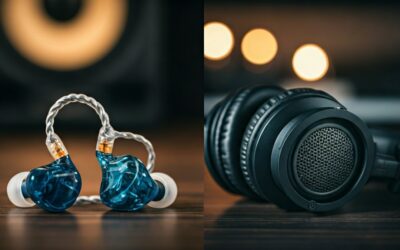
IEMs are a specialized type of headphone designed for the rigors of touring. They provide a “seal” in the ear canal that blocks out the roar of the crowd and the deafening volume of guitar stacks. This allows the musician to hear a studio-quality mix at a much lower, safer volume.
Professional models from brands like 64 Audio or JH Audio are often custom-molded to the shape of the performer’s ear. This ensures they don’t fall out during high-energy movements and provides the best possible bass response.
Mixing and Mastering: Why Headphones Are Vital for Engineers
While most mixing is done on high-end studio monitors (speakers), headphones are an essential secondary tool. They remove the “room” from the equation. Even the best studios have acoustic reflections that can color the sound.
- Panning Precision: Headphones allow you to hear exactly where an instrument sits in the stereo field.
- Low-End Check: Many home studios struggle with bass frequencies. Open-back headphones like the Sennheiser HD 650 provide a transparent look at the low-end without room resonance.
- Detail Retrieval: Headphones are better at catching “pops,” “clicks,” or subtle lip smacks in a vocal recording that might be masked by the air in a room.
Step-by-Step: How to Set Up a Monitoring Station for Recording
If you are a musician starting your home studio, follow these steps to ensure your headphone setup is professional:
- Choose Closed-Back Headphones: For recording, avoid open-back models. Look for Sony MDR-7506 or Sennheiser HD 280 Pro.
- Use a Dedicated Headphone Amp: If you have multiple musicians, use a device like the PreSonus HP4 to split the signal.
- Adjust the Buffer Size: Ensure your audio interface is set to a low buffer size (e.g., 128 samples) to avoid latency (delay) in the headphones.
- Create the Mix: Use your software to send a separate “Cue Mix” to the headphones that is different from what you hear in the control room.
- Check Levels: Ensure the click track is loud enough to lead the rhythm but not so loud that it causes ear fatigue.
Expert Perspective: The “One-Ear-Off” Technique
You may often see singers or violinists wearing headphones with one ear cup pushed off. This isn’t just a fashion statement. This is a technique used to balance the monitored sound with the natural resonance of their own body.
By keeping one ear open, a singer can hear their “internal” pitch more accurately while still getting the timing and backing track from the headphone on the other ear. However, this increases the risk of microphone bleed, so it requires a high-quality, directional microphone like a Shure SM7B.
Frequently Asked Questions
Why do drummers wear those huge earmuff-style headphones?
Drummers use Isolation Headphones (like the Vic Firth SIH2) which function like construction-site earmuffs. They reduce the ambient noise of the drum kit by about 25 decibels, protecting the drummer’s hearing while allowing them to hear the music clearly.
Can I use regular AirPods for professional music recording?
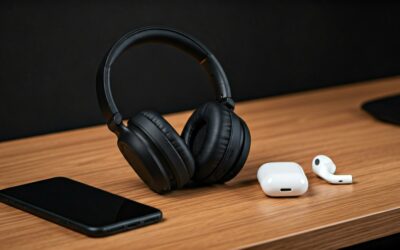
It is not recommended. Bluetooth latency (the delay between the sound happening and reaching your ears) is too high for professional performance. Furthermore, the “colored” sound profile of consumer headphones can lead to poor mixing decisions.
Do headphones damage a musician’s hearing?
If used incorrectly, yes. However, because IEMs block out external noise, musicians can actually listen at lower volumes than they would need with loud floor speakers. This makes them a vital tool for preventing tinnitus.
Why do some musicians wear headphones during a live radio session?
In a radio or podcast studio, the microphones are extremely sensitive. Headphones allow the musicians to hear the “broadcast mix”—exactly what the listeners at home are hearing—including any effects like reverb or compression applied by the station’s engineer.
What is the difference between open-back and closed-back headphones for musicians?
Closed-back headphones have a solid outer shell to prevent sound leakage (perfect for recording). Open-back headphones have a perforated shell that allows air and sound to move freely, creating a more natural “soundstage” (perfect for mixing).