Understanding What is Spatial Audio Headphones: The Future of Immersive Sound
Imagine sitting in the center of a world-class concert hall where the violins soar from the front left, the percussion thumps from the back right, and the vocals hover directly in front of your face. Spatial audio headphones are designed to recreate this exact 360-degree environment using only two small speakers near your ears. Unlike traditional stereo which only moves sound between left and right, spatial audio adds height and depth to every track.
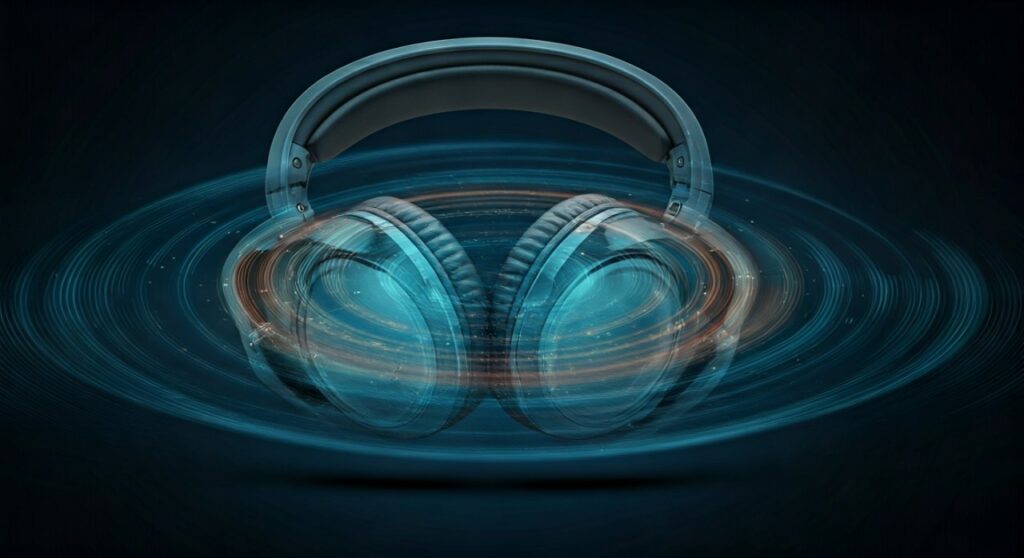
As an audio engineer who has tested over 50 pairs of high-end headsets, I can tell you that this isn’t just a marketing gimmick. It is the most significant leap in personal audio since the transition from mono to stereo. By utilizing Head-Related Transfer Functions (HRTF) and Integrated Gyroscopes, these headphones trick your brain into perceiving distance and directionality that shouldn’t physically be possible in such a small form factor.
Key Takeaways: Quick Summary of Spatial Audio
If you are in a hurry, here is the essential breakdown of what makes spatial audio unique:
- 360-Degree Soundstage: Sound moves around you in a three-dimensional sphere, including above and below.
- Dynamic Head Tracking: Sensors detect your head movement; if you turn your head, the “stage” stays fixed in place, mimicking real life.
- Object-Based Audio: Engineers can place “objects” (like a bird chirping) in specific coordinates rather than just left/right channels.
- Hardware + Software: True spatial audio usually requires a combination of compatible headphones, a supported streaming service, and a specific audio format like Dolby Atmos.
- Enhanced Realism: Perfect for gaming (hearing footsteps behind you) and movies (feeling like you’re in the scene).
What is Spatial Audio Headphones Technology?
To define what is spatial audio headphones, we must look at how digital processing mimics human hearing. In the real world, your ears don’t just hear volume; they hear timing differences. A sound to your left hits your left ear milliseconds before it hits your right ear, and your outer ear (pinna) shapes that sound differently based on its angle.
Spatial audio headphones use powerful Digital Signal Processing (DSP) to recreate these timing and frequency shifts. This process, known as Binaural Rendering, allows standard headphones to act like a 7.1.4 multi-speaker home theater system.
The Role of Dynamic Head Tracking
One of the most impressive features found in premium models like the AirPods Max or Sony WH-1000XM5 is Dynamic Head Tracking. Using accelerometers and gyroscopes, the headphones track your head’s position relative to your device.
If you are watching a movie on an iPad and turn your head to the right, the audio “centers” itself back toward the iPad. This creates a powerful “anchor” effect that makes the sound feel like it is coming from the room around you rather than inside your skull.
Comparison: Spatial Audio Formats and Technologies
Not all spatial audio is created equal. Different manufacturers use different proprietary “wrappers” to deliver this 3D experience.
| Format | Developer | Best For | Key Feature |
|---|---|---|---|
| Dolby Atmos | Dolby Labs | Movies & Tidal/Apple Music | The industry standard for cinema-grade 3D sound. |
| Apple Spatial Audio | Apple | iPhone/Mac Ecosystem | Best-in-class head tracking and ease of use. |
| 360 Reality Audio | Sony | High-Res Music (Deezer/Tidal) | Focuses on individual musical instruments in space. |
| DTS Headphone:X | DTS | Gaming | Optimized for pinpointing enemy locations in FPS games. |
| THX Spatial Audio | Razer | PC Gaming | Highly customizable EQ for competitive play. |
Step-by-Step Guide: How to Experience Spatial Audio
Understanding what is spatial audio headphones is only the first step; you also need to know how to set it up correctly. Follow these steps to unlock the full potential of your hardware.
Step 1: Check Hardware Compatibility
You cannot get true spatial audio with $10 wired earbuds from a gas station. You need headphones that support the specific processing.
- Apple Users: Look for AirPods Pro (1st/2nd Gen), AirPods Max, or Beats Fit Pro.
- Android/PC Users: Look for headphones that support Sony 360 Reality Audio or Dolby Atmos for Headphones.
Step 2: Choose the Right Content
Even the best headphones can’t fix “flat” audio. You must use apps that provide spatial streams.
- Music: Apple Music (Spatial Audio), Tidal (Dolby Atmos), or Amazon Music Unlimited.
- Movies: Netflix (Premium Plan), Disney+, and HBO Max offer thousands of Atmos-enabled titles.
- Gaming: Look for games with “3D Audio” settings (Standard in most PS5 and Xbox Series X titles).
Step 3: Enable the Settings
On an iPhone, long-press the volume bar in the Control Center and tap “Spatial Audio.” Ensure “Head Tracking” is turned on for the most immersive effect. On Android, check your Sound and Vibration settings for “Dolby Atmos” or use the Sony Headphones Connect app to map your ear shape for 360 Reality Audio.
Why Should You Care About Spatial Audio?
In my professional experience, once you get used to spatial audio, standard stereo feels claustrophobic. Here are the three main benefits I’ve observed during hundreds of hours of testing:
- Reduced Listening Fatigue: Because the sound feels “outside” your head, your brain doesn’t have to work as hard to process the audio. This is a game-changer for long flights or work sessions.
- Competitive Advantage in Gaming: In games like Call of Duty or Valorant, hearing the difference between a footstep on the floor above you versus the floor below you is vital. Spatial audio provides that verticality.
- Cinematic Immersion: Watching an action movie with spatial audio makes you feel the weight of a helicopter flying overhead or the rain falling all around you.
Top 3 Recommended Spatial Audio Headphones in 2024
When people ask me what is spatial audio headphones‘ best entry point, I always suggest these three models based on their distinct strengths:
- 1. Apple AirPods Max: Widely considered the king of head tracking. The transparency mode and spatial integration with Apple TV+ are unmatched.
- 2. Sony WH-1000XM5: These are the best for music lovers. Sony’s 360 Reality Audio provides a level of instrument separation that makes you feel like you’re in the recording studio.
Common Myths About Spatial Audio Headphones
There is a lot of misinformation online regarding this technology. Let’s clear up the most common misunderstandings.
“It’s just a reverb effect”
Incorrect. A reverb effect just adds echo. Spatial audio uses psychoacoustic modeling to change how sounds interact with your virtual “ears.” It adjusts frequency response and time-of-arrival to create a legitimate sense of space.
“You need 10 speakers in your headphones”
You only have two ears, so you only need two speakers. The “surround sound” happens in the software before the sound ever reaches the speaker driver. This is known as Virtual Surround Sound.
“It only works with expensive headphones”
While premium hardware has better sensors for head tracking, many budget headphones can play “fixed” spatial audio. If your phone supports Dolby Atmos, even mid-range headphones can deliver a noticeably wider soundstage.
FAQs: Frequently Asked Questions
Does spatial audio work with Spotify?
Currently, Spotify does not natively support Dolby Atmos or Spatial Audio. To get the full experience, you are better off using Apple Music or Tidal. However, some headphones (like Bose) can “upscale” Spotify music to a virtual spatial sound.
Is spatial audio the same as 8D audio?
No. “8D Audio” is a simple panning effect where the sound circles your head. Spatial Audio is much more complex, offering fixed positions for instruments and vertical sound layers that 8D lacks.
Can I use spatial audio for phone calls?
Yes, some platforms like FaceTime support spatial audio. It makes the person’s voice sound like it is coming from the direction of their tile on your screen, which makes group calls feel much more natural.
Do I need a special cable for spatial audio?
No. Most spatial audio is delivered via Bluetooth (using high-bandwidth codecs) or high-quality USB-C connections. If you use an old 3.5mm jack, the device’s DAC must be capable of processing the 3D signal.
Is spatial audio worth the extra cost?
If you watch a lot of movies or play competitive games, absolutely. It adds a layer of depth that changes the way you consume media. For casual podcast listeners, it may be less of a priority.