The Reality: Are AirPods Max Good Studio Headphones?
Are AirPods Max good studio headphones? The short answer is: No, they are not suitable for professional mixing or mastering because they lack a flat frequency response and introduce significant digital signal processing (DSP). However, they are excellent secondary tools for monitoring Spatial Audio, testing Dolby Atmos mixes, and cross-referencing how your music sounds on high-end consumer hardware.
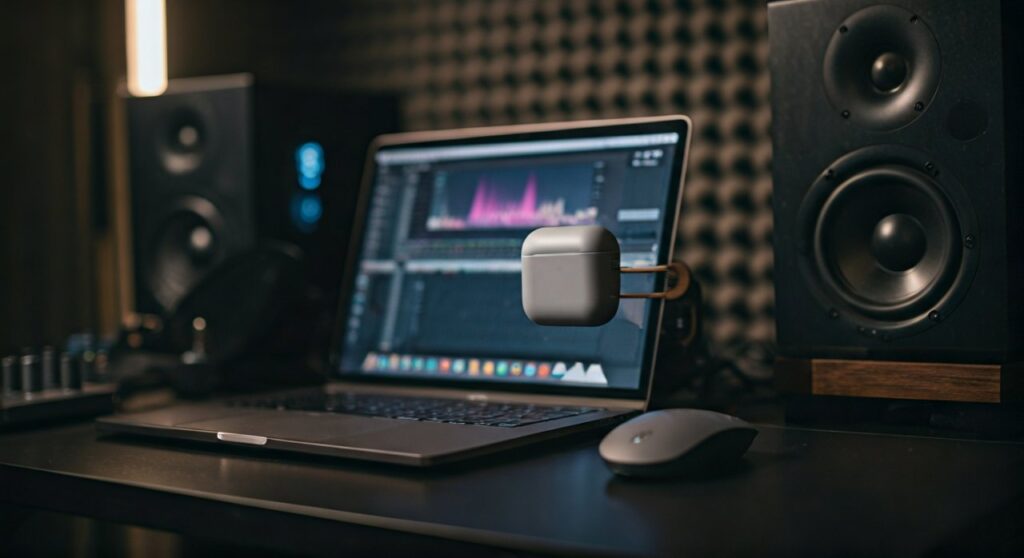
While a traditional studio engineer requires transparency, the AirPods Max are designed for “enjoyment.” This creates a “colored” sound that can mask flaws in your mix. If you are looking for your primary pair of production cans, industry standards like the Sennheiser HD 600 or Beyerdynamic DT 1990 Pro remain superior choices for accuracy.
Key Takeaways: AirPods Max in the Studio
If you’re in a hurry, here is the essential breakdown of how the Apple AirPods Max perform in a professional audio environment:
- Best Use Case: Cross-referencing mixes and monitoring Spatial Audio/Dolby Atmos projects.
- The “Dealbreaker”: The H1 chips use computational audio that cannot be fully turned off, meaning you never hear the “raw” audio.
- Connectivity Issues: Even when wired with the Lightning to 3.5mm cable, the audio undergoes an Analog-to-Digital conversion, preventing a true lossless analog path.
- Comfort: Exceptional build quality with breathable mesh, but the 385-gram weight can cause neck fatigue during 8-hour sessions.
- The Verdict: They are world-class consumer headphones, but mid-tier studio tools at best.
Why Frequency Response Matters for Producers
In a professional studio, the goal is “translation.” You want a mix that sounds good on a phone, in a car, and at a club. To achieve this, you need flat frequency response headphones.
AirPods Max feature a frequency response that is slightly “V-shaped.” This means the bass is emphasized, and the highs are boosted to provide clarity and excitement. While this makes Spotify playlists sound incredible, it is dangerous for a producer.
If your headphones boost the bass for you, you will likely turn the bass down in your mix. When a listener plays your track on standard speakers, the mix will sound thin and weak. Professional studio monitors aim for a “neutral” profile so you can hear the ugly truths of your recording.
The Computational Audio Conflict
The biggest hurdle in answering are AirPods Max good studio headphones lies in the Apple H1 chip. Most studio headphones are “passive,” meaning they just vibrate a diaphragm based on the electrical signal.
The AirPods Max are “active.” They use Computational Audio to:
- Adjust EQ in real-time based on the fit and seal of the ear cushions (Adaptive EQ).
- Cancel external noise using multiple microphones (ANC).
- Model a 3D space via Spatial Audio.
For a mixing engineer, these features are “moving targets.” You cannot make precise EQ moves if the headphones are changing their own internal EQ 200 times per second to compensate for your head movement.
Comparing AirPods Max to Industry Standards
To understand where these headphones sit, we must compare them to the legends found in studios like Abbey Road or Sterling Sound.
| Feature | AirPods Max | Sennheiser HD 650 | Beyerdynamic DT 770 Pro |
|---|---|---|---|
| Sound Profile | Colored / Consumer-tuned | Neutral / Mid-forward | Clinical / Bright |
| Driver Type | 40mm Dynamic (Active) | 42mm Dynamic (Passive) | 45mm Dynamic (Passive) |
| Connection | Bluetooth / Lightning (Digital) | 1/4″ or 3.5mm (Analog) | 1/4″ or 3.5mm (Analog) |
| Open/Closed | Closed-back | Open-back | Closed-back |
| Primary Use | Travel / Spatial Audio | Mixing / Mastering | Tracking / Recording |
| Price (MSRP) | $549 | $399 | $169 |
As the table shows, the AirPods Max are significantly more expensive while offering less “honesty” in sound reproduction compared to the Sennheiser or Beyerdynamic options.
The Latency Problem in Recording
If you are a vocalist or a guitarist, latency is your worst enemy. Bluetooth 5.0, which the AirPods Max use, has a delay of approximately 150ms to 200ms.
In a recording session, this means you will hear your voice in your ears a fraction of a second after you speak. This makes it impossible to stay on beat. Even with the Apple Lightning to 3.5mm Audio Cable, there is a tiny amount of latency due to the internal conversion process.
For tracking (recording), you should always use wired, high-impedance headphones that connect directly to your Audio Interface (like a Focusrite Scarlett or Universal Audio Apollo).
When Are AirPods Max the Best Headphones for Producers?
It isn’t all bad news. In fact, many Grammy-winning producers keep a pair of AirPods Max on their desk. Here is why:
Mastering for the “Real World”
Most of your listeners will be using AirPods. By checking your mix on AirPods Max, you can hear exactly what your target audience will hear. If the bass is “muddy” on the Max, you know you need to clean up the low-end for consumer devices.
Spatial Audio and Dolby Atmos
Apple is the leader in Spatial Audio. If you are mixing a project in Dolby Atmos within Logic Pro, the AirPods Max are arguably the best tool for monitoring how the head-tracking and object-based audio will behave for the end-user.
Noise Isolation in Loud Environments
If you are a mobile producer working in coffee shops or on planes, the Active Noise Cancellation (ANC) on the AirPods Max is world-class. It allows you to focus on your arrangement and song structure in environments where traditional open-back studio headphones would be useless.
Technical Limitations: Wired vs. Wireless
A common misconception is that plugging in the AirPods Max turns them into “normal” headphones. This is false.
Because the AirPods Max do not have a 3.5mm jack, you must use the Apple-branded Lightning to 3.5mm cable. This cable is directional and contains a built-in ADC (Analog-to-Digital Converter).
- The signal goes out of your interface (Analog).
- The cable converts it to Digital.
- The headphones convert it back to Analog.
Each conversion stage introduces a slight loss in signal integrity and adds a “floor” of digital noise. For high-fidelity mastering, this is unacceptable.
Comfort and Build Quality for Long Sessions
The AirPods Max are built like a luxury watch. The stainless steel frame and acoustically engineered memory foam cushions feel premium.
However, in a studio setting, weight is a factor.
- AirPods Max: 385 grams.
- Sennheiser HD 600: 260 grams.
After 4 hours of surgical EQing, that extra 125 grams feels like a lead weight on your skull. However, the breathable knit mesh on the headband does an excellent job of preventing “hot spots” on the top of the head, a common complaint with the Sony WH-1000XM5.
Expert Tips for Using AirPods Max in Your Workflow
If you already own them and want to incorporate them into your music production, follow these professional tips:
- Disable Spatial Audio while Mixing: Always keep the output in “Stereo” to ensure you are hearing the correct phase relationships of your tracks.
- Use “Transparency Mode” for Communication: If you are working with a partner in the room, Transparency Mode allows you to talk naturally without removing the headphones.
- Calibration Software: Use a plugin like Sonarworks SoundID Reference. While it can’t fix the DSP entirely, it can apply a calibration curve to make the AirPods Max sound much flatter and more accurate.
- Final Polish Check: Use them only for the last 5% of your project. Do the heavy lifting on monitors or open-back cans.
Frequently Asked Questions (FAQs)
Can I use AirPods Max for professional mixing?
You can use them to cross-reference, but they are not recommended as your primary mixing tool. Their computational audio and non-flat frequency response make it difficult to achieve a mix that translates well to other systems.
Is the wired connection for AirPods Max lossless?
No. Because the Lightning-to-3.5mm cable involves an analog-to-digital conversion, the signal is not truly “lossless” or “pure analog.” It is, however, much higher quality than Bluetooth.
Do professional producers use AirPods Max?
Yes, many top producers use them to test their tracks. Since millions of consumers listen to music on Apple devices, engineers use them to ensure the “Apple version” of their mix sounds perfect.
Are AirPods Max better than the Sony WH-1000XM5 for the studio?
The AirPods Max have a slightly more “natural” timbre and better build quality, but the Sony XM5s offer more control over the EQ via their app. Neither is a “true” studio headphone, but the AirPods Max are superior for Spatial Audio workflows.
Will AirPods Max work with my Windows PC or Audio Interface?
Yes, but you will need the specific Apple Lightning to 3.5mm Audio Cable ($35) to connect to an audio interface. If using Bluetooth on Windows, you may experience significant latency and lower audio codec quality compared to using them with a Mac.