

The Real Truth: Are Bigger Driver Better for Headphones?
Many audio enthusiasts assume that a larger driver automatically translates to superior sound quality, but the reality is more complex. Are bigger driver better for headphones? The short answer is no; while larger drivers can move more air and produce deeper bass, the overall sound quality depends more on driver material, magnet strength, and acoustic tuning.
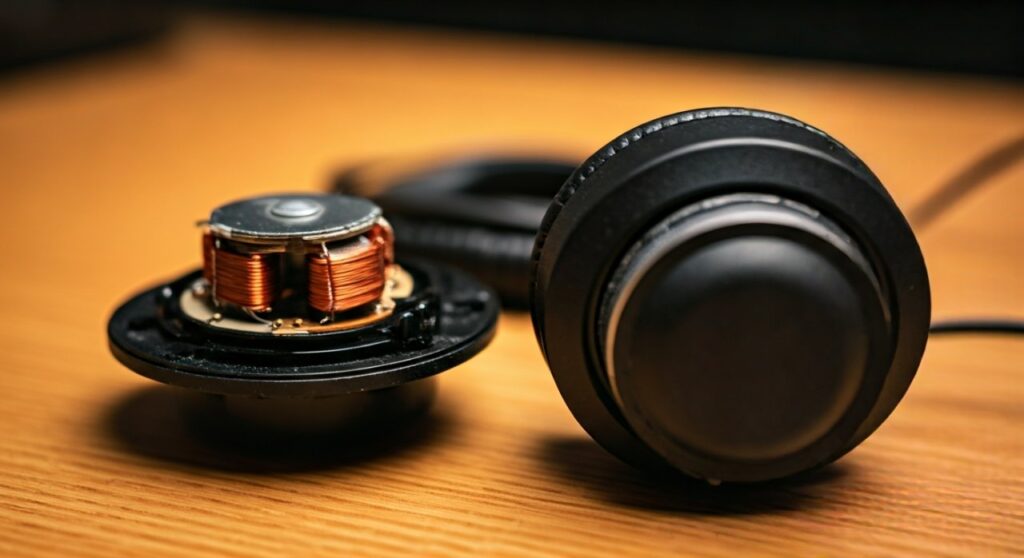
In my years testing high-end audio gear, I have found that a well-engineered 40mm driver can easily outperform a poorly designed 50mm driver in terms of clarity and detail. Driver size is just one piece of a much larger engineering puzzle that includes impedance, sensitivity, and frequency response.
Key Takeaways: Driver Size vs. Sound Quality
If you are in a hurry, here is the essential breakdown of how driver size affects your listening experience:
- Bass Performance: Larger drivers (50mm+) generally displace more air, leading to more effortless sub-bass extension.
- Detail and Speed: Smaller drivers (under 40mm) often have less mass, allowing them to move faster and reproduce high-frequency transients with greater precision.
- Comfort vs. Sound: Bigger drivers require larger earcups, which can improve the soundstage but may lead to a heavier, less comfortable headset.
- Quality over Quantity: The diaphragm material (e.g., Beryllium, Bio-cellulose, or PET) is more critical for “High-Fidelity” than the diameter itself.
- Distortion: Large, cheaply made drivers are prone to diaphragm breakup, causing distortion at high volumes.
Understanding the Role of the Headphone Driver
The driver is the heart of your headphones, acting as the transducer that converts electrical signals into audible sound waves. It consists of a permanent magnet, voice coils, and a diaphragm.
When the electrical current passes through the voice coil, it creates a magnetic field that interacts with the permanent magnet. This causes the diaphragm to vibrate rapidly, pushing air and creating the sound waves your ears perceive.
While size determines how much air can be pushed, the efficiency of this movement determines the “texture” and “accuracy” of the music. In my experience, focusing solely on “mm” specs is the most common mistake beginners make when buying audiophile gear.
Benefits of Larger Drivers in Headphones
There are specific physical advantages to increasing the surface area of a diaphragm. If you enjoy cinematic soundscapes or EDM, these factors matter.
Superior Air Displacement and Bass
To produce low-frequency sounds (bass), a driver must move a significant volume of air. A 50mm driver has roughly 56% more surface area than a 40mm driver.
This allows the headphone to reach lower frequencies without the diaphragm having to travel as far (excursion). This often results in a “cleaner” bass hit that feels more physical and less “strained.”
Wider Soundstage and Imaging
Larger drivers are usually housed in larger earcups. This physical space allows the sound waves to interact with your pinna (outer ear) more naturally.
Models like the Sennheiser HD800S use massive 56mm drivers tilted at an angle. This design creates a “holographic” soundstage where you can pinpoint exactly where each instrument is located in a 3D space.
Lower Total Harmonic Distortion (THD)
Because a large driver doesn’t need to vibrate as violently to achieve high volumes, it often maintains better linear motion. This reduces Total Harmonic Distortion (THD), ensuring the music stays clear even when you turn the volume up.
Why Bigger Drivers Are Not Always Better
Despite the advantages, bigger isn’t always “better” in the world of acoustics. There are significant trade-offs that engineers must manage.
The Problem of Diaphragm Mass and Inertia
A larger diaphragm is naturally heavier. In physics, more mass means more inertia, making it harder for the driver to start and stop moving instantly.
In my testing of various Planar Magnetic vs. Dynamic drivers, I noticed that heavy, large dynamic drivers sometimes struggle with “speed.” This can make high-frequency sounds like cymbals or acoustic guitar plucks sound “smeary” or “veiled.”
Diaphragm Break-up Modes
When a large diaphragm vibrates at very high frequencies, it doesn’t always move as a single, rigid unit. Parts of the surface may vibrate out of sync, a phenomenon known as break-up.
To combat this, manufacturers must use expensive materials like Titanium coating or Beryllium. If a brand uses a cheap plastic 50mm driver, it will likely sound worse than a high-quality 30mm driver used in professional In-Ear Monitors (IEMs).
Comparison: Driver Size Across Different Headphone Types
| Headphone Category | Typical Driver Size | Primary Benefit | Common Trade-off |
|---|---|---|---|
| In-Ear Monitors (IEMs) | 6mm – 12mm | Incredible detail and isolation | Limited “physical” bass impact |
| On-Ear (Supra-aural) | 30mm – 40mm | Portability and mid-range clarity | Can leak sound; less sub-bass |
| Over-Ear (Circumaural) | 40mm – 50mm | Balanced performance; versatile | Can be bulky or heavy |
| Audiophile/Planar | 50mm – 100mm+ | Massive soundstage; linear bass | Requires a dedicated amplifier |
Factors That Matter More Than Driver Size
If you want the best audio experience, stop looking at the “mm” count and start looking at these professional specifications.
Diaphragm Material
The “recipe” of the diaphragm determines how it handles resonance. Bio-cellulose (found in many Fostex headphones) offers a warm, natural sound. Beryllium (used in Focal headphones) is incredibly stiff and light, offering near-perfect accuracy.
Magnet Strength (Flux Density)
Higher-quality magnets, like Neodymium (N52), provide better control over the driver. This “grip” allows for tighter bass and faster transients, regardless of size.
Acoustic Chamber Design
Whether a headphone is Open-Back or Closed-Back affects the sound more than the driver size. An open-back 40mm headphone will almost always have a wider soundstage than a closed-back 50mm headphone.
Tuning and Frequency Response
Manufacturers tune headphones to follow specific “target curves” (like the Harman Curve). A 50mm driver tuned poorly will sound muddy, while a 40mm driver tuned by experts (like those at Sennheiser or Beyerdynamic) will sound “hi-fi.”
Amplifier Pairing
Large drivers often have higher Impedance (measured in Ohms). If you plug a 300-ohm, 56mm driver headphone into a smartphone, it will sound thin and quiet. You need a DAC/AMP to provide the voltage necessary to move that large diaphragm properly.
Step-by-Step Guide: How to Choose Headphones (Beyond the Specs)
Don’t let marketing jargon about “XL Drivers” fool you. Follow these steps to find your perfect pair.
Step 1: Identify Your Preferred Sound Signature
Do you like “V-shaped” sound (heavy bass and treble) or a “Neutral” sound? If you want heavy bass, a 50mm dynamic driver is a good starting point. If you want vocal clarity, look for multi-driver IEMs or high-quality 40mm drivers.
Step 2: Check the Impedance (Ohms)
- Under 32 Ohms: Great for mobile use and laptops.
- Over 100 Ohms: You will need an external amplifier to hear the driver’s full potential.
Step 3: Research the Driver Type
- Dynamic: The most common. Great for bass.
- Planar Magnetic: Uses a flat thin film. Incredible for low-distortion and speed. Usually very large (70mm+).
- Electrostatic: The pinnacle of detail, but requires a special “Energizer” power supply.
Step 4: Prioritize Comfort and Weight
A massive driver often means a heavy headphone. If you plan to wear them for 8 hours a day, a 300g headphone with 40mm drivers is better than a 500g monster with 60mm drivers.
Step 5: Read Independent Frequency Response Graphs
Look for reviews that show a “Frequency Response Graph.” This tells you the objective truth about how much bass, mids, and treble the driver actually produces, regardless of its size.
Real-World Examples: Size vs. Performance
To illustrate this, let’s look at two iconic headphones I have used extensively:
- Sony WH-1000XM5: Uses a 30mm driver. Despite being smaller than its predecessor (which had 40mm), it uses a carbon fiber composite that is stiffer and lighter, resulting in much better high-frequency clarity.
- Sennheiser HD600: Uses a 42mm driver. Even though it is decades old and has a “modest” size, it is still considered the gold standard for mid-range “naturalness” and vocal accuracy.
These examples prove that are bigger headphone drivers better is a myth—innovation in materials often beats raw size.
FAQs: Common Questions About Driver Size
Does a bigger driver mean louder volume?
No. Volume is determined by Sensitivity (measured in dB/mW) and Impedance. A small, sensitive earbud can reach ear-damaging volumes much easier than a large, high-impedance audiophile headphone.
Are 50mm drivers better for gaming?
For gaming, Imaging (the ability to hear footsteps) is more important than driver size. While 50mm drivers can provide immersive explosions, a high-quality 40mm driver with an open-back design usually provides better directional accuracy.
Why do some IEMs have 10+ drivers?
In-ear monitors often use Balanced Armature drivers. These are very small and only handle specific frequency ranges (one for bass, one for mids, one for highs). By splitting the work, they achieve a level of detail that a single large driver struggle to match.
Can a small driver produce deep bass?
Yes, but it requires a perfect “seal” in your ear canal. This is why IEMs can produce sub-bass that you “feel” inside your head, despite having drivers as small as 6mm.
Is there a “perfect” size for drivers?
For over-ear headphones, 40mm to 45mm is generally considered the “sweet spot” where you get a balance of bass extension, quick transient response, and manageable weight.









