Understanding the Headphone Game: Audiophilia vs. Social Play
The headphone game primarily refers to the obsessive pursuit of high-fidelity audio through the constant upgrading of headphones, amplifiers, and digital-to-analog converters (DACs). In a secondary context, it also refers to a popular social party game known as the Whisper Challenge, where players guess phrases while wearing noise-canceling headphones.
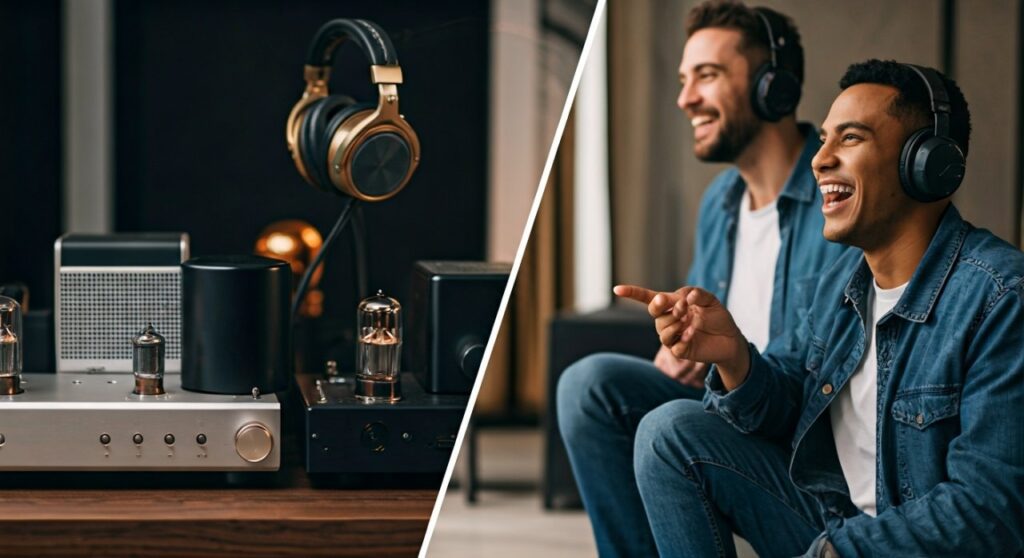
Whether you are looking to build a high-end “endgame” audio setup or just want to know how to play the viral party game with friends, this guide covers the mechanics of both. Understanding the headphone game requires a mix of technical knowledge regarding sound signatures and a practical approach to social entertainment.
Key Takeaways: The “Headphone Game” at a Glance
If you are looking for a quick summary of what this term encompasses, refer to the table below for the two distinct definitions.
| Feature | The Audiophile Hobby (Gear Game) | The Social Party Game (Whisper Challenge) |
|---|---|---|
| Primary Goal | Achieving “perfect” sound reproduction. | Guessing a phrase by lip-reading. |
| Key Equipment | DACs, Amps, Planar Magnetic drivers. | Noise-canceling headphones, loud music. |
| Common Terms | Soundstage, Imaging, Endgame. | Lip-reading, Silent shout. |
| Difficulty | High (Technical & Financial). | Low (Fun & Accessible). |
| Community | r/headphones, Head-Fi, Audiogon. | YouTube, TikTok, Family gatherings. |
The Audiophile Perspective: What is the Gear Game?
In the world of high-end audio, the headphone game is a metaphorical “game” of strategy, budgeting, and critical listening. It involves a “rabbit hole” where enthusiasts constantly seek better clarity, a wider soundstage, and more accurate imaging.
For many, the game starts with a simple pair of consumer headphones and escalates into owning specialized equipment like Electrostatic drivers or Open-back headphones. I have spent over a decade testing gear from Sennheiser, HIFIMAN, and Focal, and I can tell you that the “game” is as much about the journey as it is about the final sound.
The Concept of the “Endgame”
The “Endgame” is a term used to describe a setup so perfect that the user no longer feels the need to upgrade. However, in the headphone game, the endgame is often a moving target. New technologies, such as Beryllium drivers or advanced DSP (Digital Signal Processing), constantly tempt users to reach for the next level of performance.
How to Enter the Audiophile Headphone Game (Step-by-Step)
Entering the hobby can be overwhelming due to the technical jargon and wide range of available gear. Follow these steps to start your journey without wasting time on “fluff” gear.
Step 1: Identify Your Preferred Sound Signature
Before buying anything, you must understand what kind of sound you enjoy. Use a basic equalizer on your current headphones to see if you prefer:
- Warm/Bassy: Emphasized lows for a “fun” sound (e.g., Meze 99 Classics).
- Neutral/Flat: Accurate reproduction, often used for professional mixing (e.g., Sennheiser HD600).
- Bright/Treble-focused: High detail and “sparkle,” but can be fatiguing (e.g., Beyerdynamic DT 1990 Pro).
Step 2: Choose Your Driver Type
The “heart” of the headphone determines how the air moves to create sound.
- Dynamic Drivers: The most common; great for bass and punch.
- Planar Magnetic: Uses a thin film; offers incredible speed and low distortion.
- Electrostatic: Requires specialized energizers; provides the ultimate in transparency.
Step 3: Build Your “Signal Chain”
A headphone is only as good as the signal it receives. To truly play the headphone game, you need three components:
- The Source: Lossless files (FLAC) or high-res streaming like Tidal or Qobuz.
- The DAC: Converts digital 0s and 1s into an analog signal.
- The Amplifier: Provides the power (voltage and current) to drive the headphones, especially high-impedance models.
Step 4: Explore Open-Back vs. Closed-Back
Most “serious” players in the game prefer Open-back headphones. These allow air to pass through the ear cups, resulting in a more natural, “out-of-head” experience. Closed-back headphones are better for isolation and deep bass but often have a “boxed-in” sound.
The Social Context: How to Play the Headphone Party Game
If you aren’t here for the gear, you’re likely looking for the Whisper Challenge. This game became a viral sensation on talk shows and YouTube. It is a test of lip-reading and non-verbal communication.
Rules of the Party Game
- The Setup: One player puts on noise-canceling headphones with music playing at a volume loud enough to mask outside voices.
- The Phrase: A second player whispers or speaks a specific phrase (e.g., “The quick brown fox jumps over the lazy dog”).
- The Guess: The player wearing the headphones must guess the phrase solely by reading the other person’s lips.
- The Scoring: Points are awarded for correct guesses or the fewest attempts needed to get the phrase right.
Best Equipment for the Party Game
To play this effectively, you don’t need audiophile gear. You need Active Noise Cancellation (ANC).
- Sony WH-1000XM5: Widely considered the king of noise cancellation.
- Apple AirPods Max: Excellent transparency and noise-blocking modes.
- Bose QuietComfort Ultra: Best-in-class comfort for long gaming sessions.
Technical Deep Dive: Understanding Impedance and Sensitivity
In the professional headphone game, numbers matter. If you buy high-end headphones like the Sennheiser HD800S, you can’t just plug them into a smartphone and expect greatness.
Impedance (Ohms)
Impedance is the electrical resistance of the headphones.
- Low Impedance (16-32 Ohms): Easy to drive; works with phones and laptops.
- High Impedance (250-600 Ohms): Requires a dedicated Headphone Amplifier to reach listenable volumes and maintain sound quality.
Sensitivity (dB/mW)
Sensitivity measures how loud the headphones get at a specific power level. A headphone with low sensitivity (e.g., HIFIMAN Susvara) is notoriously difficult to drive, even if its impedance isn’t extremely high. Mastering the balance between power and sensitivity is a hallmark of an expert in the headphone game.
Comparing Budget vs. Mid-Fi vs. Summit-Fi
To help you navigate your choices, I have categorized the “levels” of the headphone game based on industry standards and personal testing.
| Tier | Target Audience | Example Gear |
|---|---|---|
| Entry Level | Beginners / Casual | Philips SHP9500, Moondrop Aria |
| Mid-Fi | Serious Enthusiasts | Sennheiser HD660S2, HIFIMAN Edition XS |
| Summit-Fi | Collectors / Professionals | Focal Utopia, Audeze LCD-5 |
| The “Stack” | Everyone in the hobby | JDS Labs Atom, Schiit Magni/Modi |
The Psychology of Information Gain in Audio
Why do people invest so heavily in the headphone game? It comes down to Information Gain—the ability to hear details in music that were previously hidden.
When you move from a basic earbud to a capable planar magnetic headphone, you begin to hear the “texture” of a cello string or the faint breath of a singer before a verse. This “micro-detail” is the drug that keeps the hobby alive.
However, be wary of diminishing returns. The jump between entry-level and mid-range gear can be massive. The jump between premium and flagship equipment is often subtle and only perceivable to highly trained ears.
Common Pitfalls to Avoid in the Headphone Game
As an expert who has made every mistake in the book, here is my advice for newcomers:
- Don’t buy for the brand name: Many “gaming” brands focus on RGB lights rather than sound quality. Stick to audio-first companies like Beyerdynamic or Audio-Technica.
- Ignore the “Burn-in” Myth (mostly): While some mechanical stabilization occurs, don’t expect a headphone you hate on day one to sound magical after 100 hours of “burn-in.”
- Comfort is King: It doesn’t matter if a headphone sounds like heaven if it feels like a vice on your head. Always check the weight (measured in grams) before buying.
- Cables don’t change sound: Unless a cable is broken or poorly shielded, investing in a “silver-plated” cable is a waste of resources that could go toward better drivers.
Frequently Asked Questions (FAQs)
What does “soundstage” mean in the headphone game?
Soundstage refers to the perceived spatial extent of the audio. A “wide” soundstage makes it feel like the music is coming from speakers in a large room rather than from inside your ears. Open-back headphones are famous for having a superior soundstage.
Do I need an amp for all headphones?
No. Most consumer headphones (under 32 Ohms) are designed to be “high sensitivity” and work perfectly with standard jacks. You only need an amplifier if your headphones have high impedance or low sensitivity, resulting in low volume or “thin” sound when plugged into a phone.
Is the “Whisper Challenge” the same as the headphone game?
In social media contexts, yes. If you see a video titled “The Headphone Game,” it is almost certainly people trying to guess phrases while wearing noise-canceling gear. In audiophile forums, it refers to the hobby of collecting gear.
What is the best “bang for buck” in the headphone game?
Currently, the HIFIMAN Sundara or the Sennheiser HD560S are considered the gold standards for “entry-level” audiophiles. They offer a level of detail that competes with far more expensive headphones.
Are wireless headphones good for the audiophile headphone game?
Wireless headphones (Bluetooth) usually involve compression, which loses some audio data. While models like the Sony WH-1000XM5 are great for convenience and the “party game,” they are generally not used for critical listening in the “gear game” compared to wired, high-resolution setups.