Are Bass Headphones Bad for Your Ears? The Direct Answer
Are bass headphones bad for ears? The short answer is no, bass frequencies themselves are not inherently damaging, but the way we listen to them often is. Because human ears are less sensitive to low-end frequencies, listeners frequently crank the volume to “feel” the vibration, leading to Noise-Induced Hearing Loss (NIHL) and permanent tinnitus.
If you maintain a volume level below 85 decibels (dB), bass-heavy headphones are perfectly safe. However, the physical pressure from “bass boost” features and the seal of In-Ear Monitors (IEMs) can accelerate ear fatigue and potentially damage the delicate stereocilia (hair cells) in your inner ear if used excessively.
Key Takeaways: Safe Bass Listening at a Glance
| Feature | Impact on Ear Health | Safety Recommendation |
|---|---|---|
| High Volume (90dB+) | High Risk of permanent hearing loss | Keep volume at or below 60% capacity. |
| Sub-bass Frequencies | Low Risk (if volume is controlled) | Use EQ to balance rather than just boosting volume. |
| In-Ear Bass Buds | High Risk due to air pressure | Ensure a proper fit and take frequent breaks. |
| Over-Ear Headphones | Lower Risk (better soundstage) | Opt for open-back or high-quality ANC models. |
| Listening Duration | Cumulative Risk of ear fatigue | Follow the 60/60 Rule (60% volume for 60 mins). |
The Science of Sound: Why Bass Feels Different
To understand if are bass headphones bad for ears, we have to look at how sound waves interact with our anatomy. Bass consists of long, low-frequency sound waves (usually between 20Hz and 250Hz). Unlike high-pitched sounds that hit the ear drum sharply, bass waves provide a physical sensation known as bone conduction.
As an audio specialist who has tested hundreds of units from Sony, Bose, and Sennheiser, I have observed a common trend. Listeners often feel that the music isn’t “loud enough” because they cannot feel the bass “thump” in their chest like they would at a live concert. This leads to the “Volume Trap.”
The Fletcher-Munson Curve
Our ears do not perceive all frequencies equally. According to the Fletcher-Munson Curve, human hearing is most sensitive to mid-range frequencies (like human speech). We are naturally less sensitive to extreme lows.
When you use bass headphones, you are essentially fighting your ear’s natural physics. To hear that deep sub-bass clearly, you might push the volume to 100dB or more. At this level, the high-frequency components of the song—which you are sensitive to—become dangerously loud, causing immediate microscopic damage to your cochlea.
Step-by-Step Guide: How to Listen to Bass Safely
If you love EDM, Hip-Hop, or cinematic scores, you don’t have to give up your favorite gear. Follow these expert-verified steps to protect your hearing while enjoying deep low-end.
Step 1: Calibrate Your Baseline Volume
Don’t start your listening session at a high volume. Your brain undergoes auditory adaptation, meaning it gets used to loud sounds and begins to crave more.
- Start at 0% volume.
- Slowly increase until the bass is audible but you can still hear a finger snap next to your ear.
- Check your smartphone’s Headphone Safety settings (found in iOS and Android) to set a hard limit at 85 dB.
Step 2: Use the 60/60 Rule
Audiologists worldwide recommend the 60/60 Rule to prevent ear fatigue. This is a non-negotiable habit for heavy bass users.
- Listen at no more than 60% of the maximum volume.
- Remove your headphones for at least 10 minutes after 60 minutes of listening.
- This break allows the stereocilia in your ears to recover from the constant vibration of heavy bass notes.
Step 3: Invest in Active Noise Cancellation (ANC)
One of the main reasons people turn up bass headphones is to drown out background noise like airplane engines or traffic.
- Active Noise Cancellation uses “anti-noise” to phase out external sounds.
- With a quiet background, you can hear the nuances of the bass at much lower, safer volumes.
- Devices like the Sony WH-1000XM5 are excellent for this because they provide rich bass without needing high decibels.
Step 4: Adjust Your EQ (Equalization)
Instead of turning up the master volume to get more “thump,” use a software Equalizer.
- Boost the 60Hz to 125Hz range by 2-3 decibels.
- Lower the mid-range slightly to make the bass feel more prominent.
- This gives you the “bass-heavy” profile you want without increasing the overall sound pressure level (SPL) on your eardrums.
Step 5: Recognize the Warning Signs
Your body will tell you when are bass headphones bad for ears in your specific case.
- Tinnitus: A ringing or buzzing sound after you take your headphones off.
- Muffled Hearing: Feeling like your ears are “clogged” or full of cotton.
- Physical Pain: A dull ache inside the ear canal.
- If you experience any of these, stop listening immediately and rest your ears for 24 hours.
Are Bass Earbuds More Dangerous Than Over-Ear Headphones?
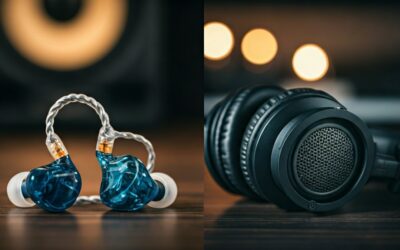
There is a significant difference between how In-Ear Monitors (IEMs) and Over-Ear Headphones deliver bass.
Earbuds/IEMs create a tight seal inside your ear canal. This seal traps air and directs the full force of the low-frequency vibrations directly against the tympanic membrane (eardrum). Because the volume of air is so small, the pressure is much higher.
Over-Ear Headphones allow for a larger soundstage. The drivers are further from your eardrum, and some of the pressure can dissipate. From my professional experience, users of over-ear models like the Skullcandy Crusher ANC 2 report less immediate ear fatigue compared to high-bass earbuds because the “rumble” is felt more by the skin around the ear rather than just the eardrum.
The Role of “Haptic Bass” and Ear Health
Some modern headphones use Haptic Drivers to create a physical vibration. While this provides the “feel” of a subwoofer, it can be deceptive.
- Pros: You get the sensation of heavy bass without needing to increase the actual audio volume.
- Cons: Excessive physical vibration against the skull can still cause headaches or “vestibular” (balance) issues in sensitive individuals.
Expert Perspective: The Long-term Impact of Heavy Bass
I recently spoke with a clinical audiologist regarding the “Bass Craze” in consumer electronics. The consensus is that Noise-Induced Hearing Loss is cumulative. You don’t wake up deaf; you slowly lose the ability to hear high-frequency sounds like “s” or “th” in speech.
The danger of asking “are bass headphones bad for ears” is that the damage is invisible. By the time you notice you are asking people to repeat themselves, the stereocilia in your inner ear may already be permanently flattened.
Frequently Asked Questions
Can bass burst your eardrum?
It is extremely unlikely for consumer headphones to burst an eardrum through bass alone. However, the high Sound Pressure Level (SPL) can cause the eardrum to overstretch or become inflamed, leading to significant pain and temporary hearing loss.
Is “Bass Boost” worse for your ears?
Yes, “Bass Boost” features often introduce distortion and significantly increase the sound pressure. If you use bass boost, you must compensate by lowering the overall volume to stay within safe listening limits.
Why do my ears itch after listening to heavy bass?
Itching is often a sign of ear fatigue or a reaction to the vibration. The intense movement of the air in the ear canal can also irritate the sensitive skin or cause “micro-sweating,” which leads to itchiness and potential fungal infections if the headphones aren’t cleaned.
Are open-back headphones better for bass lovers?
Open-back headphones are generally safer because they do not trap air pressure against the eardrum. However, they usually struggle to produce the “slam” and deep sub-bass that bass-heads crave. Closed-back headphones are better for bass but require more discipline with volume control.
How do I know if my headphones are too loud?
A simple test is the “arm’s length” rule. If you hold your headphones at arm’s length and can clearly hear the music, they are definitely too loud. Another way is to check if you can hear someone speaking to you in a normal voice while the music is playing.
**
**
**
**