

No, Beats headphones are not OSHA approved for use as hearing protection in noisy work environments. Because Beats products are designed for high-fidelity audio consumption rather than industrial safety, they lack a certified Noise Reduction Rating (NRR) required by federal safety standards.
Are Beats Headphones OSHA Approved? The Definitive Answer
The short answer is a definitive no. Beats by Dre headphones, including popular models like the Beats Studio Pro and Beats Fit Pro, are classified as consumer electronics, not Personal Protective Equipment (PPE). To be considered “OSHA approved” for hearing protection, a device must be tested according to ANSI S3.19-1974 standards and carry a visible Noise Reduction Rating (NRR).
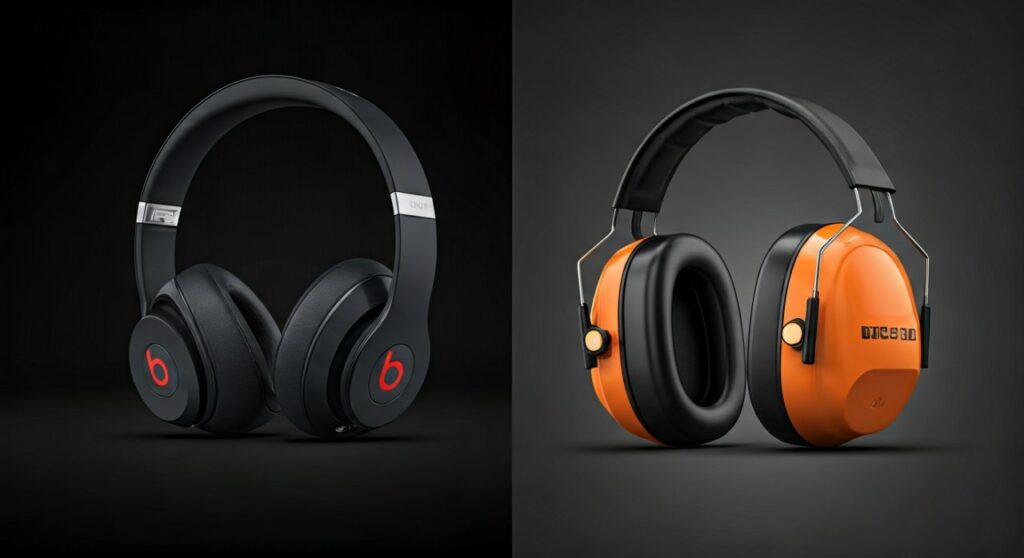
While Beats products feature excellent Active Noise Cancellation (ANC), this technology is designed to enhance your listening experience by filtering out background hums. It is not a substitute for the physical barrier required to protect your inner ear from high-decibel industrial impulses or sustained loud machinery noise.
Key Takeaways: Safety Compliance and Beats Headphones
- Zero NRR: Beats headphones do not have a certified Noise Reduction Rating (NRR).
- Not PPE: They are not recognized as Personal Protective Equipment under OSHA Standard 1910.95.
- ANC Limitation: Active Noise Cancellation does not provide the same protection as passive earplugs or muffs.
- Employer Discretion: While OSHA does not strictly ban music, they allow employers to prohibit Beats if they create a safety hazard.
- Legal Risk: Using non-compliant headphones in loud zones can lead to OSHA citations for the employer and permanent hearing loss for the employee.
Understanding OSHA’s Stance on Hearing Protection
OSHA (Occupational Safety and Health Administration) does not “approve” specific brands of equipment. Instead, they set the criteria that equipment must meet. Under 29 CFR 1910.95, employers must provide hearing protection when noise exposure exceeds an 8-hour time-weighted average of 85 decibels (dBA).
For a device to be compliant in these zones, it must provide a measurable reduction in noise. Beats headphones are “open” or “closed” back consumer units that have never undergone the rigorous ANSI testing required to prove they can safely attenuate industrial noise.
Furthermore, OSHA issued a standard interpretation memo stating that while listening to music may be allowed, it cannot interfere with the effectiveness of required hearing protection or the ability to hear warning signals.
Why Beats ANC is Not Industrial Hearing Protection
Many workers mistakenly believe that because their Beats Studio Pro makes the job site sound “quiet,” they are being protected. This is a dangerous misconception based on how Active Noise Cancellation (ANC) works compared to passive protection.
Active Noise Cancellation works by using microphones to pick up low-frequency noise and creating “anti-noise” waves to cancel it out. However, ANC struggles with high-frequency, impulsive sounds like a hammer strike or a nail gun.
In contrast, OSHA-compliant earmuffs use dense, specialized foam to create a physical seal. This seal blocks the sound energy from ever entering the ear canal. Beats lack this dense acoustic seal, meaning harmful sound pressure levels can still reach your eardrum even if the “sound” seems quieter.
Comparing Beats vs. OSHA-Compliant Work Headphones
| Feature | Beats Studio Pro / Fit Pro | 3M WorkTunes / ISOtunes |
|---|---|---|
| NRR Rating | None (0 dB) | 22 dB – 29 dB |
| ANSI Certified | No | Yes (S3.19-1974) |
| Primary Use | Music/Lifestyle | Hearing Protection |
| OSHA Compliant | No | Yes |
| Volume Limiting | No (Can reach 100+ dB) | Yes (Typically limited to 85 dB) |
| Safe for Construction | No | Yes |
How to Determine if Your Headphones are Safe for Work: A Step-by-Step Guide
If you are unsure whether your current headset is acceptable for your job site, follow these steps to verify compliance with OSHA and MSHA standards.
Step 1: Look for the NRR Label
Check the original packaging or the inside of the ear cup for a Noise Reduction Rating (NRR). If the box does not explicitly state an NRR number (e.g., NRR 25), the device is not a safety product. Beats will never have this label.
Step 2: Verify ANSI S3.19-1974 Testing
Standard hearing protectors are tested under American National Standards Institute (ANSI) protocols. Search the manufacturer’s technical specifications for “ANSI S3.19-1974.” If this certification is missing, the product cannot be used as a substitute for earplugs in high-noise areas.
Step 3: Check for Integrated Volume Limiters
True OSHA-compliant work headphones often include a “SafeMax” or similar technology that limits the internal speaker volume to 85 decibels. This ensures that you aren’t damaging your hearing with your own music while trying to block out external noise.
Step 4: Consult Your Company’s Safety Manual
Most industrial employers have a specific policy regarding “Entertainment Audio.” Even if a pair of headphones has an NRR, your employer may ban them to ensure you can hear backup alarms, fire sirens, or verbal instructions from coworkers.
The Risks of Wearing Beats in Industrial Settings
Wearing Beats headphones on a construction site or factory floor introduces several high-level risks that go beyond simple hearing loss.
Auditory Masking
Beats are designed to immerse you in music. This “immersion” causes auditory masking, where the music prevents your brain from recognizing critical safety sounds. If a forklift operator honks their horn and you are wearing Beats, you may not hear the frequency of the horn over the bass of your music.
False Sense of Security
Because ANC reduces the “perceived” volume of a machine, workers often stay near loud equipment longer than they should. They assume they are safe, while the actual sound pressure is still vibrating the delicate bones of the middle ear, leading to Tinnitus or permanent hearing impairment.
Physical Safety Hazards
Beats Solo or Studio models are bulky. They can easily snag on moving machinery or interfere with the proper fit of a hard hat or safety glasses. OSHA requires that PPE must not create a secondary hazard, and bulky consumer headphones often fail this requirement.
Recommended OSHA-Approved Alternatives to Beats
If you love the wireless convenience of Beats but need to stay compliant with OSHA 1910.95, consider these “Work-Safe” alternatives that offer Bluetooth connectivity:
- 3M WorkTunes Connect: These look like standard earmuffs but include high-quality Bluetooth speakers and a 24 dB NRR.
- ISOtunes PRO 2.0: These are ruggedized Bluetooth earbuds that look like Powerbeats but are fully ANSI certified with a 27 dB NRR.
- Elgin Ruckus Discord: Industrial-grade earbuds designed for noisy environments with a focus on durability and hearing protection.
- Honeywell Sync Wireless: A professional-grade headset that balances high-fidelity audio with industrial-strength attenuation.
Expert Perspective: What Safety Officers Say
“In my ten years as a safety consultant, the most common violation I see is workers wearing Beats or AirPods under their earmuffs or as a standalone,” says Mark Thompson, a certified safety professional.
“Not only does this negate the protection of the earmuffs by breaking the seal, but it also increases the risk of the worker being distracted. From a liability standpoint, if an accident occurs while a worker is wearing non-NRR headphones, the employer is almost always found at fault for failing to enforce PPE standards.”
Frequently Asked Questions (FAQs)
Can I wear Beats under my OSHA-approved earmuffs?
No. Wearing Beats (especially over-ear models) under earmuffs breaks the acoustic seal of the protector. This allows noise to leak in, reducing the NRR to nearly zero. Even small earbuds like Beats Fit Pro can cause discomfort and pressure points when pressed against the ear by earmuffs.
Does OSHA allow music at all on job sites?
OSHA does not have a blanket ban on music, but they prohibit it if it exceeds 85 dBA or prevents employees from hearing warning signals. Most employers interpret this by banning consumer headphones like Beats and only allowing specialized OSHA-compliant audio gear.
Is the “Transparency Mode” on Beats safe for work?
No. Transparency Mode uses microphones to pass ambient sound through the speakers. While this helps with situational awareness, it does not provide any protection against high-decibel noise. In fact, it may actually amplify certain loud sounds, making the environment more dangerous for your hearing.
Will my employer get fined if I wear Beats?
Yes. If an OSHA inspector visits a job site where hearing protection is required and sees employees wearing Beats headphones, the company can be cited for a “Serious” violation. Fines for these violations can exceed $15,000 per instance.
Are there any Beats models that are safety rated?
As of current production, Apple (the parent company of Beats) does not manufacture any headphones that carry an ANSI certification or an NRR. They are strictly consumer-focused products.









