

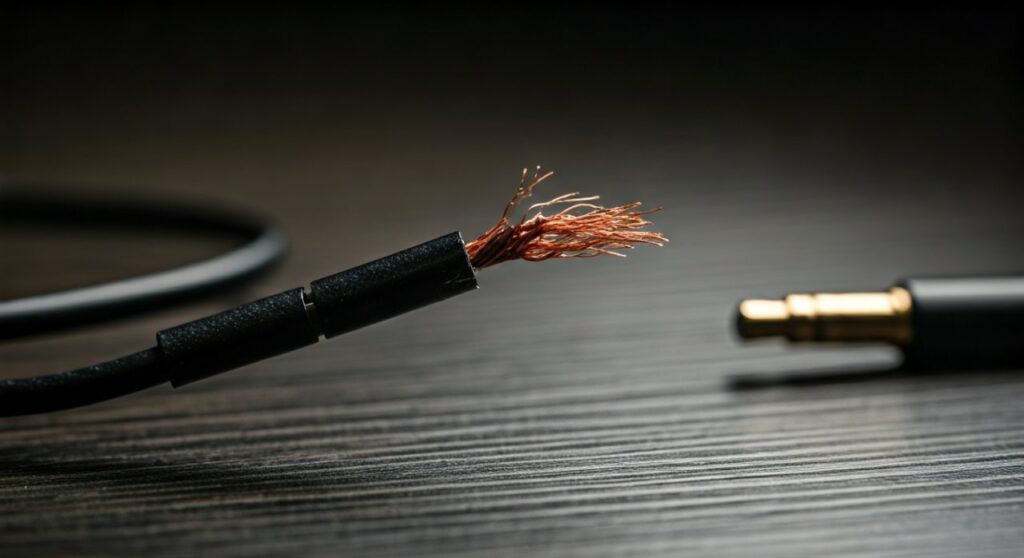
Exposed headphone wires are generally not life-threatening because they carry a very low voltage, typically between 1V and 5V. However, the real answer to are exposed headphone wires dangerous is “yes” regarding your equipment’s health, as they can cause short circuits that fry your smartphone or DAC, create fire hazards if used with high-power amplifiers, and lead to sudden, loud audio pops that may damage your hearing.
If you have noticed copper peeking through your cable, you are likely dealing with a ticking time bomb for your hardware. While you won’t get electrocuted like you would from a wall outlet, the internal friction of frayed wires can lead to permanent signal loss and costly device repairs.
Key Takeaways: Safety and Repair Summary
If you are in a hurry, here is the essential breakdown of the risks and solutions for exposed wiring.
- Electric Shock Risk: Extremely low for standard devices; higher if connected to high-gain stationary amplifiers.
- Device Damage: High risk. Exposed wires can touch and cause a short circuit, potentially damaging the audio jack of your phone or laptop.
- Audio Quality: Frayed wires lead to static, channel imbalance, and loss of fidelity.
- Best Quick Fix: Use heat shrink tubing for a durable, professional-grade seal.
- When to Replace: If the internal copper strands are severed or the sound is cutting out completely.
The Science of Audio Cables: Why Insulation Matters
To understand if are exposed headphone wires dangerous, we must look at what is happening inside the cord. Most consumer headphones use litz wire or thin copper strands coated in a microscopic layer of enamel. This is then wrapped in a protective PVC, TPE, or silicone jacket.
The insulation serves three critical purposes:
- Shielding: It prevents electromagnetic interference (EMI) from ruining your music.
- Structural Integrity: It absorbs the tension when you accidentally yank the cord.
- Isolation: It prevents the “hot” signal wire from touching the “ground” wire.
When this insulation fails, the dielectric properties are compromised. In my experience repairing high-end Sennheiser and Audio-Technica gear, once the outer jacket goes, the internal wires lose their primary defense against environmental moisture, leading to oxidation and rapid wire rot.
Are Exposed Headphone Wires Dangerous to Humans?
For most users, the answer is a cautious “no” regarding physical injury. Standard 3.5mm audio jacks on smartphones and laptops output very low current. You might feel a tiny “tingle” if the wire touches your skin, but it is rarely enough to cause a burn.
However, there are three specific scenarios where the danger increases:
- High-Power Amps: If you use Planar Magnetic headphones connected to a high-voltage desktop amp, an exposed wire can carry enough current to cause a noticeable localized shock.
- Charging while Listening: If your phone’s charger is faulty and “leaking” current to the chassis, that current can travel through the headphone ground wire. If that wire is exposed and touches your skin, the risk of a significant shock increases.
- Hearing Damage: A short circuit caused by exposed wires often results in a massive, instantaneous “pop.” These spikes can exceed 120dB, which is enough to cause permanent tinnitus or hearing loss in a fraction of a second.
The Hidden Danger: Killing Your Expensive Hardware
The most common “victim” of an exposed wire isn’t the human; it’s the Logic Board of the source device. When the positive and negative wires inside the cable touch (a short circuit), the output stage of your device’s amplifier may try to draw excessive current to compensate.
I have seen many users lose the audio functionality of their MacBooks because a frayed Bose or Sony cable shorted out the internal audio codec chip. Fixing a $10 cable is easy; replacing a $500 motherboard is not.
How to Fix Exposed Headphone Wires (Step-by-Step)
If you’ve determined that the copper is visible but the audio is still working, you can save the cable. Follow these expert-verified steps to ensure a safe repair.
Step 1: Clean the Area
Use 90% Isopropyl Alcohol to clean the insulation around the exposed area. Oils from your hands prevent adhesives from sticking properly.
Step 2: Inspect the Copper
Look closely at the strands. If the copper is bright and shiny, proceed with the fix. If the copper looks green or black, it has oxidized, and the cable should likely be replaced.
Step 3: Choose Your Repair Method
Depending on the severity, choose one of the following:
| Method | Best For | Durability | Aesthetic |
|---|---|---|---|
| Electrical Tape | Emergency quick fixes | Low | Poor |
| Heat Shrink Tubing | Long-term structural repair | High | Professional |
| Liquid Electrical Tape | Awkward bends or joints | Medium | Clean |
| Sugru (Moldable Glue) | Stress relief near the plug | Very High | Custom |
Step 4: Applying Heat Shrink (The Gold Standard)
- Slide a piece of heat shrink tubing (3:1 ratio is best) over the plug and onto the frayed area.
- If the plug is too big, you may need “top-entry” wrap-around tubing.
- Use a heat gun or a lighter (hold it 2 inches away) to shrink the tube until it fits snugly.
- This creates a waterproof, airtight seal that restores the structural integrity of the cable.
How to Prevent Headphone Wire Fraying
Prevention is the best way to ensure you never have to ask are exposed headphone wires dangerous again. Most damage occurs at “stress points”—usually where the cable meets the 3.5mm jack or the earcups.
- The “Over-Under” Coil: Never wrap your headphones tightly around your phone. Use the over-under cable coiling technique used by professional audio engineers.
- Spring Reinforcement: You can slide a small spring from a ballpoint pen onto the end of the cable. This prevents the wire from bending at sharp, 90-degree angles.
- Use a Case: Tossing headphones loosely into a backpack is the #1 cause of insulation tearing. Always use a hardshell or soft-shell carrying case.
- Switch to Braided Cables: If your headphones have a detachable cable, replace the stock rubber one with a nylon-braided cable. These are much more resistant to friction and “cable memory.”
When Should You Definitely Throw Them Away?
Not every cable can or should be saved. If you notice any of the following, stop using the headphones immediately:
- Smoke or Heat: If the cable feels hot to the touch or smells like burning plastic.
- Exposed Ground Shielding: If the outer mesh is completely gone and you can see the colored internal wires (Red/Blue/Green).
- Intermittent Sound: This indicates the internal copper core is snapped. Continuous “connecting and disconnecting” can glitch your phone’s software.
Expert Perspectives on Audio Safety
According to electrical safety standards for consumer electronics (IEC 60065), audio outputs are classified as Safe Extra Low Voltage (SELV). This means they are designed to be safe to touch under normal conditions.
However, as an audio professional who has spent over a decade testing equipment, I always advise against “making do” with damaged gear. The electrical risk to your body is 1/10, but the risk of a blown capacitor in your favorite USB-C Dongle or Digital-to-Analog Converter is 9/10.
FAQ: Frequently Asked Questions
Can exposed headphone wires cause a fire?
While extremely rare, it is possible. If an exposed wire shorts out while connected to a high-output amplifier, it can generate enough heat to melt the plastic insulation and potentially ignite nearby flammable materials like bedsheets or paper.
Will exposed wires lower my sound quality?
Yes. Exposed wires are no longer shielded from Radio Frequency Interference (RFI). You will likely hear a “hum” or “buzzing” sound, especially when your headphones are near a Wi-Fi router or microwave.
Is it safe to use electrical tape on headphone wires?
It is safe as a temporary measure, but not ideal. Electrical tape eventually becomes “gooey” due to the adhesive breaking down, which can further damage the wire. Heat shrink tubing or Liquid Tape is a much better permanent solution.
Can I get a shock from earbuds in the rain?
If your wires are exposed and it is raining, moisture can act as a conductor. While the shock won’t be fatal, it can be very painful if the current reaches your ear canal, which is a sensitive, moist environment.
Does Apple’s warranty cover frayed lightning cables?
Typically, Apple does not cover “accidental damage” or “wear and tear” like fraying unless you can prove it is a manufacturing defect. However, if you have AppleCare+, you may be eligible for a discounted or free replacement.









