What Is a Short Throw Projector?
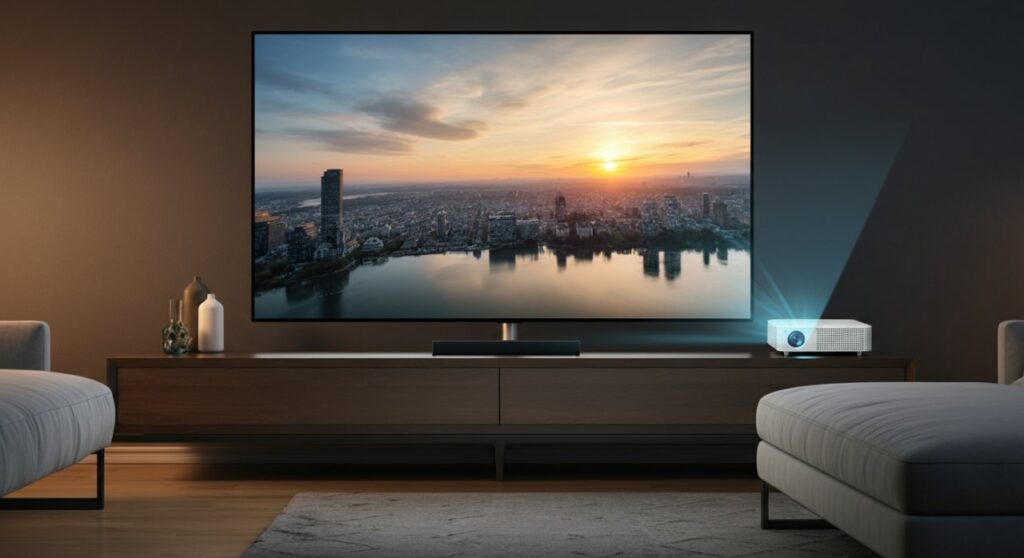
A short throw projector is a specialized display device designed to project a large image from a very close distance to the screen or wall, typically between 1 to 4 feet. Unlike traditional projectors that require long distances to “throw” light across a room, these units use advanced wide-angle lenses to achieve massive visuals in compact spaces. Understanding what is a short throw projector is essential for anyone looking to maximize screen size in a small apartment or a crowded media room without dealing with obstruction shadows.
TL;DR: Quick Comparison
| Feature | Traditional Projector | Short Throw Projector | Ultra Short Throw (UST) |
|---|---|---|---|
| Distance | 10+ feet | 3–8 feet | 0–2 feet |
| Space Needed | Large room | Medium/Small room | Minimal (wall-hugging) |
| Shadows | High risk | Low risk | Negligible |
| Best For | Dedicated theaters | Living rooms | Small apartments/offices |
Understanding What Is Short Throw Projector Technology
When you ask what does short throw projector mean, you are essentially asking about focal distance. Manufacturers engineer these optics to spread light aggressively at a steep angle. This allows the device to sit on a standard TV stand or media console while still filling an 80 to 120-inch screen.
Key Benefits of Short Throw Models
- Shadow-Free Experience: Because the projector sits in front of the viewer, you don’t have to worry about people walking through the beam.
- Space Efficiency: You reclaim the floor space behind the couch that would otherwise be needed for a standard projector mount.
- Easier Installation: There is no need for ceiling mounts or running long HDMI cables across the entire ceiling.
Are Short Throw Projectors Better for Your Needs?
Whether or not they are better depends entirely on your room layout. If you have a dedicated home theater with plenty of depth, a traditional long-throw projector might offer better lens shift flexibility. However, for most urban living situations, short throw projectors are superior because they blend seamlessly into existing furniture.
Factors to Consider Before Buying
Choosing the right unit requires looking past the “short throw” label. You need to balance brightness, resolution, and throw ratio to get a quality picture.
Brightness (Lumens)
Always prioritize ANSI Lumens. If you are using the device in a room with ambient light (like a living room with windows), look for at least 2,500 to 3,000 lumens.
Resolution
For a premium home cinema experience, 4K UHD resolution is becoming the standard. If you are on a budget, 1080p (Full HD) is still very capable for gaming and casual movie watching.
Throw Ratio
The throw ratio determines how big the image will be at a specific distance. A lower ratio means the projector can create a larger image from a closer distance. Always check the manufacturer’s spec sheet to ensure your furniture placement matches the throw distance requirements.
Practical Setup Tips for Optimal Performance
Setting up a short throw projector requires more precision than a standard TV. Because the light hits the wall at such a steep angle, any bump in the wall surface will be magnified.
- Use a Smooth Surface: A flat, smooth white wall is the minimum requirement. For the best image quality, invest in a Fixed Frame ALR (Ambient Light Rejecting) Screen.
- Leveling is Critical: Because these units sit so close, even a slight tilt will cause significant keystoning (trapezoidal distortion). Use the adjustable feet to ensure the unit is perfectly level.
- Cable Management: Since the projector sits on your furniture, keep the power cable and source connections tidy with cable sleeves or clips to maintain a clean aesthetic.
Frequently Asked Questions
Can I use a regular wall as a screen for a short throw projector?
Yes, but you will see every texture on the wall. For a high-quality image, we recommend a smooth matte white surface or a dedicated ALR screen designed to reject glare and improve contrast.
Are short throw projectors noisy?
Most modern short throw projectors are relatively quiet, but they do have cooling fans. Because the unit is placed closer to the seating area than a ceiling-mounted projector, look for models rated below 30dB if you are sensitive to fan noise.
Do I need a special stand for these projectors?
You don’t need a “special” stand, but you do need one that is the correct height. Ensure your furniture is low enough so that the projector sits at the bottom edge of where your screen will begin.
How long do the light sources usually last?
Most modern models use Laser or LED light sources rather than traditional bulbs. These typically offer 20,000 to 30,000 hours of life, meaning they can last for over a decade with regular daily use.