Understanding DLP Projector Technology
A DLP projector (Digital Light Processing) is a high-performance display device that uses millions of microscopic mirrors arranged on a semiconductor chip called a Digital Micromirror Device (DMD). When you ask what is a dlp projector, the simplest answer is that it reflects light through a color wheel to produce sharp, high-contrast images, making it the gold standard for cinema and professional presentations. Because these mirrors switch on and off thousands of times per second, they create smooth motion and vivid, deep blacks that are difficult for other technologies to replicate.
TL;DR: Key Takeaways
- How it works: A light source shines through a color wheel onto a DMD chip containing millions of tiny mirrors.
- Major strengths: High contrast ratios, excellent motion handling, and compact, reliable design.
- Best use cases: Home theater setups, corporate boardrooms, and digital cinema.
- The “Rainbow Effect”: A minor issue for some sensitive viewers caused by the spinning color wheel.
What is DLP in Projector Technology?
To truly grasp what is dlp in projector systems, you must understand the DMD chip. This chip is the heart of the device, acting as a sophisticated switch for light.
Unlike LCD projectors which pass light through liquid crystal panels, DLP technology uses reflective light processing. This difference is why DLP models generally offer superior black levels and image depth.
The Role of the Color Wheel
In most single-chip DLP projectors, a color wheel spins rapidly between the light source and the DMD chip. This wheel contains segments of primary colors (Red, Green, Blue). By spinning at high speeds, it syncs with the mirrors to create a full-color image that your eye perceives as a single, fluid picture.
Advantages of DLP Projectors
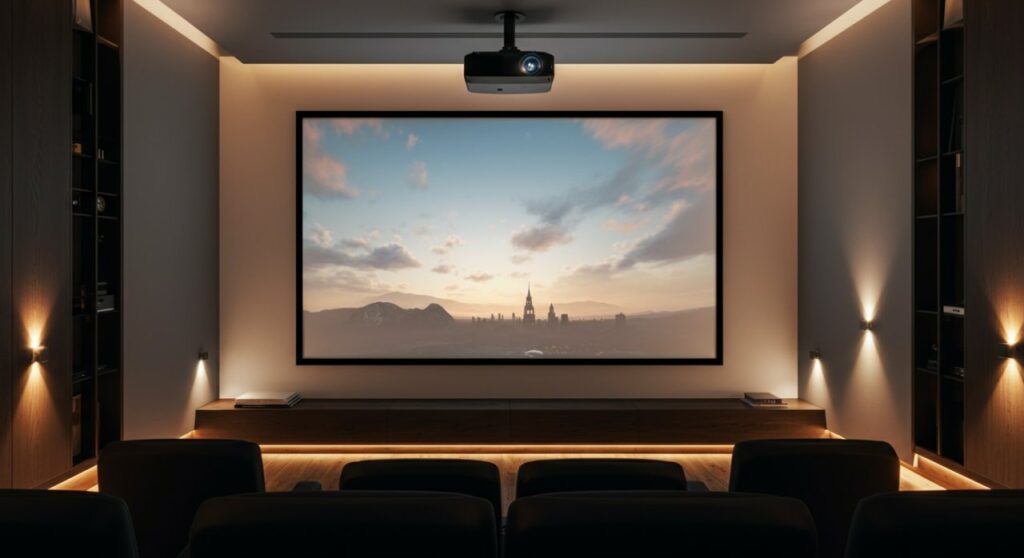
After years of setting up home theaters, I have found that DLP projectors consistently outperform others in specific categories:
- High Contrast: They deliver deeper blacks and more “pop” in high-brightness environments.
- Motion Sharpness: They exhibit minimal motion blur, which is a game-changer for sports and action movies.
- Durability: The sealed DMD chip is resistant to dust and environmental wear, leading to a longer overall lifespan.
- Portability: DLP chips are incredibly compact, allowing for smaller, lighter projector chassis.
DLP vs. LCD: Which Should You Choose?
When comparing projection technologies, it is essential to look at the practical differences for your specific needs. Use this table to decide if a DLP projector is the right choice for your space.
| Feature | DLP Projector | LCD Projector |
|---|---|---|
| Contrast Ratio | Excellent (Deep Blacks) | Good (Typically lower) |
| Motion Blur | Very Low | Moderate |
| Maintenance | Low (Sealed engine) | High (Requires filter cleaning) |
| Color Accuracy | High (Great saturation) | Excellent (Natural tones) |
| Portability | Very Compact | Larger footprint |
How to Set Up Your DLP Projector for Success
Getting the most out of your what is dlp projector investment requires careful placement. Based on my experience, follow these steps to achieve a professional-grade image.
Calculate Throw Distance
Every projector has a specific “throw ratio.” Before drilling holes in your ceiling, use an online throw distance calculator to ensure your projector is the correct distance from the screen to achieve your desired image size.
Optimize Ambient Light
While modern DLP units are bright, they still perform best in controlled lighting. If you are setting up in a living room, invest in blackout curtains to prevent ambient light from washing out your dark scenes.
Calibrate Your Colors
Out of the box, many projectors are set to “Vivid” mode, which often blows out colors. Switch to “Cinema” or “Reference” mode in the settings menu for more natural, accurate color reproduction.
Maintenance and Long-Term Care
One of the best features of a DLP projector is its low-maintenance design. Because the light path is usually sealed, you don’t have to worry about cleaning internal panels like you would with LCD units.
However, you should keep the air intake vents clear of dust. I recommend using a vacuum with a soft brush attachment on the vents every 3 to 6 months to ensure proper airflow, which prevents the lamp from overheating and extending its operational life.
Frequently Asked Questions
What is the main downside of a DLP projector?
Some users experience the “rainbow effect,” a brief flash of color seen in their peripheral vision, which occurs because of the fast-spinning color wheel. Most modern DLP projectors spin the wheel at such high speeds that this is rarely an issue for the average viewer.
Are DLP projectors good for gaming?
Yes, they are excellent for gaming. Due to the high speed of the DMD mirrors, DLP projectors generally offer lower input lag and better motion handling compared to most LCD or budget LED alternatives.
Does the projector lamp need to be replaced?
Yes, if you are using a lamp-based DLP projector, you will need to replace the bulb every 2,000 to 5,000 hours. Newer LED or Laser-based DLP models, however, are essentially maintenance-free and can last up to 20,000 hours.
How do I know if a DLP projector is native 4K?
Look for the technical specification “True 4K” or “Native 4K.” Some DLP projectors use pixel-shifting technology to simulate 4K, which is very high quality, but technically different from a native 4K DMD chip.