Understanding the Basics of Projector Headlight Adjustment
Learning how to adjust projector headlights is a straightforward process that significantly improves your nighttime visibility and prevents blinding oncoming drivers. By locating the horizontal and vertical adjustment screws located on the back or top of your headlight assembly, you can manually calibrate the beam pattern to the factory-recommended height. You will primarily need a Phillips-head screwdriver or a hex key, a flat wall, and about 20 minutes of your time to ensure your projector headlights are perfectly aligned for safety.
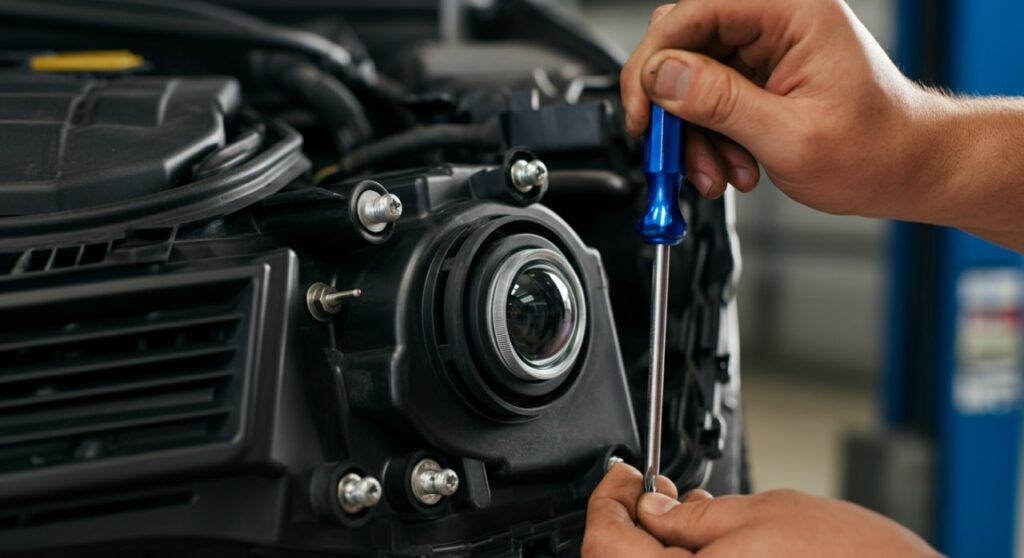
TL;DR: Quick Guide to Aligning Your Headlights
- Park on level ground: Position your car 25 feet away from a flat, vertical wall.
- Measure height: Mark the center of your headlights on the wall with painter’s tape.
- Locate screws: Find the vertical and horizontal adjustment dials on the headlight housing.
- Adjust: Turn the screws until the top of the beam cut-off line sits about 2 inches below your tape marks.
- Test: Take a short drive to confirm the light distribution is even and glare-free.
Why Proper Headlight Alignment Matters
Many drivers ignore their beam settings until they receive high-beam flashes from other vehicles. Proper alignment isn’t just about courtesy; it is a critical safety component of automotive maintenance.
When you know how to aim projector headlights, you ensure that the maximum amount of light is focused on the road surface rather than into the eyes of other motorists. Misaligned lights create “hot spots” or dark gaps in your vision, increasing the risk of accidents during night driving.
Tools Required for the Job
Before you begin, gather these essential items to make the process efficient and accurate. Having the right tools prevents stripping the plastic adjustment screws found on modern headlight units.
- Phillips-head screwdriver or Socket set (depending on your vehicle model).
- Painter’s tape or Masking tape for marking the wall.
- Measuring tape to ensure precision.
- Marker or chalk.
- A flat, level surface with access to a vertical wall (e.g., a garage door or a parking lot wall).
Step-by-Step: How to Adjust Projector Headlights
Follow these steps carefully to achieve a clean, professional beam cutoff. Always check your owner’s manual, as some high-end vehicles require dealer-specific tools or electronic calibration via the OBD-II port.
Preparing Your Vehicle
Ensure your tires are properly inflated and your vehicle is parked on a perfectly level surface. Remove any heavy or unnecessary cargo from your trunk, as uneven weight distribution can change the vehicle’s rake, causing the headlights to point incorrectly.
Measuring and Marking
Park your vehicle exactly 25 feet from the wall. Turn on your low beams and use the tape to mark the center of each beam (the brightest “hot spot”) on the wall. Connect these two marks with a horizontal line to act as your reference point.
Executing the Adjustment
Find the adjustment screws on the back of the headlight housing. Usually, there are two: one for vertical (up/down) and one for horizontal (left/right) movement.
| Adjustment Type | Function | Best Practice |
|---|---|---|
| Vertical | Changes beam height | Turn clockwise to raise, counter-clockwise to lower. |
| Horizontal | Changes beam left/right | Use sparingly to center the beam focus. |
Adjust the screws so that the top edge of your projector headlight beam pattern is roughly 2 inches below your reference line. This ensures you get maximum throw without glaring oncoming traffic.
Comparison: Projector vs. Reflector Headlights
Understanding the difference between these two technologies helps explain why how you align projector headlights differs slightly from standard reflector setups.
- Projector Headlights: Use a lens to focus the light, creating a very sharp, distinct “cut-off” line. They are generally more precise and require stricter vertical alignment to avoid glare.
- Reflector Headlights: Use a bowl-shaped housing to scatter light. They have a softer, less defined edge, making them slightly more forgiving but prone to more light spill.
Expert Tips for Perfect Alignment
After years of performing automotive lighting adjustments, I have found that small details make a big difference. Here are my professional recommendations:
- Work one side at a time: Cover the other headlight with a heavy towel or cardboard while adjusting one side. This prevents the two beams from blending, allowing you to isolate and target each beam accurately.
- Check the cut-off step: Most projector systems have a slight “step” in the beam pattern on the passenger side. Ensure this step aligns with your tape mark to avoid blinding drivers on the right side of the road.
- Re-test after 24 hours: After driving on uneven roads or speed bumps, check your alignment again. Sometimes, the internal adjustment mechanism needs to “settle” into its new position.
Frequently Asked Questions
Do I need to re-align my headlights after changing the bulb?
Usually, no. If you are simply replacing a bulb, the housing itself remains untouched. However, if the bulb is not seated perfectly in its socket, it can cause the beam to look distorted, which is often mistaken for misalignment.
What if my adjustment screws are seized?
If the screws won’t turn, do not force them, as the plastic housing can easily crack. Use a small amount of penetrating oil (like WD-40) around the threads and let it soak for 15 minutes before trying again gently.
How often should I check my headlight alignment?
It is a good habit to check your alignment once a year or whenever you install new LED or HID headlight components. If you have recently had front-end suspension work done, you should also verify your aim.
Can I adjust projector headlights on a vehicle with auto-leveling?
Vehicles with Automatic Headlight Leveling systems generally should not be adjusted manually using the screws. These systems rely on sensors on the suspension; if they are off, you likely need a diagnostic scan tool or a visit to a professional technician.