

Understanding Projector Screen Colors: Which One is Right for You?
Choosing what color is best for a projector screen depends entirely on your room’s ambient light and the contrast ratio of your projector. While traditional white screens are the industry standard for light-controlled environments, grey and black screens have revolutionized viewing in “living room” setups by boosting black levels. If your space has windows or light-colored walls, moving away from white might be the upgrade you need to achieve a cinematic experience without sacrificing image depth.
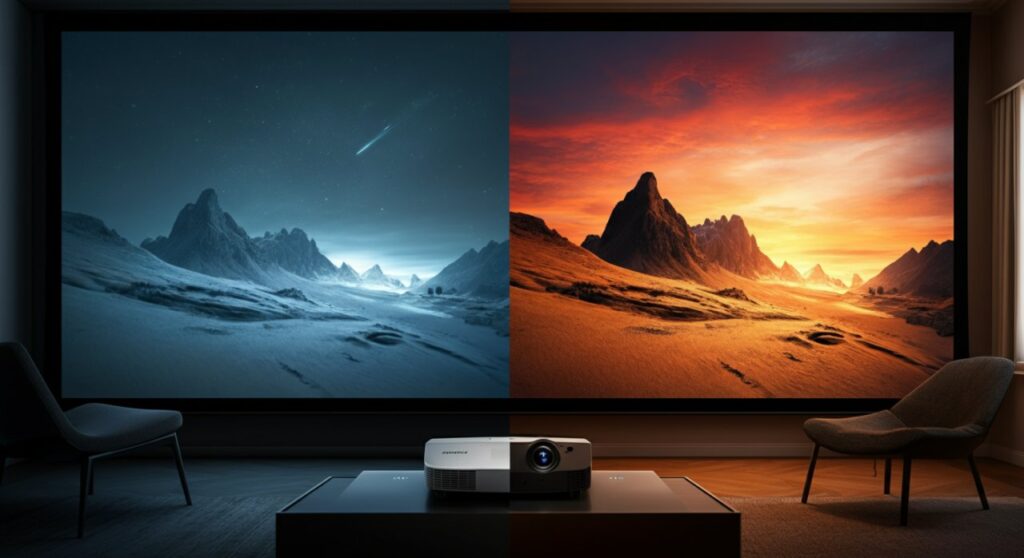
TL;DR: Quick Comparison of Screen Colors
If you are short on time, use this table to determine which screen color fits your specific environment:
| Screen Color | Ideal Environment | Main Benefit | Trade-off |
|---|---|---|---|
| White | Dark room / Cinema | Maximum brightness | Poor contrast in light |
| Light Grey | Moderate light | Better contrast | Requires more lumen output |
| Dark Grey | High ambient light | Deep black levels | Needs a powerful projector |
| Black/ALR | Daylight / Bright | Maximum contrast | Expensive; narrow viewing angle |
Why Screen Color Significantly Impacts Image Quality
Many users assume a wall or a basic white sheet is sufficient, but this ignores the science of light reflection. When you ask what color screen is best for a projector, you are really asking how to manage light bounce.
A white screen reflects almost all light that hits it, which is perfect for a pitch-black basement. However, in a room with ambient light, that same white surface will also reflect the stray light, washing out your image and turning deep blacks into murky greys.
The Role of Gain and Contrast
Gain is a measurement of a screen’s reflectivity. A screen with a gain of 1.0 reflects the same amount of light it receives.
- High Gain: Redirects light back to the viewer, increasing perceived brightness.
- Neutral Gain: Provides a balanced, color-accurate image.
- Negative Gain: Absorbs light to improve contrast, typically found in grey screens.
Choosing the Best Color for Your Specific Setup
Determining what is the best color for projector screen usage in your home requires an honest assessment of your lighting conditions. Do not simply buy what looks good in a showroom; buy for your wall.
The Case for White Screens
If you have a dedicated home theater room with no windows and black curtains, a white screen is objectively the best choice. It delivers the highest possible lumen output, ensuring your colors pop and the image remains vibrant. It is the gold standard for high-end 4K projectors.
The Case for Grey (High Contrast) Screens
For most casual users, a light grey or high-contrast grey screen is the superior choice. By darkening the surface, you reduce the intensity of reflected ambient light. This technique forces the projector to work harder to produce white, but it rewards you with much deeper, richer blacks.
Ambient Light Rejecting (ALR) Screens
If you are asking what is the best color screen for a projector in a brightly lit living room, you should move past simple colors and look into ALR technology. These screens are engineered with microscopic layers that physically block light coming from above or the sides while reflecting the projector’s light directly to your eyes. They are typically dark grey or black in appearance.
Practical Tips for Testing Before You Buy
Before spending money on a specialized screen, I recommend performing a “budget test” to see how your room reacts to different surfaces.
- The Cardboard Test: Tape a piece of matte white cardboard and a piece of matte grey cardboard side-by-side on your wall.
- Observe at Night vs. Day: Run the same high-quality movie scene during the day and at night to see which surface holds more detail in the shadows.
- Check Viewing Angles: Ensure that the screen material you choose doesn’t create a “hot spot” (a bright circle in the center of the image) when viewed from the side.
Frequently Asked Questions
Can I just paint my wall a specific color?
Yes, you can use specialized projector screen paint. While it doesn’t offer the light-rejecting properties of an ALR screen, it is a cost-effective way to get a smooth, neutral surface with the ideal gain for your room.
Does a black screen actually work?
Yes, black screens exist and work remarkably well in very bright environments, but they require high-output projectors. They absorb so much light that if your projector isn’t bright enough (measured in ANSI Lumens), your image will appear too dim.
What is the most versatile screen color?
A neutral light grey with a gain of around 0.8 to 1.0 is generally considered the most versatile “all-rounder.” It handles moderate ambient light well without demanding an ultra-powerful projector.
Does screen color affect color accuracy?
It can. Extremely dark grey or specialized ALR screens can sometimes impart a slight color cast. High-quality screens are designed to be “neutral,” meaning they shouldn’t shift the colors of your video content.









