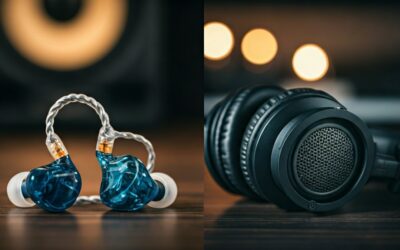

The Direct Answer: Are Headphones Better Than Speakers?
Whether headphones are better than speakers depends entirely on your environment, budget, and listening goals. Headphones are superior for critical listening, privacy, and cost-efficiency, providing immense detail for a fraction of the price of a high-end room setup.
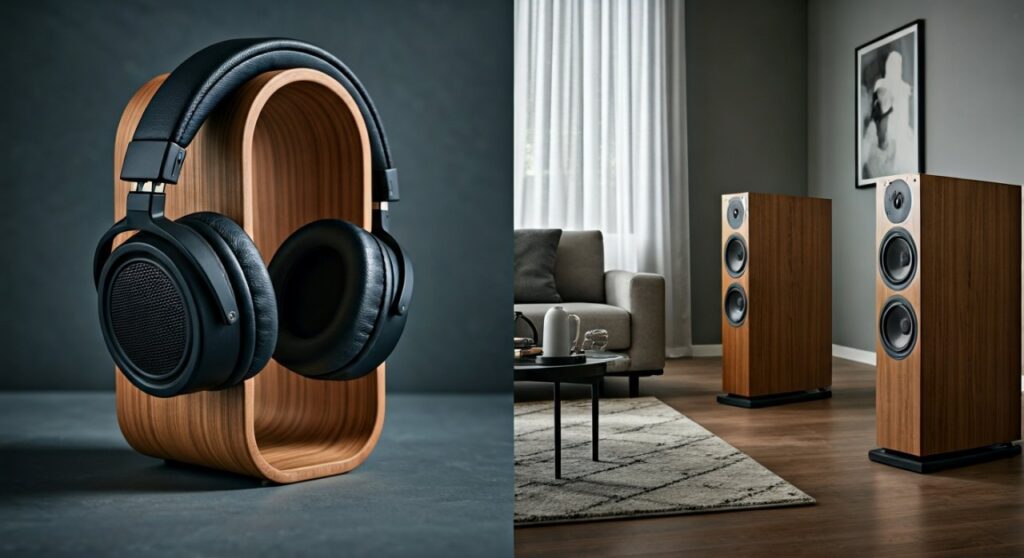
However, speakers win for spatial accuracy, physical bass impact, and long-term comfort, as they interact with your room to create a natural “soundstage” that headphones struggle to replicate. If you need to hear every micro-detail in a recording, choose headphones; if you want a visceral, social experience, speakers are the clear winner.
Key Takeaways: Quick Comparison
Before diving into the technical nuances, here is a high-level summary of how these two audio powerhouses compare across critical categories.
| Feature | Headphones | Speakers |
|---|---|---|
| Detail Retrieval | Exceptional; drivers are inches from the ear. | Good, but often obscured by room acoustics. |
| Soundstage | Perceived “inside the head” (mostly). | Natural, wide, and physically immersive. |
| Cost for Hi-Fi | $500 gets you world-class sound. | $2,000+ required for comparable quality. |
| Physical Bass | Heard, but not “felt” in the chest. | Vibrate the air and your body. |
| Portability | High; easy to use anywhere. | Low; restricted to treated rooms. |
| Ear Health | Higher risk of fatigue and hearing damage. | Generally safer for long sessions. |
Why Headphones Might Be Your Best Choice
For many modern listeners, headphones represent the pinnacle of audio practicality. Having spent thousands of hours testing gear from Sennheiser, Sony, and Audeze, I’ve found that headphones offer a “microscope” for sound that speakers simply cannot match without an acoustically treated studio.
Unmatched Detail and Transparency
Because headphone drivers are positioned directly over or inside your ears, they eliminate the room interference that plagues speakers. You hear the recording exactly as it is, without echoes or standing waves bouncing off your walls.
For tasks like music production, podcasting, or competitive gaming, this transparency is vital. You can hear the faint click of a drumstick or the distant footsteps of an enemy in Call of Duty with pinpoint accuracy.
The Privacy Factor and Noise Isolation
In a world of shared apartments and open-office plans, headphones are a necessity. Active Noise Cancellation (ANC) technology, found in models like the Bose QuietComfort Ultra, allows you to create a “silent bubble” anywhere.
Conversely, speakers are inherently social—or intrusive. If you live with roommates or have thin walls, a high-quality subwoofer is a recipe for a neighbor dispute. Headphones allow you to enjoy 100dB explosions in a movie at 2 AM without waking a soul.
Price-to-Performance Ratio
This is the strongest argument for headphones. A pair of HiFiMAN Sundara planar magnetic headphones costs roughly $300 and delivers audio fidelity that rivals a $3,000 speaker system.
To make speakers sound “perfect,” you don’t just buy the speakers; you must buy amplifiers, DACs, high-quality cables, and—most importantly—acoustic room treatment (bass traps and diffusers). With headphones, the “room” is built into the ear cup.
The Unrivaled Benefits of High-Fidelity Speakers
Despite the convenience of headphones, they cannot break the laws of physics. As an audiophile who has transitioned from a headphone-only setup to a dedicated listening room with KEF LS50 Wireless II monitors, I can attest that speakers offer a “soul” that headphones often lack.
The Physicality of Bass
Headphones use tiny diaphragms to move a small amount of air. While they can reach deep frequencies, they cannot provide the visceral impact of a dedicated 12-inch subwoofer.
True bass is felt in the chest and through the floor. This “tactile” sensation is a massive part of the cinematic and concert experience. If you enjoy EDM, Pipe Organ music, or Action Movies, speakers provide a physical dimension that headphones simply lack.
Natural Soundstage and Imaging
When you listen to speakers, your left ear hears the left speaker and a bit of the right speaker (and vice versa). This is called Interaural Time Difference (ITD).
Our brains use this to calculate where sounds are coming from in a 3D space. Because headphones isolate each ear, the soundstage often feels like it is trapped inside your skull. Speakers project a “phantom center” where the vocalist feels like they are standing five feet in front of you.
Long-Term Comfort and Health
Even the most comfortable headphones, like the Meze 99 Classics, eventually cause clamping force fatigue or “sweaty ears.” More importantly, headphones increase the risk of Tinnitus because users tend to turn up the volume to compensate for the lack of physical impact.
Speakers allow your ears to “breathe.” The sound waves dissipate naturally in the room, making them much more suitable for an 8-hour workday or a weekend-long movie marathon.
Step-by-Step Guide: How to Choose Which is Better for You
If you are struggling to decide where to invest your hard-earned money, follow this expert decision-making framework.
Step 1: Audit Your Environment
- Do you have a dedicated room? If yes, speakers are a great investment.
- Are your walls thin? If yes, stick to headphones.
- Is your room full of windows and hard tiles? These create terrible echoes. Unless you plan to buy rugs and curtains, headphones will sound better.
Step 2: Define Your Primary Use Case
- Gaming: Headphones are better for spatial awareness (hearing footsteps).
- Home Theater: Speakers are better for immersion and shared experiences.
- Critical Mixing/Editing: A combination is best, but start with “Open-Back” headphones like the Sennheiser HD600.
- Commuting/Travel: Headphones (specifically IEMs or ANC over-ears) are the only option.
Step 3: Analyze Your Budget Total Cost of Ownership (TCO)
Do not just look at the price tag of the device.
- Headphone TCO: Headphones + Small Dongle DAC = Complete System.
- Speaker TCO: Speakers + Amp + Stands + Room Treatment + Cables = Complete System.
Step 4: Test Your “Sonic Preference”
Some people find the “inside-the-head” sensation of headphones claustrophobic. Others find speakers distracting. Visit a local Hi-Fi shop and listen to a pair of Planar Magnetic headphones vs. a pair of Bookshelf Speakers. Your brain’s unique HRTF (Head-Related Transfer Function) will tell you which one feels more “real.”
The Middle Ground: Best of Both Worlds?
If you can’t decide, there are “hybrid” technologies that bridge the gap:
- Open-Back Headphones: These have perforated ear cups that allow air (and sound) to pass through. They create a much wider, speaker-like soundstage while maintaining headphone detail.
- Near-Field Monitors: These are small speakers designed to be placed on a desk, very close to your ears. They provide speaker-style imaging while minimizing the negative impact of poor room acoustics.
- Spatial Audio & Binaural Rendering: Technologies like Dolby Atmos for Headphones or Apple Spatial Audio use software algorithms to trick your brain into thinking sound is coming from speakers, even when using earbuds.
Technical Deep Dive: THD and Frequency Response
When comparing these two, experts look at Total Harmonic Distortion (THD).
- High-end headphones often have a THD of less than 0.1%, meaning the sound is incredibly pure.
- Average speakers in a typical room can have a “perceived THD” much higher because the room adds its own “distortion” through reflections.
Data from Audio Science Review suggests that for the purest signal-to-noise ratio, headphones are statistically more likely to provide a “transparent” signal to the listener’s brain than speakers in an untreated residential space.
Frequently Asked Questions (FAQs)
Are headphones worse for your hearing than speakers?
Potentially, yes. Because headphones are closer to the eardrum, it is easier to accidentally reach dangerous Decibel (dB) levels. Experts recommend the 60/60 rule: Listen at no more than 60% volume for no more than 60 minutes at a time.
Can headphones ever sound as “big” as speakers?
Not naturally. However, using DSP (Digital Signal Processing) and Binaural recordings, headphones can simulate a massive soundstage. High-end models like the Sennheiser HD800S are famous for having a “speaker-like” width.
Why do professional studios use both?
Pro engineers use speakers (studio monitors) to check the “mix balance” and how it translates to real-world environments. They use headphones to check for “pops,” “clicks,” and fine editing errors that speakers might miss.
Are expensive cables more important for speakers or headphones?
In both cases, cables are often the least important factor. Focus your budget on the transducers (the speakers/headphones themselves) and the source file quality (Lossless vs. Compressed).
Is “spatial audio” better on headphones?
Spatial Audio was specifically designed to make headphones sound more like speakers. It is a massive improvement for movie watching on headphones, but it usually cannot beat a true 7.1.4 Dolby Atmos speaker setup with physical height channels.