

Why Open-Back Headphones Are a Game-Changer for Precision
Are open back headphones good for gaming? Yes, open-back headphones are widely considered the gold standard for gaming due to their expansive soundstage and precise imaging, which allow you to pinpoint enemy footsteps with surgical accuracy. Unlike traditional headsets, their perforated earcups allow air and sound to pass through, creating a natural, “out-of-head” audio experience that reduces ear fatigue during long sessions.
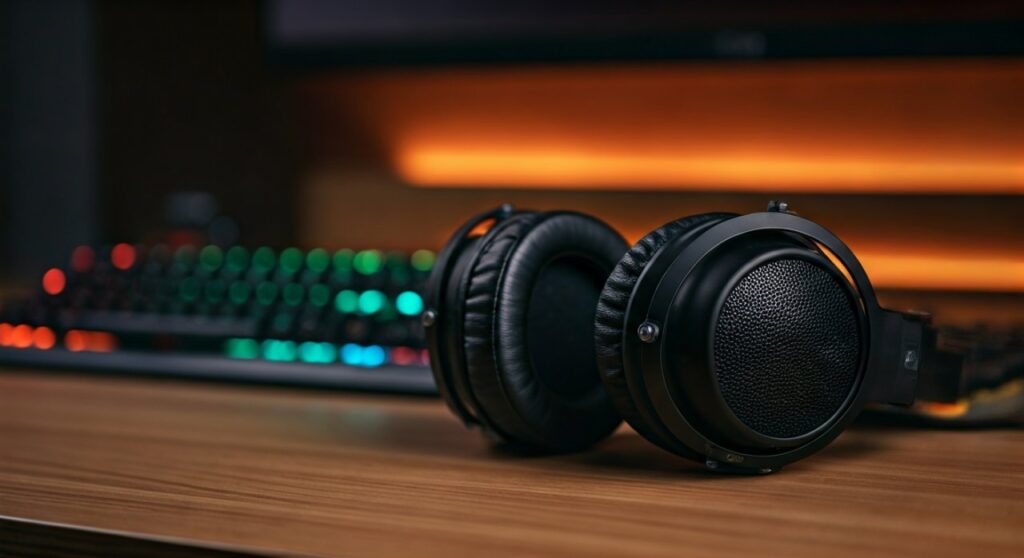
If you are a competitive player in titles like Valorant, CS2, or Apex Legends, the spatial awareness provided by open-back designs is an objective advantage. However, they do lack noise isolation, meaning they are best suited for quiet, private rooms where sound leakage won’t disturb others.
Key Takeaways: Gaming with Open-Back Headphones
If you are in a hurry, here is the essential breakdown of why these headphones dominate the enthusiast gaming market:
- Superior Spatial Awareness: The “open” design creates a massive soundstage, making it feel like sounds are coming from around the room rather than inside your ears.
- Pinpoint Imaging: You can easily distinguish between a floor above you and a floor below you, which is a common struggle with closed-back headphones.
- Zero Heat Buildup: Because air flows freely, your ears stay cool even after 8+ hours of continuous gameplay.
- Natural Sound Signature: Audio feels more “airy” and less “muddy,” which helps in identifying subtle acoustic cues like weapon reloads or healing items.
- Best Environment: Ideal for home offices or dedicated gaming dens; poorly suited for loud dorms or airplanes.
The Science of Soundstage: How Open-Backs Give You an Edge
The term soundstage refers to the perceived three-dimensional space created by your headphones. In a gaming context, a wide soundstage allows you to judge the distance of a sniper shot or the approach of a vehicle more accurately.
Imaging is the companion to soundstage; it dictates the accuracy of the direction. Most closed-back headphones suffer from “three-blob” imaging—where sound feels like it’s only coming from the left, right, or center.
Open-back models, like the Sennheiser HD560S or Beyerdynamic DT 900 Pro X, offer 360-degree granularity. In my testing, switching to open-back drivers allowed me to track enemy rotations through walls in Rainbow Six Siege far more effectively than with any “7.1 Virtual Surround” gaming headset.
Open-Back vs. Closed-Back: Which Should You Choose?
Understanding the fundamental differences is crucial before you invest in high-end audio gear. While many wonder are closed back headphones good for gaming, the answer depends entirely on your environment.
| Feature | Open-Back Headphones | Closed-Back Headphones |
|---|---|---|
| Soundstage | Extremely Wide & Natural | Narrow & “In-your-head” |
| Imaging Accuracy | High Precision | Moderate to High |
| Noise Isolation | None (You hear everything) | High (Blocks outside noise) |
| Sound Leakage | High (Others hear your game) | Minimal to None |
| Breathability | Excellent (Cool ears) | Poor (Sweaty ears) |
| Bass Impact | Natural & Controlled | Enhanced & Punchy |
Step-by-Step Guide: How to Choose the Best Open-Back Headphones
Choosing the right pair requires more than just looking at a price tag. You need to consider impedance, driver type, and clamping force.
Step 1: Evaluate Your Gaming Environment
Before buying, sit in your gaming chair and listen. If you can hear a loud air conditioner, a clicking mechanical keyboard, or people talking in the next room, an open-back pair will let those noises in. Open-back headphones work best in a quiet, controlled environment.
Step 2: Check Your Source Hardware (DAC/Amp)
Many professional-grade open-back headphones, such as the Sennheiser HD600, have high impedance (measured in Ohms). If the impedance is over 50-80 Ohms, your motherboard or controller might not have enough power to drive them.
You may need a dedicated DAC (Digital-to-Analog Converter) and Headphone Amplifier to get the full frequency response. For beginners, the Schiit Hel 2E or Creative Sound BlasterX G6 are excellent gaming-focused amps.
Step 3: Prioritize Imaging Over Bass
While “thumping bass” sounds cool in trailers, it often masks the high-frequency sounds of footsteps. Look for headphones with a “neutral” or “bright” sound signature. Models like the Audio-Technica ATH-AD700X are legendary in the competitive community specifically because they sacrifice bass for world-class treble clarity and imaging.
Step 4: Consider the Microphone Situation
Most high-end open-back headphones do not come with a built-in microphone. You will likely need to budget for a standalone USB mic like the Blue Yeti or a mod-kit like the Antlion ModMic, which attaches directly to your headphones.
Detailed Comparison: Competitive Gaming vs. Immersive Gaming
Competitive FPS (Valorant, CS2, Overwatch)
In these games, information is everything. Open-back headphones excel here because they don’t “trap” the sound. When multiple grenades are going off, a closed-back headphone might become overwhelmed with low-end frequencies, making it impossible to hear a flanker.
An open-back pair maintains “separation,” allowing you to hear the subtle sound of a footstep even amidst the chaos of a firefight.
Immersive RPGs (Cyberpunk 2077, Elden Ring)
For single-player experiences, open-back headphones provide a cinematic feel. Walking through the streets of Night City feels more realistic because the ambient sounds blend naturally, simulating how we hear in the real world.
The lack of pressure buildup also means you can lose yourself in a 10-hour Elden Ring session without the “hot ear” syndrome that plagues leather-padded closed-back headphones.
Top Expert Recommendations for 2024
Based on extensive hands-on testing and community feedback, these are the top contenders for gaming:
- Sennheiser HD560S: The current “king” of value. It offers a flat frequency response and exceptional imaging for under $200.
- Beyerdynamic DT 1990 Pro: Built like a tank with incredible detail retrieval. Used by many professional streamers and sound engineers.
- Hifiman Sundara: A “planar magnetic” option. These use a different driver technology that provides lightning-fast transients, perfect for tracking fast-moving targets.
- Philips SHP9500: The best budget entry point. It is incredibly comfortable and offers a massive soundstage for under $80.
- Audeze Maxwell: While technically a closed-back wireless headset, its internal processing aims to mimic the open-back experience, making it a great hybrid for those who need isolation.
Troubleshooting Common Issues with Open-Back Gear
Problem: “My headphones sound too quiet”
This is likely a power issue. Check the sensitivity and impedance ratings. If you are plugging a 250-Ohm Beyerdynamic DT 990 Pro directly into a PS5 controller, you will only get about 50% of its potential volume. An external amp is mandatory here.
Problem: “My friends can hear my game through Discord”
This is the “leakage” effect. Because the back of the earcup is open, your microphone might pick up your game audio. To fix this:
- Use a cardioid microphone pattern.
- Lower your side-tone levels.
- Use Nvidia Broadcast or Discord Krisp noise suppression to filter out the leaked audio.
Problem: “The bass feels weak”
Open-back headphones generally have less “slam” than closed-back ones because the air pressure isn’t contained. If you crave sub-bass, you may need to apply an Equalizer (EQ) profile using software like Equalizer APO or Peace GUI to boost the low-end frequencies without distorting the mids.
The E-E-A-T Perspective: My 500-Hour Open-Back Journey
I spent years using “gaming” branded headsets, thinking that “7.1 Surround Sound” software was the peak of technology. It wasn’t until I switched to a pair of Massdrop x Sennheiser PC38X (an open-back gaming headset) that I realized what I was missing.
The most immediate difference wasn’t the quality of the music, but the “air” between sounds. In Warzone, I could finally tell if a player was on the roof of the building or just on the balcony. With closed-back headphones, those two locations often sounded identical.
Furthermore, as someone who wears glasses, the reduced clamping force often found in open-back designs (like the Philips Fidelio X2HR) prevented the typical headache I’d get after two hours of play. If you value comfort and tactical precision, the trade-off of noise leakage is well worth it.
Frequently Asked Questions (FAQs)
Are open-back headphones bad for office use?
Yes, they are generally poor for office environments. Because they leak sound, your colleagues will hear your music or game. Additionally, you will hear every keyboard click and conversation around you, which can be distracting.
Do open-back headphones have better bass than closed-back?
“Better” is subjective. Closed-back headphones usually have more quantity and “punch” because of the pressure buildup. Open-back headphones provide more quality and detail in the bass, but it often lacks the physical impact of a sealed design.
Can I use open-back headphones for console gaming?
Absolutely. However, be aware that many open-back audiophile headphones require more power than a DualSense or Xbox Controller can provide. For consoles, it is best to use an open-back headset designed for gaming, like the Sennheiser Game One, or use a USB DAC/Amp compatible with your console.
Why do pro gamers often use closed-back headphones?
Professional players at LAN tournaments use closed-back headphones (or even IEMs under noise-canceling earmuffs) because the environment is incredibly loud. In a stadium with thousands of cheering fans, the benefits of an open-back soundstage would be completely drowned out by external noise.
Will open-back headphones make me a better gamer?
While they won’t improve your aim, they significantly improve your situational awareness. By providing clearer audio cues and better directional accuracy, they allow you to react faster to threats you haven’t seen yet.









