

Do You Need a Projector Screen? The Definitive Guide
Many new projector owners often ask, “do you need a projector screen” when setting up their home theater. The short answer is that while you can project onto a plain white wall, using a dedicated projector screen is the only way to achieve true cinematic image quality, accurate color reproduction, and optimal contrast levels. Without a purpose-built surface, you lose significant light reflection and sharpness, effectively wasting the capabilities of your expensive projector hardware.
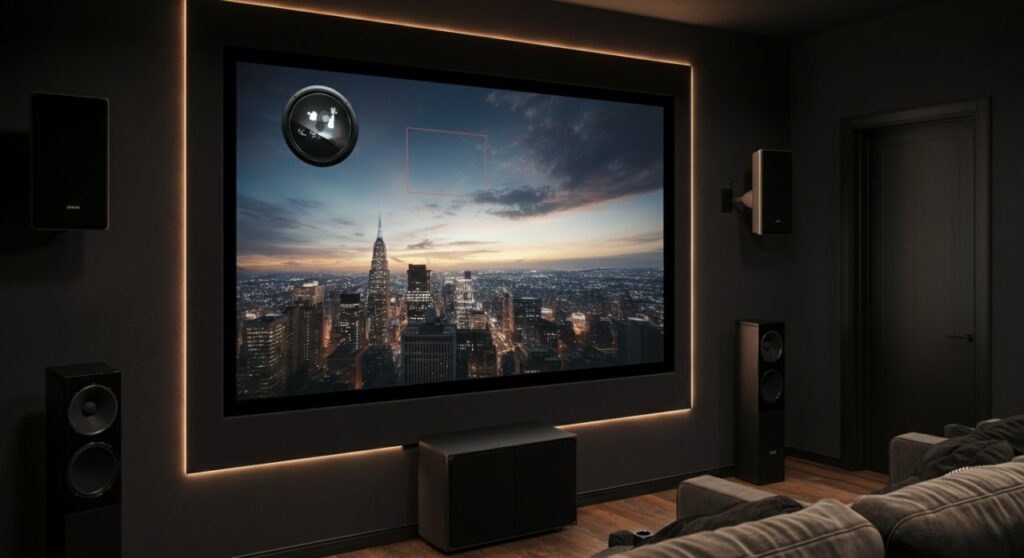
TL;DR: Quick Comparison Table
| Feature | Plain White Wall | Dedicated Projector Screen |
|---|---|---|
| Reflective Quality | Low (Absorbs light) | High (Gain-optimized) |
| Image Sharpness | Poor (Surface texture issues) | Excellent (Micro-texture) |
| Contrast Ratio | Flat/Washed out | Deep blacks/Vibrant whites |
| Installation | Permanent | Fixed, Retractable, or Portable |
Why Do You Need a Screen for a Projector?
When people wonder, “do you need a screen for a projector,” they are usually thinking about the immediate cost savings of using a wall. However, walls are rarely perfectly flat or smooth. Most drywall has “orange peel” textures or imperfections that scatter light unevenly, leading to a loss in image fidelity.
A professional projector screen uses specialized material (often PVC or high-tech fabrics) designed to maximize light reflection. This measurement is known as gain. A high-quality screen ensures that the light emitted by your projector bounces back to your eyes, rather than being absorbed into the porous paint of a wall.
The Role of Gain and Ambient Light
If you are asking, “do i need a projector screen,” consider the environment where you plan to watch movies. In rooms with high ambient light, a plain wall is almost unusable because it cannot reject off-axis light.
- High-Gain Screens: These are designed to reflect more light back to the viewer, which is vital for bright rooms.
- ALR (Ambient Light Rejection) Screens: These are the gold standard for living rooms, as they filter out light from above or the sides.
- Contrast: A dedicated screen often features a gray tint to help improve black levels, making the picture look “pop” rather than washed out.
Do Projectors Need a Screen for Best Performance?
Technically, a projector will work on any flat surface, but it won’t perform at its peak. When I first transitioned from a white wall to an ALR screen in my own basement theater, the difference was night and day. The image clarity increased, and the colors became significantly more saturated.
Common Myths About Projector Screens
- “Any white surface works”: Walls often contain slight tints (even white paint can have blue or yellow undertones) that skew the color temperature.
- “Blackout cloth is just as good”: While DIY options exist, they lack the optical coatings found in commercial screens that manage light polarization.
- “Screens are too expensive”: With the rise of budget-friendly fixed-frame screens, the price gap between a “good enough” wall setup and a professional screen has narrowed significantly.
How to Choose the Right Screen Type
Once you realize the answer to “do you need a projector screen for a projector” is a resounding “yes,” you must select the right style. Your choice depends on your room layout and usage frequency.
- Fixed Frame Screens: Ideal for dedicated home theaters where the screen remains in place. They offer a perfectly flat surface and a sleek, professional look.
- Motorized/Retractable Screens: Perfect for multi-purpose rooms. You can hide the screen behind a bulkhead or in the ceiling when not in use.
- Portable Screens: Best for outdoor movie nights or temporary setups. These are easy to assemble but usually have less sophisticated optical materials.
Frequently Asked Questions
Can I paint my wall instead of buying a screen?
While specialized projector paint exists, it rarely matches the performance of a real screen. It requires a perfectly smooth surface, and it cannot provide the gain or light-rejection properties of engineered screen fabrics.
Do I need a screen for a 4K projector?
Yes, absolutely. A 4K projector has high pixel density. Projecting onto a textured wall will negate the benefits of 4K resolution by diffusing the light and blurring the fine details that make 4K worth the investment.
Do I need a projector screen for office presentations?
For basic slides, a wall might be acceptable. However, if you are presenting high-quality images, data, or video content, a projector screen ensures the text is sharp and readable for everyone in the room.
Will a gray screen make my picture darker?
A gray screen helps with contrast in rooms that aren’t perfectly dark. It does make the image slightly darker, but it makes whites appear brighter by comparison, leading to a more dynamic image.









