
Understanding Projector Backgrounds: Do You Need a White Surface?
You do not strictly need a professional white screen, but having a white background for a projector significantly enhances image contrast, color accuracy, and brightness. While projecting onto a plain wall is possible, walls often have textures or off-white tints that distort the projected light and degrade the overall viewing experience.
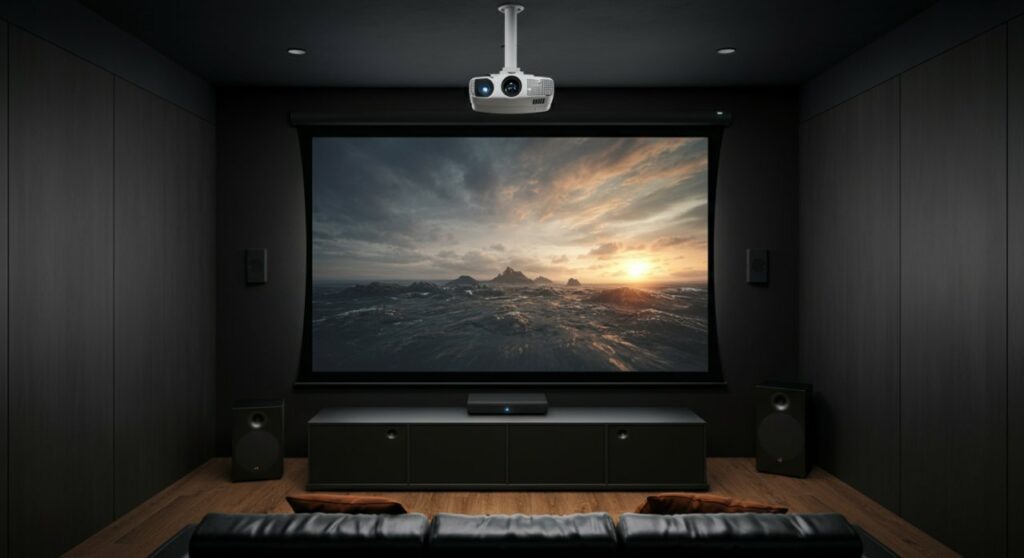
TL;DR: Quick Summary
- White backgrounds are ideal for balanced color reproduction and high brightness.
- Light gray backgrounds (High Contrast) are better for increasing black levels in rooms with some ambient light.
- Specialized screens (ALR – Ambient Light Rejecting) are the best investment for daytime viewing.
- Avoid textured walls, as they cause image artifacts and “sparkles” that ruin high-definition clarity.
Why a White Background Matters for Projection
When people ask, “do you need a white background for a projector,” they are really asking about light reflection. A projector works by bouncing light off a surface; the surface material determines how much of that light returns to your eyes.
Standard white walls often contain pigments that aren’t perfectly neutral. This means your “true white” might appear slightly yellow or blue, ruining the color calibration of your media.
Furthermore, walls are often porous or bumpy. Even minor surface texture can cause the light to scatter unevenly, resulting in a loss of sharpness that makes 4K content look like a lower resolution.
Comparing Projection Surface Options
Choosing the right surface depends heavily on your room’s lighting conditions and the quality of your projector.
| Surface Type | Best For | Pros | Cons |
|---|---|---|---|
| White Wall | Casual/Budget | No cost, accessible | Low contrast, color shift |
| Matte White Screen | Dark rooms | Accurate colors, wide viewing angle | Washes out in ambient light |
| Gray Screen | Mixed-use rooms | Improved black levels | Slightly darker image |
| ALR Screen | Living rooms | High contrast in daylight | Expensive, narrow angle |
Practical Steps to Optimize Your Projector Background
If you are deciding between a wall and a screen, follow these steps to achieve a cinema-quality setup.
Evaluate Your Room Lighting
If your room is a dedicated blackout theater, a matte white screen is the industry standard for color accuracy. If you plan to watch in the daytime, look for a High Contrast Gray screen to help maintain deep blacks.
Check for Texture
Run your hand across your wall. If you feel any bumps, bumps, or orange peel texture from paint rollers, you will see that texture during bright scenes. If your wall isn’t perfectly smooth, a dedicated pull-down screen is a necessary upgrade.
Consider Specialized Projector Paint
If you must use a wall, avoid standard flat wall paint. Invest in reflective projection paint specifically formulated to optimize gain—the measure of how much light a surface reflects.
Expert Tips for Improving Image Quality
From my experience installing home theaters, the most common mistake is neglecting the surrounding environment. Even if you have a perfect white background, light reflecting off white side walls or ceilings will wash out your image.
- Darken the surroundings: Paint your ceiling and side walls a dark, matte color to reduce light bleed.
- Mind the Gain: A screen with a 1.0 gain reflects light equally in all directions, which is best for wide seating arrangements.
- Verify your projector: If you are using a low-lumen portable projector, a high-gain screen (1.2+) can help make the image pop.
Frequently Asked Questions (FAQs)
Does a black background work for a projector?
Generally, no. A black background absorbs most of the light from the projector, resulting in a dim, muddy image where colors are completely lost. Stick to white or neutral gray for the best results.
Can I use a bedsheet as a projector screen?
You can, but it is not recommended. Bedsheets are thin, causing light to pass through (loss of brightness), and the fabric texture is usually visible, which destroys image sharpness.
Is a white wall better than a cheap screen?
Usually, no. Even a budget portable screen is typically made from specialized vinyl or fabric designed to reflect light more efficiently than house paint.
How do I know if my wall is “white enough”?
Compare your wall to a standard sheet of printer paper under the same lighting. If the wall looks yellow or gray by comparison, your projector’s colors will be heavily distorted.