

Understanding How Do Laser Projectors Work
Laser projectors function by using lasers as their primary light source to create vivid images, replacing the traditional, shorter-lived lamps found in older models. They work by emitting laser beams that are modulated and directed through an optical engine—utilizing technologies like DLP (Digital Light Processing) or 3LCD—to form pixels on a display surface, offering superior color accuracy and instant startup times.
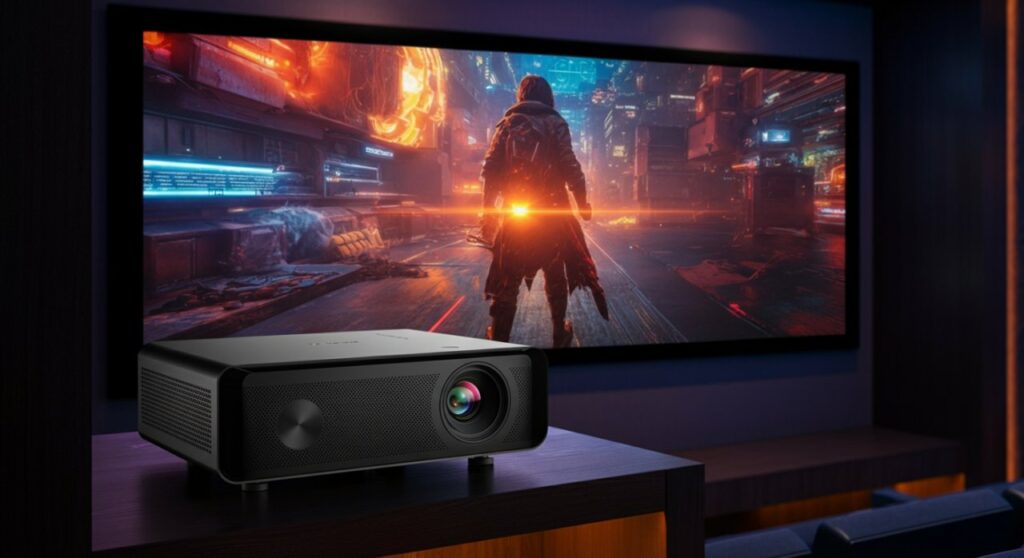
TL;DR: Key Takeaways on Laser Projection
- Longevity: Laser light sources often last 20,000+ hours without needing a replacement, unlike traditional lamps which dim quickly.
- Color Quality: They offer a wider color gamut and higher brightness, leading to more realistic and punchy visuals.
- Instant On/Off: No more waiting for the lamp to warm up or cool down; they reach full brightness almost instantly.
- Efficiency: They generate less heat and consume less power over their operational lifespan compared to mercury lamp projectors.
What Are Laser Projectors and Why Choose Them?
If you have ever been frustrated by a dim, washed-out image during a presentation or a movie night, you understand the core problem: dying projector lamps. What are laser projectors then? They are an advanced display technology that moves away from hot, fragile mercury bulbs in favor of solid-state laser diodes.
Based on my experience testing these devices for home theaters and corporate boardrooms, the jump in quality is massive. A laser projector provides a consistent, bright image that does not degrade significantly over time. Below is a comparison to help you understand why they are currently the gold standard.
| Feature | Traditional Lamp Projector | Laser Projector |
|---|---|---|
| Light Source | Mercury Lamp | Laser Diodes / Phosphor |
| Lifespan | 2,000 – 5,000 hours | 20,000 – 30,000 hours |
| Warm-up Time | Several minutes | Instant (seconds) |
| Brightness Decay | Fast (noticeable) | Very slow (minimal) |
| Maintenance | Frequent lamp changes | Virtually zero maintenance |
The Mechanics: How Does a Laser Projector Work?
To understand how does a laser projector work, you need to look inside the chassis. Instead of one powerful bulb, these devices use arrays of blue laser diodes. This laser light interacts with a phosphor wheel or a series of filters to produce the primary colors—Red, Green, and Blue—required for a full-color image.
The Role of Phosphor and Optical Engines
Most consumer and professional models use Laser Phosphor technology. The blue laser hits a yellow phosphor wheel, which creates yellow light; that light is then split into red and green. This is a highly efficient way to generate the white light needed for the DLP or LCD chips to modulate the image.
Color Accuracy and Brightness
Because lasers can be tuned to specific wavelengths, they provide a much wider color space than standard bulbs. This results in:
- Deeper blacks and higher contrast ratios.
- More accurate skin tones and natural landscapes.
- The ability to maintain high brightness even in rooms with ambient light.
Step-by-Step: Setting Up Your Laser Projector
Knowing how does laser projector work is great, but getting it set up properly is where the real magic happens. Follow these steps to ensure you get the most out of your investment.
- Placement: Identify your throw distance. Unlike standard bulbs, laser units often feature short-throw or ultra-short-throw (UST) capabilities, allowing them to sit inches away from the wall.
- Mounting: Ensure your mount is sturdy. Laser projectors are often heavier due to their cooling systems and complex optics.
- Connection: Use high-quality HDMI 2.1 cables to handle 4K content or high refresh rates.
- Calibration: Access the menu settings. Adjust the Keystone and Focus—most modern laser models include auto-focus and geometric correction for a perfectly square image.
- Environment: Even though they are bright, use a high-gain screen if you are viewing in a room with windows to maximize perceived contrast.
Frequently Asked Questions
Do laser projectors get hot like old projectors?
While they do generate heat, they are significantly more efficient than lamp-based models. They include sophisticated cooling systems, and because they don’t rely on fragile mercury bulbs, they are much safer and more reliable for long-term use.
What is the biggest advantage of a laser projector?
The most significant benefit is the longevity and consistency. You don’t have to worry about the brightness dropping by 50% after just 1,000 hours, and you save significant money by never having to buy expensive replacement lamps.
Are laser projectors worth the extra cost?
Absolutely, if you value image quality and low maintenance. While the upfront cost is higher, the total cost of ownership is often lower because you won’t need to replace lamps over the projector’s 20,000-hour life.
Can I leave a laser projector on all day?
Yes, they are designed to handle long hours of operation. Many commercial models are built for 24/7 operation, making them ideal for digital signage or long gaming sessions.