
Finding Lost Bluetooth Headphones When Powered Off
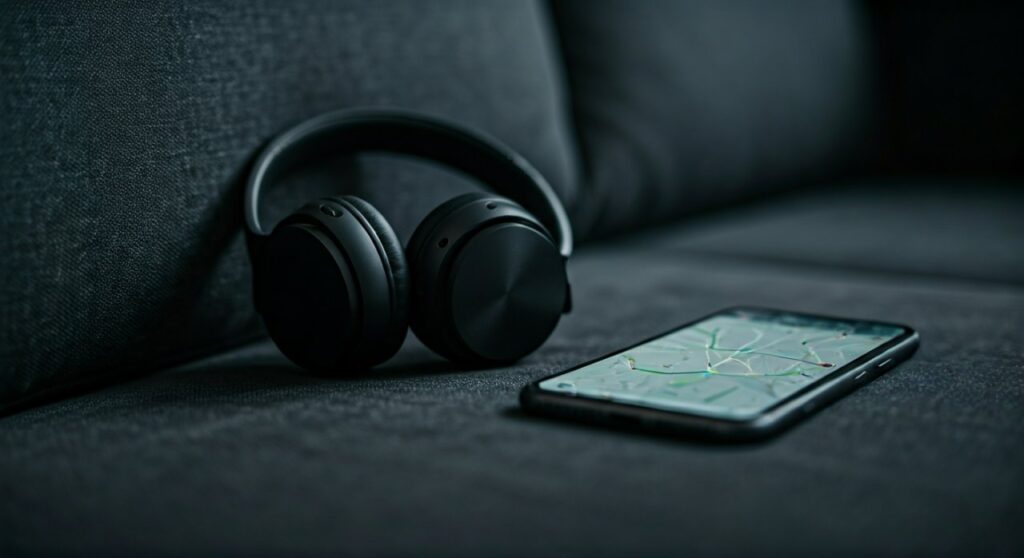
To find Bluetooth headphones that are turned off, you must rely on the Last Known Location feature provided by apps like Apple Find My, Google Find My Device, or proprietary brand apps (Sony, Bose, Tile). Because a powered-off device cannot broadcast a live signal, these digital maps show you exactly where the headphones were the moment they lost connection or power. If digital tracking fails, you must employ a Systematic Physical Search using the “Grid Method” in the areas identified by your tracking history.
Key Takeaways: How to Locate Powered-Off Headphones
If you are in a rush, here is the essential strategy for locating your missing gear:
- Check the Map First: Use the Find My (iOS) or Find My Device (Android) app to see the final GPS ping before the battery died.
- Brand Apps: Open apps like Sony Headphones Connect, Bose Music, or Sennheiser Smart Control which often have independent location logging.
- Physical Search: Check “Micro-locations” like jacket pockets, couch crevices, and gym bags.
- Future Proof: Consider attaching a Tile or AirTag to the case once found.
The Reality of Tracking “Dead” Bluetooth Devices
Finding a device that is powered off is significantly harder than finding one that is active. When your Bluetooth headphones are on, they emit a signal that apps can “sniff” out. Once the power is cut, the signal vanishes.
However, modern ecosystems have evolved. For example, Apple’s Find My Network uses a crowdsourced mesh of billions of devices. Even if your headphones are “off” or “sleeping,” some high-end models (like AirPods Pro 2) retain a tiny reserve of power to ping nearby iPhones.
If you own standard Bluetooth buds, you are essentially looking for a “digital breadcrumb.” You aren’t tracking a moving target; you are visiting the last place the target was “alive.”
Step 1: Use Ecosystem Tracking (Apple & Android)
Most users don’t realize that their phones are constantly logging the location of connected Bluetooth peripherals. This is your most powerful tool.
For Apple Users (AirPods, Beats, etc.)
Apple’s integration is the gold standard for recovery. Even if the headphones are off, the Find My app is your first stop.
- Open the Find My app on your iPhone or iPad.
- Select the Devices tab.
- Locate your headphones in the list.
- The map will show the Last Known Location. If the icon is gray, it is currently offline/off, but the address listed is where it was last seen.
- Use the Directions button to navigate to that spot.
For Android Users (Google Find My Device)
Google has recently upgraded its network to compete with Apple. If you use Fast Pair with your headphones, they are likely linked to your Google account.
- Go to android.com/find or open the Find My Device app.
- Sign in to your primary Google account.
- Select your headphones from the device tray at the top.
- Check the timestamp. It will tell you the last time the headphones synced with a Google-enabled phone.
Step 2: Leverage Brand-Specific Recovery Apps
Many premium manufacturers include “Find My Buds” features within their own software. These often provide more granular data than generic OS trackers.
| Brand | App Name | Recovery Feature |
|---|---|---|
| Sony | Sony Headphones Connect | Logs GPS via smartphone location |
| Bose | Bose Music / Bose Connect | “Find My Buds” shows last sync point |
| Jabra | Jabra Sound+ | “Find My Jabra” keeps a location history |
| Samsung | Galaxy Wearable | Integrated with SmartThings Find |
| Sennheiser | Smart Control | Basic last-seen location logging |
Expert Insight: I once lost my Sony WH-1000XM4 headphones at a crowded airport. The Google tracker was vague, but the Sony Headphones Connect app showed a precise pin at the specific terminal gate because I had opened the app to adjust noise-canceling settings minutes before boarding. Always check the proprietary app first!
Step 3: Conducting a Systematic Physical Search
When the map leads you to your house but the headphones are still nowhere to be found, it is time for a manual sweep. Don’t just wander aimlessly; use a professional search protocol.
The “Grid Method”
Divide your room into four quadrants. Search each quadrant from floor to ceiling. People often forget to look up—check shelves or the tops of refrigerators where you might have set them down while reaching for something else.
Check the “Habit Zones”
Research suggests we lose items in the same few places. Check these high-probability areas:
- The Laundry Pile: Did you leave them in a hoodie pocket?
- The “Couch Abyss”: Reach deep into the crevices between cushions.
- Charging Stations: Did you move them near a cable but forgot to actually plug them in?
- The Bathroom Counter: A common “drop zone” when getting ready in the morning.
Step 4: Using Bluetooth Scanner Apps (The “Brief Power” Hack)
Sometimes, headphones aren’t truly “off,” but in a deep sleep mode. They might wake up for a split second if they move or if a known device is near.
Download an app like Wunderfind or Bluetooth Finder.
- Walk slowly through your home.
- Hold your phone low to the ground and then high in the air.
- If the headphones have even 1% battery or a “wake-on-proximity” feature, the scanner might show a signal strength (RSSI) spike.
- If the signal strength increases as you move toward a closet, you’ve found your “cold” device.
Step 5: How to Prevent Losing Your Headphones Again
Once you recover your headphones, you should implement a “Recovery Stack” to ensure you never go through this stress again.
- Enable “Notify When Left Behind”: On iPhone, go to Find My > Devices > [Your Headphones] > Notify When Left Behind. Your phone will buzz the moment you walk 50 feet away from them.
- Use a Tracking Tag: For over-ear headphones, I recommend sticking a Tile Sticker inside the ear cup (if there is room) or on the case. For earbuds, use a case cover that has a slot for an Apple AirTag.
- The “Designated Spot” Rule: Always return your headphones to the same charging dock or hook. Physical habits are more reliable than any GPS chip.
Comparison: Digital Tracking vs. Physical Searching
| Feature | Digital Tracking (App) | Physical Searching |
|---|---|---|
| Best For | Finding the general area (e.g., the park, the office) | Finding the exact spot (e.g., under the car seat) |
| Requirement | Previous sync + GPS enabled | Patience and a flashlight |
| Accuracy | 10 – 50 meters | Inches |
| Success Rate | High (for broad areas) | High (for confined spaces) |
Frequently Asked Questions (FAQs)
Can I find my headphones if the battery is completely dead?
Yes, but only their last known location. You cannot track a dead battery in real-time. You must go to the last place they were powered on and search that immediate area manually.
Does “Find My” work if the headphones are inside their case?
For many earbuds (like older AirPods), being inside the case effectively “hides” them from Bluetooth scans. However, newer models like AirPods Pro (2nd Gen) have speakers and U1 chips in the case itself, allowing them to be found even when the buds are tucked away.
Will resetting my phone lose the location of my headphones?
The location is usually tied to your Cloud Account (iCloud or Google Account), not just the physical phone. If you log into another device with the same account, the last known location should still be visible.
What should I do if the map shows my headphones are at a stranger’s house?
Do not confront them. This suggests the headphones were picked up. Use the “Mark as Lost” feature in your app, which allows you to display a message with your phone number on the finder’s screen if they ever try to pair them.