
To keep your headphones untangled, you should use the “Over-Under” wrapping technique or secure them using a dedicated storage case or a simple binder clip. These methods prevent loops from sliding through each other, which is the primary cause of spontaneous knotting in pockets and bags.
Few things are as frustrating as pulling a pair of wired earbuds out of your pocket only to find a chaotic “spaghetti mess.” It feels like the wires have a mind of their own, twisting into impossible knots the second you look away. Whether you are using high-end In-Ear Monitors (IEMs) or standard 3.5mm earbuds, mastering a few professional techniques will save your hardware and your sanity.
Key Takeaways: How to Keep Headphones Untangled
If you are in a hurry, here are the most effective strategies used by audio professionals:
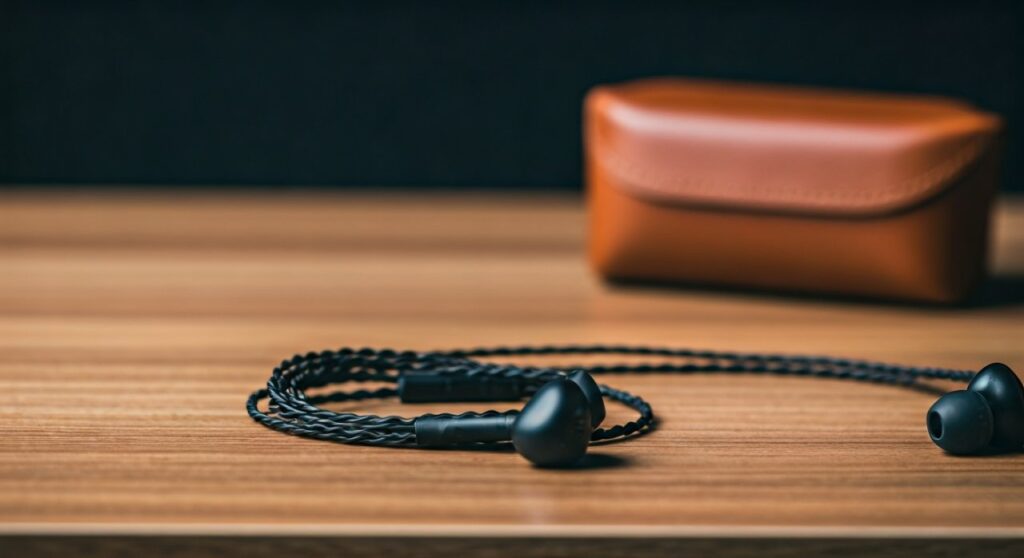
- The Over-Under Wrap: The “gold standard” for preventing cable memory and tangles.
- The Figure-8 Method: Ideal for shorter earbuds to prevent internal wire strain.
- Use Household Items: Binder clips, old credit cards, or mint tins make excellent DIY organizers.
- Invest in a Case: Hard-shell EVA cases provide the best protection against both tangles and physical damage.
- Avoid Tight Coils: Never wrap cables tightly around your phone or media player, as this causes internal copper fatigue.
| Method | Best For | Difficulty | Protection Level |
|---|---|---|---|
| Over-Under Wrap | Long cables / Professional IEMs | Medium | Very High |
| Figure-8 Wrap | Standard Earbuds | Easy | High |
| Binder Clip Hack | Budget-friendly organization | Very Easy | Medium |
| Dedicated Case | Travel and commuting | Easy | Maximum |
| Braided Sleeves | DIY enthusiasts | Hard | High |
Understanding the Physics: Why Do Headphones Tangle?
Before learning how to keep headphones untangled, it helps to understand why it happens. In 2007, researchers Raymer and Smith conducted a study on “spontaneous knotting of an agitated string.” They found that cables longer than 46 centimeters (about 18 inches) are almost guaranteed to knot when tossed loosely in a bag.
Most headphone cables are around 120cm (47 inches). Because they are flexible and made of PVC or TPE (Thermoplastic Elastomer), they have a high degree of “entropy.” When you move, the ends of the cables weave through the loops, creating complex knots. Using a structured wrapping method reduces this movement.
The Professional Choice: The “Over-Under” Wrapping Method
Audio engineers and roadies use the Over-Under wrap for every cable, from XLR studio lines to consumer headphones. This technique neutralizes the natural “twist” of the wire, ensuring it uncoils perfectly every time without a single kink.
- Hold the earbud drivers in your dominant hand.
- With your other hand, create the first loop normally (the “Over” part).
- For the second loop, flip your wrist inward so the cable comes from the “under” side (the “Under” part).
- Repeat this alternating pattern until the cable is fully coiled.
- Secure the end with a Velcro tie or a silicone strap.
I have used this method for my Sennheiser and Audio-Technica monitors for years. It doesn’t just prevent tangles; it extends the life of the internal copper strands by preventing “cable memory” issues.
How to Keep Headphones Untangled Using the Figure-8 Technique
If the Over-Under method feels too technical, the Figure-8 wrap is the next best thing. This is specifically effective for shorter earbud cables and prevents the “loop-through” effect that leads to knots.
- Extend your index and pinky fingers like “devil horns.”
- Hold the earbuds against your palm with your thumb.
- Wrap the wire in a cross-pattern (a figure-8) around your two extended fingers.
- Leave about 3-4 inches of slack at the end.
- Wrap that remaining slack around the center of the “8” and tuck the 3.5mm jack through one of the loops.
This method keeps the tension balanced. Unlike circular wrapping, the Figure-8 doesn’t put unequal pressure on one side of the insulation, which prevents the wire from becoming permanently “wiggly” over time.
DIY Solutions: Using Household Objects as Organizers
You don’t need to spend money on fancy gadgets to learn how to keep headphones untangled. Some of the best solutions are already sitting in your desk drawer.
The Binder Clip Strategy
Attach a small or medium binder clip to the edge of your desk or your backpack strap. Thread the headphones through the silver “wings” of the clip. You can also wrap the wire around the metal arms to keep it taut and organized while on the go.
The Old Credit Card Hack
Take an expired credit card or a plastic gift card. Cut two small notches on one of the long sides and one notch on the opposite side.
- Slide the earbuds into the first two notches.
- Wrap the cord around the length of the card.
- Secure the audio jack in the final notch.
This creates a flat profile that fits perfectly in a slim pocket.
The Mint Tin (Altoids) Method
A classic Altoids tin is the perfect size for a coiled pair of headphones. Line the inside with a small piece of felt or foam to prevent the metal from scratching your earbuds. This provides a “hard shell” protection that fabric pouches cannot match.
Expert Advice on Material Choices: Braided vs. Rubber Cables
If you are tired of wondering how to keep headphones untangled, you might want to look at the material of your next pair. Not all cables are created equal when it comes to “tangle resistance.”
- Braided Nylon Cables: These are generally much stiffer than standard rubber. This stiffness acts as a natural deterrent to knotting because the cable cannot bend sharply enough to loop through itself.
- Flat “Noodle” Cables: Popularized by brands like Beats by Dre, flat cables are wider in one dimension. This geometry makes it physically harder for the cable to twist, significantly reducing tangles.
- TPE Coating: High-quality TPE (Thermoplastic Elastomer) is less “sticky” than cheap PVC. Cheap PVC cables often “grab” onto themselves, which tightens knots that would otherwise slide out.
Long-Term Maintenance: Fixing “Cable Memory”
Sometimes, even if you know how to keep headphones untangled, your wires stay kinky and twisted. This is called “cable memory.” The plastic insulation has “remembered” the tangled shape.
To fix this, experts suggest a “low-heat reset.” Hang your headphones by the earbuds (letting the jack dangle) in a warm room, or gently run a hair dryer (on the lowest setting) along the length of the wire while pulling it straight. Warning: Do not get the heat too close, as you can melt the insulation. This softens the plastic, allowing it to return to a straight, neutral state.
Strategic Storage: Where You Put Them Matters
The “where” is just as important as the “how.” If you throw your headphones into a bag with keys, pens, and loose change, they will tangle regardless of how well you wrapped them.
- Dedicated Pockets: Use the small internal “tech” pockets in modern backpacks.
- Magnetic Organizers: You can buy small magnetic clips that snap around the coiled wire. These are incredibly fast to use during a commute.
- The “Shirt Clip”: If you use headphones while running, use a shirt clip to keep the cable from bouncing. Bouncing creates the mechanical agitation that starts knots.
Frequently Asked Questions (FAQs)
Does wrapping headphones around my phone damage them?
Yes, wrapping headphones tightly around a phone or MP3 player causes sharp bends at the stress relief point (where the wire meets the jack). Over time, this snaps the internal copper wires, leading to one earbud cutting out.
Why do my headphones tangle even when I am not moving?
Even small movements, like walking or shifting your bag, cause the ends of the cable to vibrate. Due to the physics of entropy, there are thousands of ways a cable can be knotted but only one way it can be straight. Statistics are simply against you.
Are wireless headphones the only real solution?
While True Wireless Stereo (TWS) earbuds like Apple AirPods or Sony WF-1000XM5 eliminate the wire entirely, many audiophiles prefer wired sets for better sound quality and zero latency. Learning proper wrapping techniques gives you the best of both worlds.
How do I clean a cable that has become “sticky” and prone to tangling?
Over time, skin oils and sweat can degrade the plastic coating, making it “tacky.” Wipe the cable down with a soft cloth dampened with a small amount of isopropyl alcohol (70%). This removes the residue and allows the cable to slide smoothly again.