
What Are Monitor Headphones? The Truth About Studio Sound
What are monitor headphones? Monitor headphones, also known as studio headphones, are professional audio tools designed for accurate, flat-frequency sound reproduction. Unlike consumer headphones that boost bass or treble to make music “fun,” monitor headphones provide a “clinical” or “uncolored” sound. This allows producers, engineers, and audiophiles to hear every flaw, detail, and frequency balance in a recording exactly as it exists.
If you have ever wondered why your favorite tracks sound different in your car versus your earbuds, you’ve experienced the “coloring” of audio. Professional creators use monitor headphones to eliminate this guesswork. They are built for critical listening, providing the transparency needed to ensure a mix sounds great on every playback system.
Key Takeaways: TL;DR
- Flat Frequency Response: They do not artificially boost bass or treble.
- Accuracy Over Comfort: Designed for clinical analysis, though professional models are built for long-wear durability.
- Closed-Back vs. Open-Back: Closed-back is for recording; Open-back is for mixing and mastering.
- High Impedance: Many professional monitor headphones require an amplifier (AMP) or audio interface to reach full potential.
- Durability: Usually feature modular parts (replaceable pads/cables) to withstand years of studio abuse.
The Core Difference: Monitor Headphones vs. Consumer Headphones
To truly understand what are monitor headphones, you must understand what they are not. Consumer brands like Bose, Beats, or Sony’s consumer line prioritize “enjoyment.” They often use a “V-shape” sound profile, which pumps up the bass and sharpens the highs to make music feel more energetic.
While this is great for the gym or a commute, it is a nightmare for a sound engineer. If your headphones are already boosting the bass, you might mistakenly lower the bass in your mix. When you play that mix on a standard speaker, it will sound thin and weak.
| Feature | Monitor Headphones | Consumer Headphones |
|---|---|---|
| Sound Profile | Flat / Neutral (No coloration) | Enhanced Bass/Treble (V-Shaped) |
| Purpose | Audio Production / Critical Listening | General Music Consumption / Travel |
| Soundstage | Precise Imaging and Separation | Immersion and Noise Cancellation |
| Build Quality | Industrial, Modular, Durable | Fashionable, Often Plastic-Heavy |
| Isolation | High (Closed-back) or Zero (Open-back) | Active Noise Cancelling (ANC) often included |
Why Accuracy Matters in Professional Audio
When I first started mixing audio in a home studio, I used high-end consumer headphones. I thought they sounded “better” because the kick drum was thumping. However, when I sent my work to a professional studio, the engineer asked why the vocals were so muddy and the low end was missing.
That was the moment I realized the importance of what are monitor headphones. They act as a “magnifying glass” for sound. In my experience, using a pair of Beyerdynamic DT 770 Pros for the first time was jarring. The music sounded “boring” and “dry.” But then, I heard a faint hiss in my recording that I never knew existed. I found a clicking noise in the background of the vocal track.
This Information Gain is why professionals pay a premium. You aren’t paying for “good” sound; you are paying for the honest sound.
Types of Monitor Headphones: Choosing Your Tool
Not all monitor headphones are created equal. Depending on your task—whether it is recording a podcast, mixing a rock song, or simply enjoying high-fidelity audio—the design matters immensely.
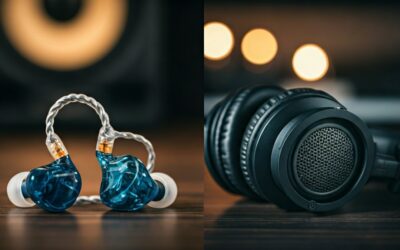
Closed-Back Monitor Headphones
These are the most common. The ear cups are completely sealed, preventing sound from leaking out and blocking external noise from coming in.
- Best For: Tracking/Recording. Musicians use these so the “click track” doesn’t bleed into the microphone.
- Popular Models: Audio-Technica ATH-M50x, Sony MDR-7506.
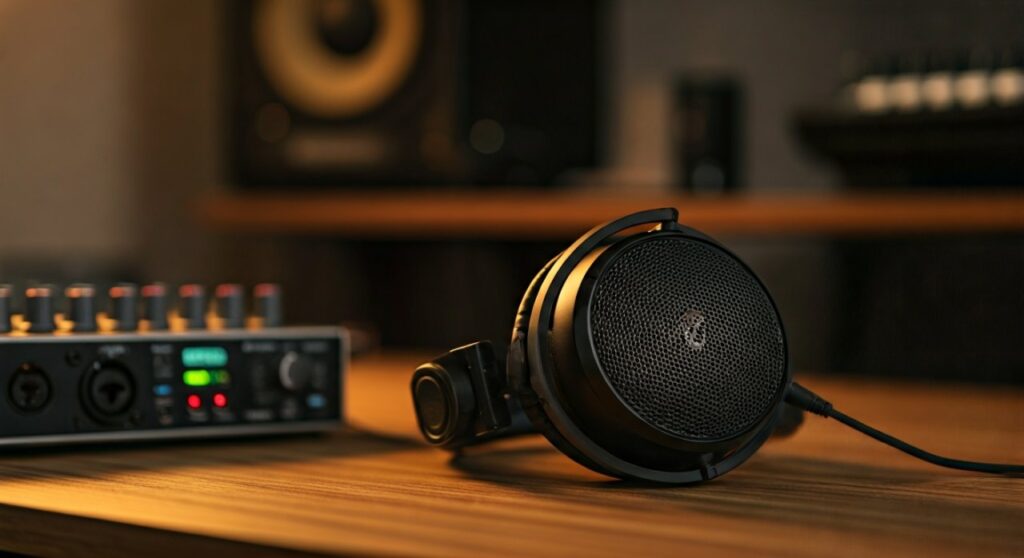
Open-Back Monitor Headphones
The back of the ear cups is perforated or open, allowing air and sound to move freely.
- Best For: Mixing and Mastering. They provide a wider soundstage and more natural stereo imaging. It feels like the sound is “around” you rather than “inside” your head.
- Popular Models: Sennheiser HD 600, Beyerdynamic DT 990 Pro.
Semi-Open Headphones
A middle ground that offers some isolation but maintains a more natural soundstage than fully closed designs.
- Popular Model: AKG K240.
How to Choose the Right Monitor Headphones: A Step-by-Step Guide
If you are looking to buy your first pair, follow this systematic approach used by professional audio consultants.
Step 1: Identify Your Primary Use Case
Are you recording vocals? Get Closed-Back. Are you mixing a podcast or music at home? Get Open-Back. If you need one pair for everything, the ATH-M50x is a versatile industry standard.
Step 2: Check the Impedance (Ohms)
Monitor headphones often come in different Impedance levels (measured in Ohms).
- 32 – 50 Ohms: Can be powered by a laptop or smartphone.
- 250+ Ohms: Requires a dedicated Audio Interface (like a Scarlett 2i2) or a Headphone Amplifier.
Expert Tip: Higher impedance often results in more precise driver control, but you must* have the power to drive them.
Step 3: Evaluate Frequency Response
Look for a wide range, typically 5Hz to 30kHz. While the human ear generally only hears 20Hz to 20kHz, the extended range ensures that the frequencies within our hearing range remain stable and undistorted.
Step 4: Prioritize Comfort and Parts Availability
In a studio, you might wear these for 8 hours. Look for:
- Velour pads (breathable) vs. Leatherette (better isolation).
- User-replaceable cables. Cables are the first thing to break; don’t buy a pair where the cable is hard-wired if you plan on heavy use.
Technical Specifications You Need to Know
To truly answer what are monitor headphones, we have to look at the data. Professional manufacturers provide detailed charts showing the Frequency Response Curve.
- Total Harmonic Distortion (THD): Professionals look for a THD of less than 0.1%. This ensures that the signal coming out is a 1:1 match of the signal going in.
- Sensitivity: This tells you how loud the headphones will be at a certain power level. Most studio monitors sit between 90dB and 105dB SPL/V.
- Driver Size: Most use 40mm to 50mm drivers. Larger drivers can move more air, often resulting in more accurate low-end reproduction without distortion.
Common Myths About Monitor Headphones
Myth 1: They are “Better” for listening to music.
Reality: Not necessarily. If you enjoy a “warm” sound with heavy bass, monitor headphones might sound thin or fatiguing to you. They are tools for work, not necessarily for leisure.
Myth 2: You need to spend $1,000 to get “Real” monitor headphones.
Reality: Some of the most famous records in history were mixed on the Sony MDR-7506, which costs around $100. Accuracy is more about knowing your gear than the price tag.
Myth 3: They don’t need an Amp.
Reality: Many high-end models like the Sennheiser HD 650 will sound quiet and “lifeless” without a proper amplifier. Always check the Ohm rating before buying.
FAQs: Everything Else You Need to Know
Can I use monitor headphones for gaming?
Yes. In fact, many competitive gamers prefer open-back monitor headphones because the wider soundstage helps them locate footsteps and directional cues more accurately than “Gaming Headsets” which often have bloated bass.
Why do monitor headphones usually have coiled cables?
Coiled cables are a studio staple because they allow the engineer to move around a large mixing console without the cable dragging on the floor or getting tangled in chair wheels, while still providing length when needed.
Do I need to “Burn-In” my monitor headphones?
This is a debated topic. While some experts believe the mechanical components (diaphragm) need 40-50 hours of use to “loosen up,” many modern tests show the difference is negligible. The most important “burn-in” is your brain getting used to the neutral sound profile.
What is the difference between “Studio” and “Monitor” headphones?
In the industry, these terms are used interchangeably. Both refer to headphones designed for accuracy and professional audio work.
Final Verdict: Should You Buy Monitor Headphones?
Understanding what are monitor headphones is the first step toward better audio. If you are a creator, a podcaster, or a budding musician, they are an essential investment. They provide the “truth” in a world of filtered and enhanced audio.
In my professional opinion, if you want one pair of headphones that will last a decade and help you produce better content, start with a pair of Closed-Back monitors. They offer the most versatility for both recording and listening in semi-noisy environments.