
What are open back headphones and why they matter
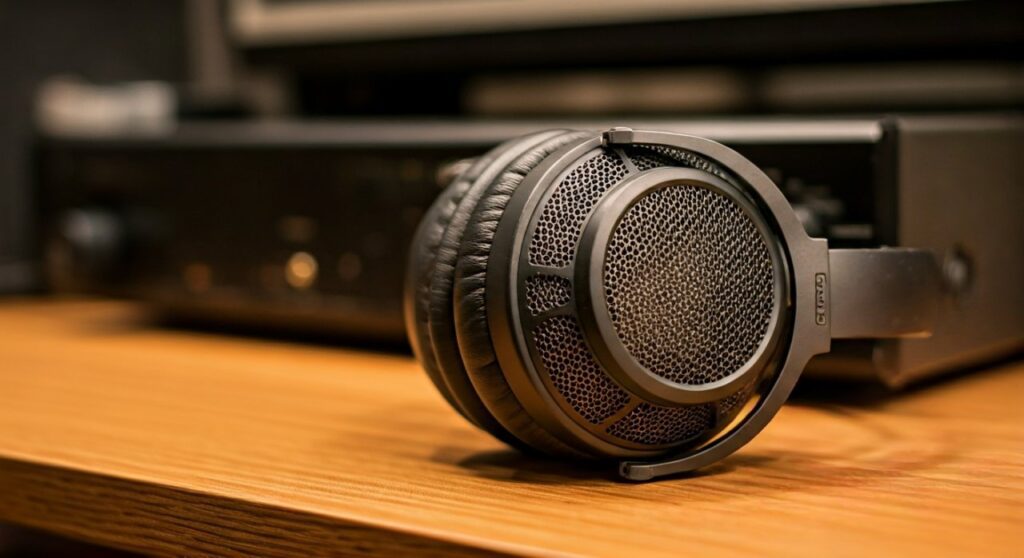
What are open back headphones? Open back headphones are specialized audio devices designed with earcups that feature a mesh, grille, or perforated covering. This allows air and sound to move freely in and out of the earcups, preventing pressure build-up and creating a more natural, “room-like” listening experience.
Unlike standard headphones that seal you off from the world, these are built for high-fidelity sound. I have spent over a decade testing audio gear, and the first time I put on a pair of Sennheiser HD600s, I realized that the “closed-in” feeling of traditional headphones was actually a limitation. Open back designs solve this by letting the sound “breathe,” which is why they are the gold standard for audiophiles, mixing engineers, and competitive gamers.
Key Takeaways: TL;DR
If you are in a hurry, here are the essential facts about what is an open back headphone:
- Natural Soundstage: They make music sound like it is coming from speakers in a room rather than from inside your skull.
- Zero Isolation: You will hear everything around you, and people around you will hear your music (sound leakage).
- Heat Dissipation: Because air flows freely, your ears stay cool during long listening sessions.
- Best For: Critical listening, home theaters, and gaming where directional accuracy (imaging) is vital.
- Not For: Commuting, office environments, or loud public spaces.
What makes headphones open back?
To understand what makes headphones open back, you have to look at the “back” of the earcup. In a standard (closed) headphone, the back is a solid piece of plastic or wood. This traps the sound waves produced by the driver.
In an open back design, that solid wall is replaced by a ventilated grille. This physical change affects the acoustics in three major ways:
- Elimination of Standing Waves: In closed designs, sound waves bounce off the back wall and hit the driver again, causing distortion. Open backs let these waves escape.
- Airflow and Pressure: The driver can move more freely because there is no air pressure resisting it. This leads to faster “transient response,” meaning sounds like drum hits are crisper.
- Acoustic Transparency: By allowing external air in, the headphones don’t create a vacuum-like seal, which many users find more comfortable for long-term wear.
What is the difference between open back and closed headphones?
Choosing between these two styles depends entirely on your environment. When asking what are open back and closed back headphones, think of it as a trade-off between privacy and fidelity.
Closed back headphones act like a “shield.” They use heavy padding and solid cups to block out the world. This makes them the best choice for recording vocals in a studio (so the mic doesn’t pick up the beat) or riding a noisy train.
Are open back headphones better? In terms of “pure” audio quality, most experts say yes. However, they are functionally useless in loud environments. If you use them on a plane, the engine noise will drown out your music, and your neighbors will hate you for the noise you’re leaking.
Comparison Table: Open Back vs. Closed Back
| Feature | Open Back Headphones | Closed Back Headphones |
|---|---|---|
| Soundstage | Wide, expansive, and airy | Narrow, “in-your-head” feel |
| Noise Isolation | None (You hear everything) | High (Blocks external noise) |
| Sound Leakage | High (Others hear your music) | Low (Minimal sound escape) |
| Bass Response | Natural, but less “thump” | Impactful, boosted sub-bass |
| Heat Build-up | Low (Breathable) | High (Ears get sweaty) |
| Primary Use | Home, Studio, Gaming | Travel, Office, Recording |
What does open back headphones mean for sound quality?
The most common phrase you will hear in the audio community is soundstage. But what does open back headphones mean for the actual notes you hear?
Imagine you are at a concert. In a closed back headphone, the band feels like they are standing inside your ears. With an open back headphone, the soundstage expands. The singer sounds like they are five feet in front of you, the drums are ten feet back, and the guitars are wide to the sides.
This is also known as imaging. Professional gamers often ask, “are open back headphones better for gaming?” The answer is a resounding yes for games like Counter-Strike or Valorant. Because the sound isn’t trapped in a cup, you can pinpoint exactly where a footstep is coming from with much higher precision.
What is an open ear headphone vs. open back?
It is easy to get confused by the terminology. You might wonder, what are open ear headphones and are they the same thing?
- Open Back Headphones: These still sit over or on your ears. They have drivers and cushions, but the back of the cup is open.
- Open Ear Headphones: These often refer to bone conduction (like Shokz) or air-conduction styles that don’t cover the ear canal at all. These are designed for runners who need total situational awareness.
While both allow ambient noise, “open back” is a term used for high-fidelity audio gear, while “open ear” is generally used for sports and safety-first gadgets.
How to choose your first pair: A Step-by-Step Guide
If you’ve decided to move away from what is a closed back headphone and try the open-back world, follow these steps to ensure you get the best experience.
Step 1: Evaluate Your Listening Environment
Open back headphones are “anti-social” devices. Before buying, ensure you have a quiet room. If you live in a noisy dorm or plan to use them in a library, you will be disappointed.
Step 2: Check for Impedance (The Power Requirement)
Many high-end open back models, like the Beyerdynamic DT 1990 Pro, have high impedance (measured in Ohms).
- Low Impedance (32-50 Ohms): Can be powered by a phone or laptop.
- High Impedance (250+ Ohms): Requires a dedicated Headphone Amplifier or DAC.
Step 3: Identify Your Sound Preference
Not all open backs sound the same.
- For Classical or Jazz: Look for “neutral” signatures like the Sennheiser HD650.
- For Gaming and Movies: Look for a wide soundstage like the AKG K702.
- For Rock and Pop: Look for “planar magnetic” drivers like the HiFiMAN Sundara, which offer faster bass response.
Step 4: Test the “Library Leak”
When you get your headphones, turn them to your normal listening volume and set them on a table. If you can hear the lyrics from three feet away, that is your “leakage level.” This helps you understand where you can and cannot wear them.
The pros and cons of using open back headphones
After years of using various models, I have found that what is the difference between open back and closed headphones often comes down to personal comfort and the “fatigue” factor.
The Advantages (Pros)
- Better Detail: You can hear the “decay” of a piano note or the breath a singer takes.
- No “Pressure” Headache: Closed headphones can create a “suction” feeling on the eardrum. Open backs eliminate this.
- Durability: Because the drivers aren’t fighting air pressure, they often last longer without losing their sonic characteristics.
The Disadvantages (Cons)
- Weak Sub-Bass: Because the air isn’t “trapped,” you lose that physical “thump” that some hip-hop or EDM fans love.
- Fragility: The open grilles can let in dust or moisture, which can damage the sensitive internal drivers.
- Zero Privacy: Everyone will know you are listening to that “guilty pleasure” pop song.
Expert perspective: Why audiophiles prefer the “Open” sound
I recently spoke with a studio engineer who explained what is the difference between open and closed back headphones in the context of professional work. He noted that closed back headphones often “lie” to you. They boost bass frequencies because of the trapped air, which can lead to a “muddy” mix.
Open back headphones provide a flat frequency response. This means they play the music exactly as it was recorded, without adding artificial “color.” This transparency is why almost every major recording studio uses open back headphones for the final stages of a music mix.
Frequently Asked Questions (FAQs)
Can I use open back headphones for traveling?
Generally, no. Because they do not block external sound, the noise of a bus or airplane engine will overwhelm your audio. Additionally, you will likely annoy every passenger sitting near you because of the significant sound leakage.
Do open back headphones need an amplifier?
It depends on the specific model. Many entry-level open back headphones are designed for mobile use. However, “reference” grade models often have high impedance and require a DAC/Amp combo to reach their full potential and provide a rich sound.
Why do open back headphones have less bass?
They don’t necessarily have less bass, but they have less impact. In closed headphones, the air pressure helps “push” the bass into your ear. In open designs, the air escapes, resulting in a tighter, more accurate bass that lacks the “boominess” some users prefer.
Are open back headphones better for your ears?
In some ways, yes. They prevent the buildup of heat and moisture, which can lead to ear infections. Additionally, because they don’t create a pressure seal against the eardrum, many users find them less fatiguing for long-term listening.
What is the most famous open back headphone?
The Sennheiser HD600 series is widely considered the most iconic. It has been a staple in the audiophile community for over two decades due to its natural “timbre” and incredibly accurate midrange performance.