
Understanding the Projector Throw Ratio
A throw ratio determines the relationship between the distance of your projector from the screen and the width of the projected image. Essentially, it tells you how large an image you can achieve from a specific distance, or conversely, how far back you need to place the projector to fill your desired screen size.
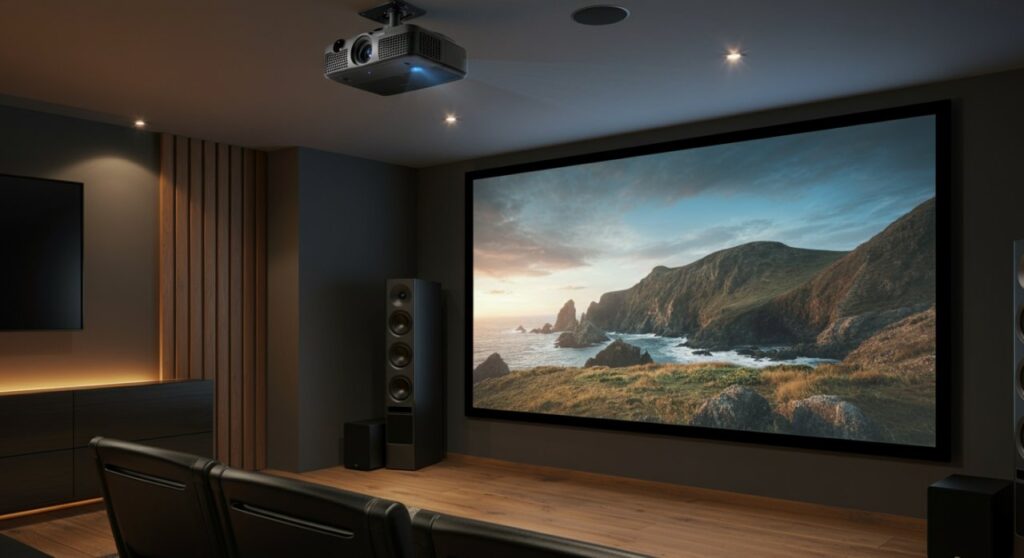
Understanding what is a throw ratio for a projector is the most critical step in avoiding installation headaches. If you ignore this metric, you may end up with an image that is either too large for your wall or too small to enjoy, regardless of the projector’s technical specifications.
TL;DR: Quick Guide to Throw Ratio
- Definition: Throw Ratio = Distance to Screen / Image Width.
- Standard Throw: Typically ranges from 1.5:1 to 2.0:1 (best for large rooms).
- Short Throw: Ranges from 0.4:1 to 1.0:1 (ideal for smaller spaces).
- Ultra-Short Throw (UST): Usually under 0.4:1 (designed to sit inches away from the wall).
- The Golden Rule: Always check the manufacturer’s specifications before drilling holes for your mount.
Why Knowing What Is a Projector Throw Ratio Matters
Many DIY enthusiasts focus entirely on lumens or 4K resolution while neglecting the physical constraints of their room. I learned this the hard way during my first home theater build; I bought a premium projector only to realize my room was too narrow to fill my 120-inch screen properly.
By understanding what is throw ratio for projectors, you can:
- Optimize Placement: Ensure the projector fits your furniture layout perfectly.
- Maximize Image Quality: Projectors work best when used within their designed focal range.
- Avoid Expensive Returns: Prevent the frustration of purchasing gear that physically cannot fit your space.
How to Calculate the Throw Ratio
Calculating the required placement is straightforward once you have the ratio. The formula is: Distance = Throw Ratio x Screen Width.
For example, if you have a projector with a 1.5:1 throw ratio and you want a 100-inch wide image:
- Calculation: 1.5 x 100 inches = 150 inches (12.5 feet).
- Result: You need to mount the projector exactly 12.5 feet from the screen.
Comparison Table: Common Throw Ratio Types
| Type | Throw Ratio Range | Best Use Case |
|---|---|---|
| Ultra-Short Throw | < 0.4:1 | Tight spaces, TV cabinets |
| Short Throw | 0.4:1 – 1.0:1 | Small rooms, gaming setups |
| Standard Throw | 1.0:1 – 2.0:1 | Living rooms, dedicated theaters |
| Long Throw | > 2.0:1 | Large halls, commercial auditoriums |
Expert Tips for Perfect Installation
When working with what is throw ratio on a projector, always account for optical zoom. Many projectors have a zoom lens, which provides a range of throw ratios (e.g., 1.4:1 to 1.8:1) rather than a single fixed number.
- Check the Lens Offset: Some projectors project the image slightly higher or lower than the center of the lens. Use lens shift features to adjust the image vertically or horizontally without distorting the geometry.
- Measure Twice, Drill Once: Physically place the projector on a temporary stand before mounting it to the ceiling. Ensure the image fits your screen edges perfectly.
- Consider Ambient Light: If you are using a short-throw projector in a bright room, pair it with an ALR (Ambient Light Rejecting) screen to maintain contrast.
Frequently Asked Questions
What is the difference between throw ratio and zoom?
Throw ratio defines the projection distance required for a specific image size. Zoom allows you to slightly adjust that image size from a fixed location, providing flexibility in where you can place the projector.
Can I change the throw ratio of a projector?
No, the throw ratio is a physical property of the lens design. While you can use the optical zoom to adjust the image size slightly, you cannot fundamentally change the projector’s throw capabilities after purchase.
What is the easiest way to find my projector’s throw ratio?
The most reliable method is to check the official product manual or use an online projector throw distance calculator. Most major brands like Epson, BenQ, or Optoma provide these tools on their websites.
Does a smaller throw ratio mean a better projector?
Not necessarily. It simply means the projector is designed for different environments. Short-throw projectors are better for small rooms, while standard-throw projectors are often preferred for larger, dedicated home cinema spaces.