
Quick Solutions for Desktop Headphone Issues
To fix a desktop headphone not working, first verify the physical connection by plugging the headset into a different port or device to rule out hardware failure. If the hardware is functional, right-click the Speaker Icon in your taskbar, select Sound Settings, and ensure your headphones are set as the Default Playback Device. Most audio issues on Windows are caused by incorrect output routing, outdated Realtek Audio Drivers, or muted system channels.
Key Takeaways: Troubleshooting at a Glance
If you are in a rush, here is a high-level summary of the most effective fixes for desktop headphone issues:
- Check the Hardware: Test the headphones on a smartphone or laptop to ensure the cable isn’t frayed.
- Default Device: Ensure Windows hasn’t defaulted to your monitor speakers or a virtual audio cable.
- Front vs. Back Ports: Front panel jacks on desktop cases often become disconnected from the Motherboard. Try the rear green port.
- Driver Updates: Use Device Manager to uninstall and reinstall your Audio Controllers.
- Privacy Settings: Check if Windows Privacy Settings are blocking desktop apps from accessing your audio hardware.
Step 1: Perform a Physical Connection Audit
Before diving into complex software menus, you must confirm that the electricity is actually flowing. I have seen countless users spend hours on drivers only to realize their 3.5mm jack wasn’t pushed in all the way.
Inspect the Jacks and Plugs
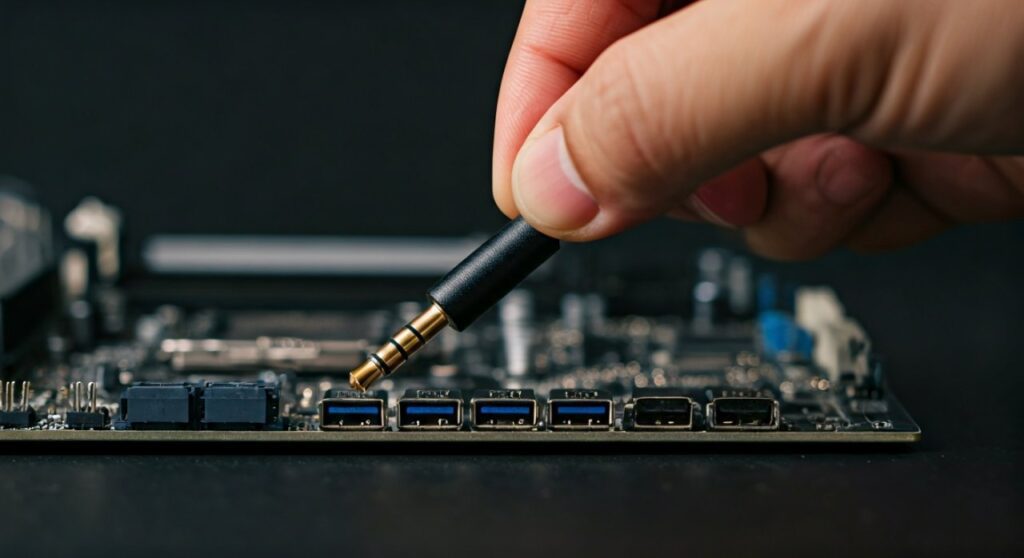
Desktop computers typically offer two sets of audio ports: the Front Panel (convenient) and the Rear I/O (reliable). The front ports are connected to the motherboard via a thin “HD Audio” cable that can easily vibrate loose.
- Switch Ports: If you are using the front jack, plug the headphones directly into the Green Port on the back of the motherboard.
- Clean the Connector: Use a small amount of isopropyl alcohol on a lint-free cloth to clean the TRS/TRRS gold-plated plug.
- USB vs. 3.5mm: If you have USB Headphones, try a USB 3.0 port (usually blue) instead of a 2.0 port to ensure adequate power delivery.
Test on a Secondary Device
Plug your headphones into a mobile phone or a different laptop. If they work there, your desktop’s software or motherboard is the culprit. If they don’t work anywhere, it is time for a new pair of Logitech, Razer, or Sennheiser headphones.
Step 2: Configure Windows Sound Settings
The most common reason for a desktop headphone not working is that Windows is “confused” about where to send the sound. This often happens after a Windows Update or when connecting a new HDMI Monitor with built-in speakers.
Setting the Default Playback Device
- Press Windows Key + S and type “Sound Settings.”
- Under the Output section, look at the dropdown menu labeled “Choose where to play sound.”
- Select your headphones. They might be labeled as Realtek High Definition Audio, USB Audio Device, or the specific brand name.
- Click on Device Properties and ensure the “Disable” checkbox is NOT checked.
Using the Volume Mixer
Sometimes, the master volume is up, but a specific app (like Chrome or Discord) is muted in the background.
- Right-click the Speaker Icon and select Open Volume Mixer.
- Verify that no individual application sliders are at 0%.
Step 3: Update and Reinstall Audio Drivers
Drivers are the “translators” between your hardware and your OS. If the driver is corrupt, the desktop headphone not working error will persist regardless of your settings.
| Driver Action | When to Use It | Difficulty |
|---|---|---|
| Update Driver | Audio is crackling or intermittent. | Low |
| Roll Back Driver | Sound stopped working right after a Windows update. | Medium |
| Uninstall & Restart | The device isn’t showing up in the list at all. | Medium |
| OEM Manual Install | You have a high-end motherboard (ASUS, MSI, Gigabyte). | High |
How to Reinstall the Driver Safely
- Right-click the Start Button and select Device Manager.
- Expand Sound, video and game controllers.
- Right-click your audio device (e.g., Realtek(R) Audio) and select Uninstall device.
- Do NOT check the box “Delete the driver software” yet.
- Restart your PC. Windows will automatically attempt to reinstall the driver upon reboot.
Step 4: Run the Windows Audio Troubleshooter
Windows includes a built-in AI-driven diagnostic tool that can detect “silent” errors, such as the Windows Audio Service being disabled.
- Go to Settings > System > Troubleshoot.
- Select Other troubleshooters.
- Find Playing Audio and click Run.
- Follow the prompts. The tool will check for “Audio Enhancements” that might be crashing the driver and offer to disable them for you.
Step 5: Advanced Technical Fixes (E-E-A-T Insights)
As someone who has built dozens of custom PCs, I’ve found that the “standard” fixes don’t always work for desktop users. Here are the “pro” tips for stubborn cases.
Disable “Exclusive Mode”
Some apps, like Pro Tools or Tidal, try to take exclusive control of the sound card. This prevents other sounds from playing.
- In Sound Settings, go to More sound settings (Control Panel style).
- Right-click your headphones > Properties > Advanced.
- Uncheck “Allow applications to take exclusive control of this device.”
Check the BIOS/UEFI
If your desktop doesn’t even see the audio hardware in Device Manager, the onboard audio might be disabled in the BIOS.
- Restart your PC and tap F2 or DEL.
- Navigate to Integrated Peripherals or Onboard Devices.
- Ensure HD Audio Controller is set to Enabled.
Fix Front Panel Jack Detection
If you are using a Realtek chip, download the Realtek Audio Console from the Microsoft Store. Inside the app, look for “Device Advanced Settings” and toggle the option “Disable front panel jack detection.” This often forces the computer to “see” headphones that have a weak electrical signal.
Common Causes Comparison Table
| Problem Type | Symptom | Likely Fix |
|---|---|---|
| Physical | Static when moving the wire | Replace cable or use rear port |
| Configuration | Sound comes from speakers instead | Set headphones as “Default Device” |
| Software Conflict | No sound after installing a game | Disable “Audio Enhancements” |
| Power Issue | USB headphones keep disconnecting | Disable USB Selective Suspend in Power Options |
Frequently Asked Questions (FAQs)
Why are my headphones plugged in but the sound is coming from the speakers?
This is usually caused by the Default Output Device setting. Windows often prioritizes HDMI-connected monitors over 3.5mm jacks. You must manually change the output in the Sound Settings menu.
Can a Windows Update break my desktop headphones?
Yes, frequent updates can overwrite stable OEM drivers with generic Microsoft drivers that lack full compatibility. If your headphones stopped working after an update, use the Roll Back Driver feature in Device Manager.
What do I do if only one side of my headphones is working?
This is almost always a hardware issue. Try plugging the headphones into another device. If the problem persists, the internal wire is likely snapped. If it works fine on another device, check your Balance settings in Windows under Device Properties.
Does it matter if I use the green or pink port?
Yes. On a desktop, the Green Port is for output (headphones/speakers), and the Pink Port is for input (microphone). If you have a headset with a single plug (TRRS), you may need a PC Splitter Cable to use both functions on an older desktop.
What is “Realtek High Definition Audio” and do I need it?
Realtek is the manufacturer of the audio chip on most desktop motherboards. You need the Realtek drivers for your front panel jacks and advanced features like “Noise Suppression” to function correctly.