
When choosing the best gear for the booth, knowing what to look for dj headphones involves prioritizing high sound isolation, rugged durability, and a sound profile that emphasizes low-end frequencies. Unlike studio headphones, DJ models must withstand high-volume environments and physical abuse while allowing you to hear the “clack” of a snare over a loud PA system.
Key Takeaways for Buying DJ Headphones
If you are in a rush to get to your gig, here are the essential factors to consider:
- Design: Always choose Closed-Back headphones to block out external club noise.
- Driver Sensitivity: Look for a high Sound Pressure Level (SPL)—ideally above 100dB—to ensure clarity at high volumes.
- Flexibility: Ensure the earcups have a swivel mechanism for single-ear monitoring.
- Cables: Coiled cables are preferred by pros to prevent tripping in the booth.
- Durability: Prioritize models with replaceable parts (cables and ear pads).
Why Standard Headphones Fail in the DJ Booth
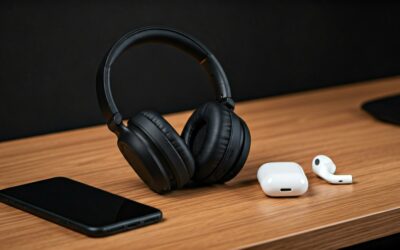
Most consumer headphones, like Apple AirPods or Bose QuietComfort, are designed for relaxed listening or travel. They often feature Active Noise Cancellation (ANC), which introduces a slight delay (latency) that makes beatmatching impossible.
When researching what to look for dj headphones, you must understand that the club environment is an entirely different beast. You are fighting against 110dB of room sound. Your headphones need to be a physical barrier, not just a sound source.
Professional DJ headphones use Passive Noise Isolation. This is achieved through thick padding and a high “clamping force” that creates a seal around your ears. Without this, you will find yourself cranking the volume to dangerous levels just to hear your cue track.
The Technical Checklist: What to Look for DJ Headphones
To make an informed purchase, you need to look past the marketing jargon and focus on the technical specifications that actually affect your performance.
Closed-Back vs. Open-Back Design
This is the most critical factor. Open-back headphones allow air (and sound) to pass through the earcups, which provides a natural soundstage for mixing music in a quiet studio.
However, for a DJ, open-back headphones are useless. You need Closed-Back headphones. They trap the sound inside and keep the “thump” of the club’s subwoofers out. This allows for precise monitoring of your next track without interference.
High Sound Pressure Level (SPL)
In a loud booth, your headphones need to be louder than the monitors. SPL measures how efficiently the headphones convert an electrical signal into sound.
- Pro Tip: Look for an SPL rating of 105dB to 115dB.
- Headphones with low sensitivity will distort when you try to push them to the levels required in a festival or club setting.
Impedance Matching
Impedance (measured in Ohms) determines how much power is required to drive the headphones.
- Low Impedance (25–50 Ohms): Ideal for DJs. These work perfectly with DJ controllers, laptops, and professional mixers without needing an external amplifier.
- High Impedance (above 100 Ohms): Generally found in studio gear. If you use these on a standard DJ controller, the volume will be too low and “thin.”
Comparing Top DJ Headphone Specifications
| Model | Design | Impedance | SPL | Key Feature |
|---|---|---|---|---|
| Sennheiser HD-25 | On-Ear | 70 Ohms | 120 dB | Fully modular/Indestructible |
| Pioneer HDJ-X10 | Over-Ear | 32 Ohms | 106 dB | Nano-coating for sweat |
| Technics EAH-DJ1200 | On-Ear | 45 Ohms | 106 dB | Swing arm for easy monitoring |
| V-MODA Crossfade M-100 | Over-Ear | 32 Ohms | 103 dB | Military-grade durability |
| Audio-Technica ATH-M50x | Over-Ear | 38 Ohms | 99 dB | Great crossover for studio/DJ |
Ergonomics and Physical Build Quality
When you are three hours into a set, the weight and fit of your gear matter. When considering what to look for dj headphones, pay close attention to the mechanical build.
Swivel and Pivot Mechanisms
DJs rarely keep both ears covered. You need to hear the “Master” output from the booth monitors with one ear while listening to the “Cue” track in the headphones with the other.
- Look for 90-degree swivels.
- The hinges should be made of reinforced metal or high-grade polymers. Plastic hinges are the #1 point of failure for touring DJs.
On-Ear vs. Over-Ear
- On-Ear (Supra-aural): Like the Sennheiser HD-25. They are lighter and cooler (less sweat), but can press against the ears, causing discomfort after several hours.
- Over-Ear (Circumaural): Like the Pioneer HDJ-X series. These surround the ear entirely. They offer superior isolation and comfort but can be bulky and make your ears feel hot.
Cable Versatility
Never buy fixed-cable headphones for DJing. If you step on your cable and jerk your head, a fixed cable will snap, and your headphones are dead.
- Detachable cables are a must.
- Coiled cables are the industry standard because they stretch when you move across the console but don’t tangle around your feet.
The “DJ Sound” Profile: Why Bass Isn’t Everything
A common mistake beginners make when asking what to look for dj headphones is assuming they just need “heavy bass.” While you need to feel the kick drum, excessive, “muddy” bass will hide the high frequencies.
Professional DJ headphones have a V-Shaped frequency response. This means:
- Boosted Lows: To help you beatmatch by feeling the rhythm.
- Crisp Highs: To hear the “snap” of the snare and the “tick” of the hi-hats. This is how you align the beats perfectly.
- Recessed Mids: This prevents ear fatigue during long, loud performances.
Step-by-Step Guide to Testing DJ Headphones
Before you commit to a purchase, if you are at a physical store, follow these steps to ensure the headphones are right for you:
- The Shake Test: Put them on and shake your head. If they slide off, the clamping force is too low for an active DJ set.
- The One-Ear Flip: Pivot one cup away from your ear. Does it stay in place comfortably on your neck or temple?
- The Distortion Test: Plug them into a mixer, turn the volume up to 75%, and listen for “crackling.” High-quality drivers like those in the V-MODA or Pioneer lines will remain crystal clear.
- Check the Pads: Squeeze the ear pads. They should be firm but use memory foam or protein leather to ensure a good seal.
Essential Accessories to Consider
When you find the right pair, your journey doesn’t end there. Professional DJs often upgrade their kits with:
- Hard Shell Carrying Case: Protects your investment from being crushed in your gig bag.
- Velour Ear Pads: Some DJs prefer these for comfort, though they offer less isolation than leather.
- Threaded 1/4″ Adapters: Most professional mixers use a 6.3mm jack, while controllers use 3.5mm. Always carry spares.
Expert Perspective: The “Industry Standard” Choice
If you ask any professional touring DJ what to look for dj headphones, they will almost certainly mention the Sennheiser HD-25.
Why? Because every single part is replaceable. If a cable breaks, you can swap it in 30 seconds. If a driver dies, you can buy just that component. In an industry where gear is constantly exposed to smoke, sweat, and travel, modularity is the ultimate luxury.
FAQs About DJ Headphones
Can I use noise-canceling headphones for DJing?
No. Active Noise Cancellation (ANC) creates digital latency. This tiny delay between the music and your ears makes it impossible to beatmatch accurately. Always stick to Passive Isolation.
Is Bluetooth okay for DJing?
Generally, no. Bluetooth has significant lag. While some newer models like the Pioneer HDJ-CUE1BT offer Bluetooth for casual listening, they always include a cable for when you are actually DJing.
How much should I spend on my first pair?
For a reliable pair that will last years, expect to spend between $100 and $200. Anything cheaper usually lacks the durability or the SPL levels required for a club environment.
Do I need a headphone amp?
If you follow the advice of choosing low-impedance headphones (under 50 Ohms), you will not need an amp. Professional DJ mixers have very powerful internal headphone amps.
Why do DJs only wear one side of their headphones?
This is called split-cueing or manual monitoring. DJs listen to the upcoming track in one ear (headphones) and the track currently playing in the room with the other ear (the monitor speaker). This allows them to match the beats of both tracks in real-time.
**
**
**
**