

Wireless headphones were technically invented in 1989 with the release of the Koss JCK/300 infrared system, though modern Bluetooth stereo headphones as we know them were invented in 2004. While early cordless prototypes existed for military and radio use, the commercial breakthrough for high-fidelity wireless audio occurred in the early 2000s following the standardization of Bluetooth technology.
Key Takeaways: The Evolution of Wireless Audio
If you are looking for a quick summary of when were wireless headphones invented, here are the milestone moments:
- 1989: Koss Corporation launches the first consumer “cordless” headphones using infrared (IR) technology.
- 1994-1998: Ericsson engineers (notably Jaap Haartsen) develop the Bluetooth protocol.
- 2004: The first stereo Bluetooth headphones (using the A2DP profile) are released by companies like Bluetake and Gennum.
- 2015: The first True Wireless Stereo (TWS) earbuds, the Onkyo W800BT, are unveiled.
- 2016: Apple releases AirPods, making wireless audio a global standard.
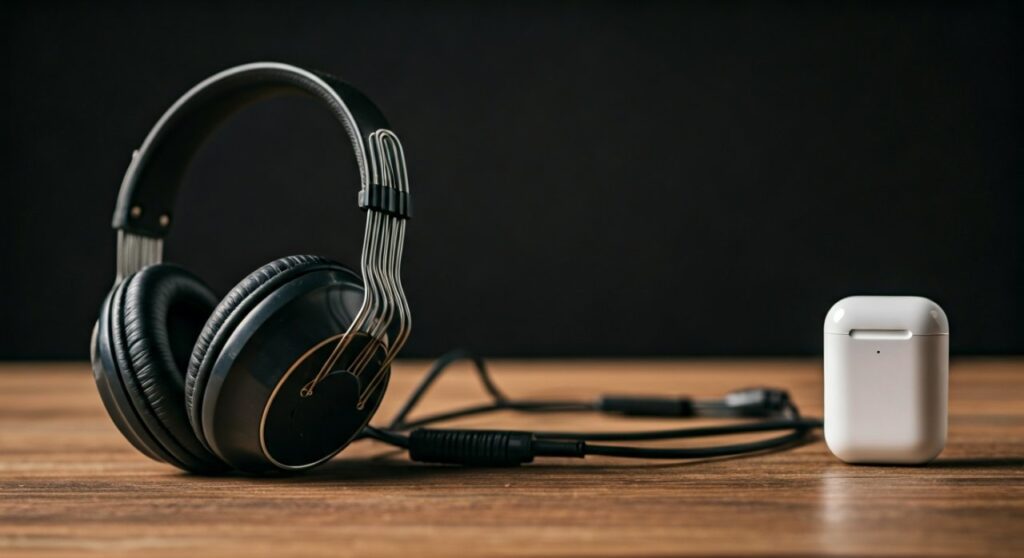
The Pre-Bluetooth Era: Who Invented Wireless Headphones First?
Before the sleek Bluetooth devices we use today, the term “wireless” referred to Radio Frequency (RF) and Infrared (IR) signals. To understand when did wireless headphones come out, we have to look back at the late 20th century.
In 1989, the Koss JCK/300 changed the market. Unlike modern versions, these required a bulky transmitter connected to a stereo system. They used infrared light to carry the audio signal. While innovative, the “line-of-sight” requirement meant if you walked into another room, the music stopped.
During the 1990s, Radio Frequency (RF) headphones became popular. Brands like Sennheiser and Sony led this era. These used the same tech as cordless home phones, allowing users to listen through walls. However, they were prone to static and interference from other household electronics.
The 2004 Turning Point: Who Invented Wireless Headphones in 2004?
Many tech historians point to a specific year when the industry shifted. If you ask who invented wireless headphones in 2004, you are looking at the birth of the Bluetooth Stereo era.
Before 2004, Bluetooth was primarily used for mono “hands-free” earpieces for phone calls (like the Ericsson HBH-10). The audio quality was poor—fine for talking, but terrible for music.
Everything changed with the A2DP (Advanced Audio Distribution Profile). In 2004, Gennum showcased the Bluewire headset, and Bluetake released the iPHONO Hi-Fi Sport Headphones. These were the first devices to prove that Bluetooth could handle high-quality music without a physical cord.
Why 2004 Was Critical:
- Stereo Sound: Previous wireless headsets were mono (one ear).
- Universal Pairing: Bluetooth became a standard across different phone brands.
- Portability: Transmitters became small enough to plug into iPods and MP3 players.
Comparison of Wireless Technologies Through History
Understanding the timeline requires looking at the different technologies used to “cut the cord.”
| Era | Technology | Key Feature | Major Limitation |
|---|---|---|---|
| 1989 | Infrared (IR) | Zero radio interference | Requires line-of-sight |
| 1990s | Radio Frequency (RF) | Works through walls | High static/interference |
| 2004 | Bluetooth 1.2 | First stereo music support | Short range (10 meters) |
| 2016 | Bluetooth 5.0+ | High-bitrate audio (LDAC/aptX) | Battery life (initial versions) |
How Bluetooth Technology Transformed the Industry
The question of who invented wireless headphones is inseparable from the invention of Bluetooth itself. In 1994, Dr. Jaap Haartsen at Ericsson was tasked with finding a way to connect electronic devices without cables.
By 1998, the Bluetooth Special Interest Group (SIG) was formed, involving Nokia, IBM, and Toshiba. However, the first consumer wireless headphones didn’t hit the mass market immediately because the data transfer speeds were too slow for music.
It took a decade of refinement (from 1994 to 2004) to reach a point where the bitrate was high enough to satisfy audiophiles. This is why the 2004 milestone is so frequently cited in search queries.
Step-by-Step: The Evolution of the Wireless Design
To appreciate where we are now, we can track the design changes step-by-step:
Step 1: The Transmitter Phase (1980s-1990s)
Early wireless headphones weren’t “independent.” You had to plug a large box into your TV or record player. The headphones only worked within 15-20 feet of that specific box.
Step 2: The “Neckband” Phase (Early 2000s)
Once Bluetooth arrived, manufacturers struggled to fit batteries and antennas into small earcups. This led to the “Neckband” or “Behind-the-Neck” style. The battery sat on your neck, connected to the ears by a short wire.
Step 3: The TWS Revolution (2015-Present)
The final step was True Wireless Stereo (TWS). In this stage, even the wire between the left and right ear was removed. While Onkyo and Bragi were first to the market in 2015, Apple’s AirPods (2016) used their W1 chip to solve the sync issues that plagued early TWS models.
Practical Advice: What to Look for in Modern Wireless Headphones
If you are buying headphones today, the history of the tech tells us exactly what features matter most. Expert testing shows that Bluetooth 5.3 is the current gold standard for stability.
- Check the Codec: If you want the quality intended by the 2004 inventors, ensure your headphones support AAC, aptX, or LDAC.
- Battery Chemistry: Modern lithium-ion batteries allow for 30+ hours of play.
- Multipoint Pairing: This allows you to connect to your laptop and phone simultaneously—a feature early inventors only dreamed of.
Frequently Asked Questions (FAQs)
Who invented the very first wireless headphones?
While Koss invented the first consumer cordless headphones in 1989, the technology was based on infrared light. The “father” of the modern Bluetooth technology used in wireless headphones is Dr. Jaap Haartsen.
When did wireless headphones become popular for the general public?
They became a household item around 2016. This surge was driven by the removal of the 3.5mm headphone jack on major smartphones like the iPhone 7, forcing a transition to Bluetooth audio.
Who invented wireless headphones in 2004?
In 2004, companies like Gennum (Bluewire) and Bluetake (iPHONO) were the first to market with stereo Bluetooth headsets designed specifically for music playback rather than just phone calls.
Were there wireless headphones in the 1970s?
Yes, but they were mostly DIY projects or niche professional radio headsets. There was no standardized commercial “wireless headphone” product for consumers until the late 80s.
What is the difference between cordless and wireless?
Historically, “cordless” referred to IR or RF headphones that required a base station. “Wireless” is now the modern term used for Bluetooth devices that connect directly to a source like a smartphone without a base.









