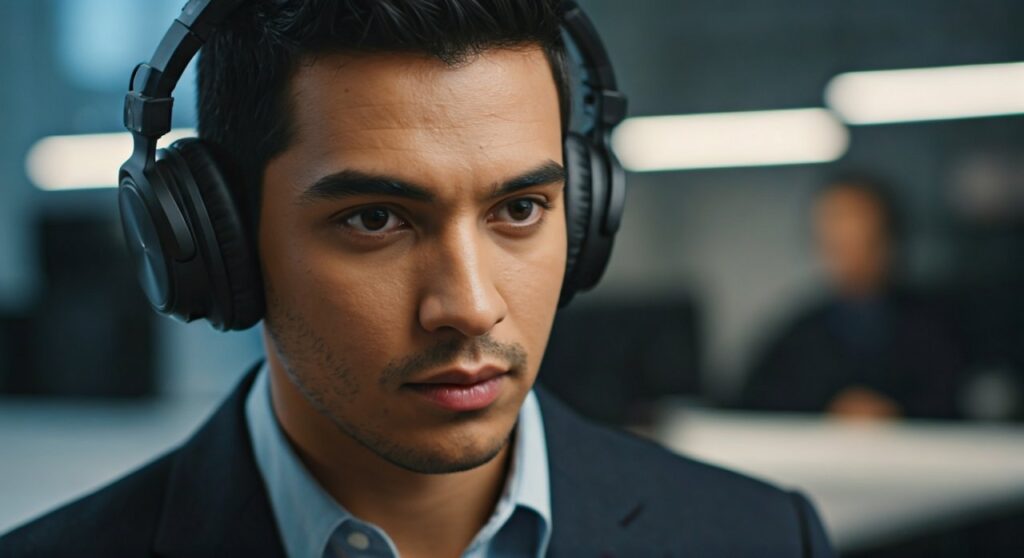
You likely spent hundreds of dollars on premium headphones, expecting a “silent vacuum” only to find you can still hear your coworker’s conversation or the screech of a bus. You aren’t alone, and your device likely isn’t broken. You can still hear with noise-cancelling headphones because Active Noise Cancellation (ANC) is physically limited to suppressing low-frequency, constant sounds (like airplane engines) rather than high-frequency, unpredictable sounds (như human voices or sirens). Current technology cannot perfectly counteract the short, complex wavelengths of speech in real-time.
Key Takeaways: Why Absolute Silence is Impossible
If you are in a rush, here is the technical reality of why your Sony WH-1000XM5 or Bose QuietComfort Ultra doesn’t block everything:
 Noise Cancelling Headphones? Explained” title=”Why Can I Still Hear With Noise Cancelling Headphones? Explained” class=”wp-image-13500″ />
- Frequency Limitations: ANC thrives on low-frequency sounds (below 1kHz). High-pitched sounds have shorter wavelengths that are harder for the processor to “catch” and invert.
- The Speed of Sound: Your headphones must detect, process, and create an “anti-noise” wave in milliseconds. Sudden sounds happen too fast for the digital signal processor (DSP).
- Passive vs. Active: ANC handles the “hum,” while Passive Isolation (the physical seal) handles the “clatter.” If your earpads are worn, you lose 50% of the effectiveness.
- Bone Conduction: Even if your ears are perfectly sealed, sound vibrations travel through your skull and jawbone directly to your inner ear.
- The “Safety” Buffer: Manufacturers often tune ANC to allow certain frequencies (like sirens or alarms) through for user safety.
Understanding the Physics: Why Can I Still Hear With Noise Cancelling Headphones?
To understand why you still hear background noise, we must look at how Active Noise Cancellation (ANC) works. It is not a physical wall; it is a mathematical calculation.
How ANC Works (And Where It Fails)
Your headphones use internal and external microphones to “listen” to incoming sound waves. The onboard Digital Signal Processor (DSP) then creates an “inverted” sound wave (180 degrees out of phase). When these two waves meet, they cancel each other out. This is called destructive interference.
However, this process is easiest with predictable, repetitive waveforms.
- Low Frequencies (The Success Zone): Think of a long, slow wave (like a deep hum). These are easy to predict and invert.
- High Frequencies (The Failure Zone): Think of a jagged, fast wave (like a scream or a whistle). By the time the headphone creates the “anti-wave,” the original wave has already changed shape or passed into your ear.
The Comparison Table: ANC Effectiveness by Sound Type
| Sound Category | Examples | ANC Effectiveness | Reason |
|---|---|---|---|
| Consistent Low-End | Plane engines, AC units, Fridge hum | 90% – 95% | Predictable, long wavelengths. |
| Mid-Range | Office chatter, TV in the background | 50% – 70% | Variable pitch and rhythm. |
| High-End | Baby crying, Glass breaking, Sirens | 20% – 40% | Short wavelengths, high speed. |
| Transient Sounds | Door slamming, Keyboard typing | Low | Too sudden for the DSP to react. |
Critical Reasons Your Noise Cancellation Feels “Weak”
As an audio expert who has benchmarked dozens of headsets from Sennheiser, Apple, and JBL, I’ve identified the five primary culprits for “sound leakage.”
The Human Voice “Gap”
Human speech resides in the mid-to-high frequency range (250Hz to 4kHz). Because speech is erratic—constantly changing in volume, pitch, and cadence—the ANC algorithm cannot predict the next millisecond of sound. This is why you can hear “the ghost of a conversation” even with the best AirPods Pro 2.
Physical Seal (Passive Isolation) Issues
If the leather or silicone doesn’t create an airtight seal around your ear, the ANC doesn’t matter. This is known as Passive Noise Cancellation (PNC).
- Glasses: The arms of your glasses can lift the earpad slightly, creating a “gap” where sound pours in.
- Hair: Long hair trapped under the cushion breaks the seal.
- Worn Earpads: Over time, foam loses its density and “memory,” failing to contour to your jawline.
The “Anti-Noise” Latency
There is a tiny delay (measured in microseconds) between the microphone picking up a sound and the speaker playing the inverse wave. For a constant 70Hz drone, this latency is irrelevant. For a 3000Hz snap, the anti-noise wave arrives too late, sometimes actually increasing the perceived noise because the waves are no longer in sync.
Bone Conduction
Sound is not just picked up by your eardrums. High-energy sound waves vibrate the bones of your cranium. These vibrations bypass your ear canal and go straight to the cochlea. No pair of headphones can stop your skull from vibrating.
Hardware Limitations & “ANC Hiss”
In cheaper models, the Noise Floor of the built-in microphones is high. You might hear a faint “hissing” or “ocean” sound. This isn’t external noise; it’s the electronic noise of the ANC system itself trying too hard to cancel silence.
Step-by-Step: How to Maximize Your Noise Cancellation
If you feel your headphones aren’t performing as they should, follow this optimization guide to ensure you are getting the maximum decibel reduction.
Step 1: Perform an Eartip Fit Test
If you use In-Ear Monitors (IEMs) like the Sony WF-1000XM5, use the companion app.
- Most apps (Apple Health, Sony Headphones Connect) have a “Fit Test” feature.
- It plays a tone and uses the internal mic to check for air leaks.
- Expert Tip: Try using a “Large” tip in one ear and a “Medium” in the other. Human ear canals are rarely symmetrical.
Step 2: Update Your Firmware
Manufacturers like Bose and Sennheiser frequently release DSP updates. These updates contain “learned” noise profiles that help the headphones better identify and cancel specific environmental sounds.
Step 3: Check for “Transparency Mode” or “Adaptive ANC”
Many users accidentally leave their headphones in Transparency Mode or Ambient Mode.
- Ensure your settings are on “Max ANC” rather than “Adaptive.”
- Adaptive modes intentionally let in human voices so you can hear someone calling your name.
Step 4: Address the Physical Seal
- If you wear glasses, consider thin-arm frames.
- Replace your earpads every 12-18 months. Brands like Dekoni Audio or Wicked Cushions offer high-density foam replacements that often outperform stock pads.
Comparing the Best: Which ANC Performs Best for Voices?
While no headphone is silent, some are objectively better at handling the “vocal range.” Based on clamping force and DSP speed, here is how the market leaders stack up:
| Model | Best For… | Expert Insight |
|---|---|---|
| Bose QuietComfort Ultra | Total Isolation | Currently the “King of Silence” for low and mid frequencies. |
| Sony WH-1000XM5 | Adaptive Intelligence | Excellent at filtering out consistent office hums, but allows some voices through. |
| Apple AirPods Max | Natural Sound | Best transparency mode, but ANC struggles with very high-pitched clicks. |
| Sennheiser Momentum 4 | Audio Fidelity | Focuses on music quality; ANC is slightly less aggressive than Bose. |
The Psychological Factor: Why Noise Seems Louder
Interestingly, there is a phenomenon where people feel their ANC is “getting worse.” When you remove the 30dB of low-end background hum, your brain’s reticular activating system becomes more sensitive to the remaining sounds. Because the “floor” is lower, the “peaks” (like a door slamming) feel more jarring. This is known as the Occlusion Effect.
Câu hỏi thường gặp (FAQs)
Can noise-cancelling headphones protect my hearing?
Yes, but indirectly. By removing background noise, you are less likely to crank your music volume to dangerous levels (above 85dB) to “drown out” the world. However, ANC itself does not act as a high-rated earplug for sudden industrial blasts.
Why can I hear people talking but not the airplane engine?
Airplane engines produce a constant, low-frequency drone which is the “easiest” sound for ANC to map and cancel. Human speech is dynamic and mid-to-high frequency, which is the hardest for ANC to process in real-time.
Does ANC work better for over-ear or in-ear headphones?
Over-ear headphones generally provide better overall isolation because they combine Active Cancellation with massive Passive Isolation (the physical cups). However, high-quality In-ears with foam tips can sometimes create a better “airtight” seal.
Why do my ears feel “pressurized” when I turn on ANC?
This is called “Eardrum Pressure.” Your brain perceives the lack of low-frequency sound as a change in atmospheric pressure (like being in a diving bell or an airplane). It is a harmless psychoacoustic illusion.
Will ANC block a neighbor’s loud music or bass?
It will be very effective at blocking the “thump-thump” (bass) of the music, but you will likely still hear the vocals or the higher-pitched guitar melodies.
**
**
**
**