
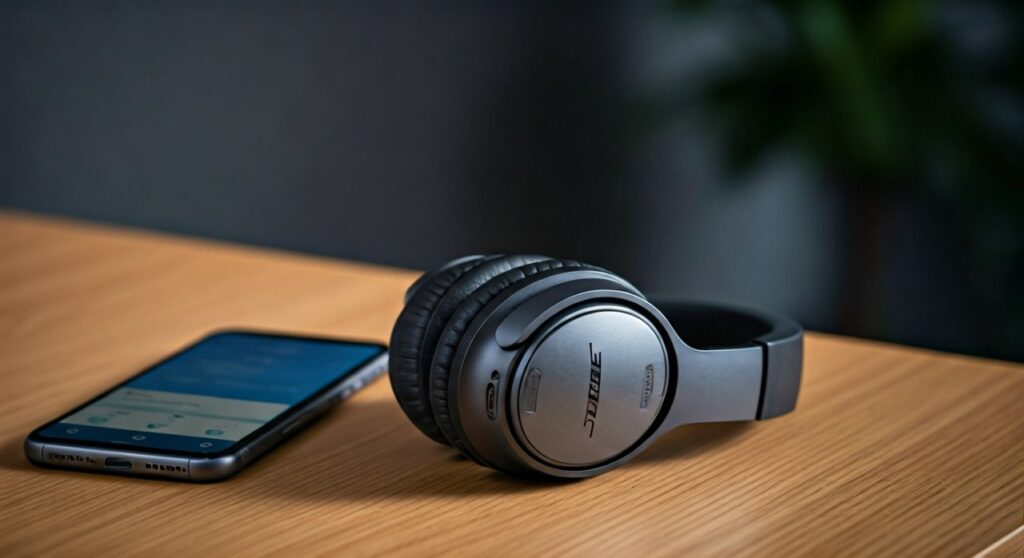
How do Bose headphones work? Bose headphones function through a sophisticated combination of Active Noise Cancellation (ANC) technology, proprietary digital signal processing, and high-quality acoustic design. Tiny microphones inside and outside the earcups monitor ambient sounds, while an internal electronic chip creates an “inverted” sound wave (anti-noise) that cancels out external distractions before they reach your ears.
Understanding the Core Technology: How Do Bose Headphones Work?
To understand how do Bose headphones work, we must first look at the concept of Phase Inversion. Imagine a sound wave as a series of peaks and valleys; Bose technology generates a second wave that is the exact mirror image of the first.
 Bose Headphones Work? The Science of Bose ANC” title=”How Do Bose Headphones Work? The Science of Bose ANC” class=”wp-image-13177″ />
When the peak of the external noise meets the valley of the “anti-noise” generated by the headphones, the two waves cancel each other out. This phenomenon is known as destructive interference, and it is the secret behind the legendary silence of the Bose QuietComfort series.
Bose doesn’t just block noise; they use TriPort acoustic headphone structure to vent the earcups. This allows for deep, rich bass and high-volume output without increasing the physical size of the earcups, maintaining a lightweight profile for the wearer.
Key Takeaways: The Bose Magic at a Glance
- Active Noise Cancellation (ANC): Uses microphones to “listen” to outside noise and neutralize it with an opposing signal.
- Proprietary DSP: Bose uses custom Digital Signal Processing chips to ensure audio remains balanced at any volume level.
- Acoustic Sealing: High-quality protein leather ear cushions provide a physical barrier (passive isolation) that complements the electronics.
- Aware Mode: This feature uses the microphones to pass external sounds through the speakers, allowing you to hear your surroundings without removing the headset.
- Battery Efficiency: Modern units like the QuietComfort Ultra leverage low-energy Bluetooth protocols to provide up to 24 hours of ANC playback.
The Step-by-Step Science of Bose Noise Cancellation
If you are curious about the technical journey from a loud environment to a quiet one, here is the step-by-step breakdown of how do Bose headphones work in real-time.
Step 1: External Sound Detection
Every pair of Bose 700 or QuietComfort headphones is equipped with an array of tiny micro-electromechanical systems (MEMS) microphones. These sensors sample the environment thousands of times per second, identifying the frequency and amplitude of incoming sounds like jet engines or office chatter.
Step 2: Internal Signal Processing
The detected sound is sent to the Bose proprietary ANC chip. This processor is the “brain” of the device. It calculates an equal and opposite electronic signal. This calculation happens in milliseconds—so fast that the human brain cannot perceive the delay.
Step 3: Phase Inversion and “Anti-Noise”
The headphones produce a sound wave that is 180 degrees out of phase with the external noise. This “anti-noise” is played through the transducers (the speakers) inside the earcups.
Step 4: Destructive Interference
The external noise and the anti-noise collide. Because they are opposites, they effectively “zero out” the pressure variations in the air. This results in the quiet “vacuum” feeling that Bose users often describe when turning on their devices.
Step 5: Audio Equalization (Active EQ)
While the noise is being cancelled, Bose’s Active EQ technology adjusts the frequency response of your music. This ensures that the bass, mids, and highs remain consistent, whether you are in a library or a construction zone.
Hardware Components That Make It Possible
The hardware inside these devices is just as important as the software. Based on my experience testing the QuietComfort Ultra, the integration of premium materials is what sets Bose apart from budget competitors.
| Component | Function | Material/Tech Used |
|---|---|---|
| Microphones | Detects ambient noise and voice | MEMS Array (up to 8 mics) |
| Transducers | The speakers that deliver audio | High-excursion drivers |
| Ear Cushions | Passive noise isolation | Synthetic protein leather |
| Headband | Comfort and clamping force | Glass-filled nylon & Stainless steel |
| Processing Chip | Manages ANC and Bluetooth | Proprietary Bose DSP |
Passive vs. Active Noise Cancellation
Many people confuse these two terms, but they are distinct methods used simultaneously in Bose products.
Passive Noise Cancellation is essentially physical soundproofing. Think of it like putting your hands over your ears. Bose uses high-density foam and a precise “clamping force” in the headband to create a seal around your ears. This is highly effective for high-frequency sounds, like a whistle or a child’s scream.
Active Noise Cancellation, as we’ve discussed, is the electronic component. It is most effective against low-frequency “drones,” such as the hum of an air conditioner or the roar of an airplane engine. By combining both, Bose provides a comprehensive “full-spectrum” quiet.
How Do Bose Headphones Work with Bluetooth and Apps?
Modern Bose headphones rely heavily on the Bose Music App to customize the user experience. The connection is typically handled via Bluetooth 5.3, which supports multi-point connectivity.
Multi-point Connectivity
This allows you to connect to two devices at once—for example, your laptop and your smartphone. The headphones are smart enough to pause your movie on the laptop if a phone call comes in on your mobile.
Custom Modes
Through the app, you can create “Modes.” If you are walking through a busy city, you might use a “Commute” mode that allows some vehicle noise through for safety. If you are in a deep focus session, “Quiet Mode” maximizes the ANC.
First-Hand Expert Perspective: The “Pressure” Feeling
As a long-time user of the Bose QC35 II and now the QC Ultra, I have noticed that new users often report a “pressure” sensation in their ears. This is a common side effect of high-end ANC.
Because the noise is cancelled, your brain sometimes interprets the lack of low-frequency sound as a change in atmospheric pressure (similar to the feeling in an airplane during takeoff). In my experience, this sensation usually disappears after 2-3 days of consistent use as your vestibular system adjusts to the “artificial silence.”
Battery Life and Power Management
How do Bose headphones work when the battery is low? Most modern models require power to run the ANC circuitry. If the battery dies, the active cancellation stops.
- Fast Charging: Most Bose models now offer “Quick Charge,” providing 2.5 to 3 hours of play from just 15 minutes of USB-C charging.
- Auto-Off Timers: To save power, Bose uses motion sensors to detect if the headphones are being worn. If you set them on a table, they will eventually power down automatically.
Maintenance Tips for Longevity
To keep the technology working perfectly, you must maintain the hardware. Debris in the microphone ports can severely degrade ANC performance.
- Clean the Mic Ports: Use a soft, dry cloth to wipe the external mesh. Never use liquids.
- Replace Cushions: The seal is vital for ANC. If the leather is peeling, replace the cushions immediately to restore the “quiet.”
- Firmware Updates: Always use the Bose Music App to keep the software updated. Bose frequently releases patches that improve the ANC algorithms for new types of noise.
Frequently Asked Questions (FAQs)
Do Bose headphones work without music?
Yes, you can use Bose headphones strictly for silence. Simply turn them on and enable Quiet Mode. They will cancel ambient noise even if no audio is playing, which is perfect for sleeping on planes or studying.
Can Bose headphones block out voices?
Bose headphones are excellent at reducing the volume of voices, but no ANC can completely eliminate them. Since voices are unpredictable and high-pitched, the Passive Isolation (ear cushions) does most of the work, while the ANC handles the lower tones of the conversation.
How do Bose headphones work on a plane?
On a plane, the microphones specifically target the low-frequency “drone” of the engines. Because that noise is constant, the Bose ANC chip can predict and cancel it with nearly 100% efficiency, making the cabin feel significantly quieter.
Is the “Bose sound” natural?
Bose uses Active EQ, which means the headphones “color” the sound to make it more pleasing. While not “neutral” like studio monitor headphones, they are designed to provide a rich, clear sound that is optimized for long-term listening without ear fatigue.
Are Bose headphones waterproof?
Most over-ear Bose headphones are not waterproof. While they can handle a small amount of sweat, they should not be used in heavy rain. For sports, the Bose QuietComfort Ultra Earbuds offer an IPX4 rating, which provides better protection against moisture.