Choosing between LED and HID for your projector headlights often comes down to one question: do you value instant-on convenience or raw, long-distance punch? For most modern drivers, LEDs are the better choice due to their 50,000-hour lifespan, “instant-on” capability, and simple plug-and-play installation. However, HIDs (High-Intensity Discharge) still hold the crown for maximum light throw and a more uniform beam pattern in high-end enthusiast retrofits.
Key Takeaways: HID vs. LED for Projectors
If you are in a hurry, here is the rapid-fire breakdown of which is better: HID or LED on projector headlights based on professional testing and real-world usage.
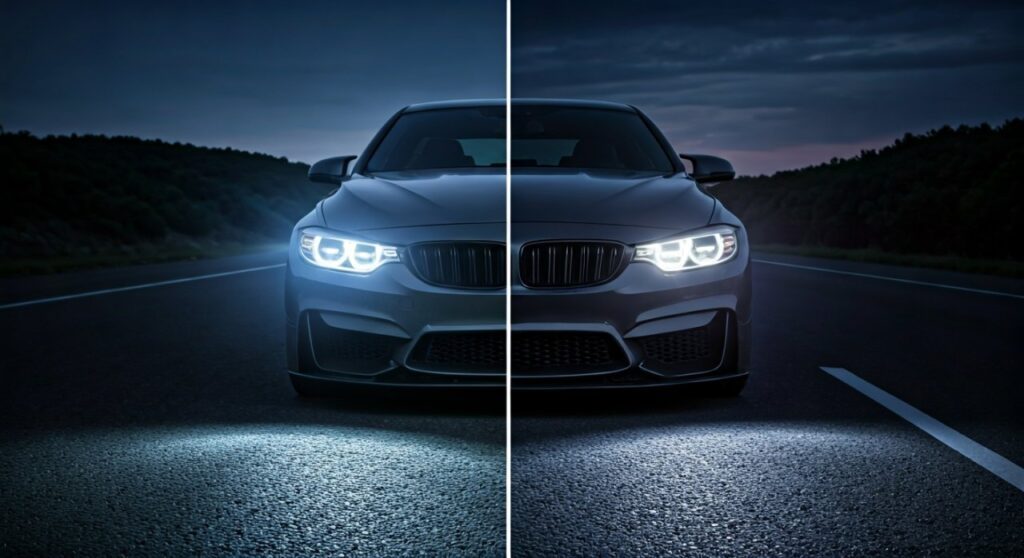
- LEDs win on longevity, startup speed, and ease of installation.
- HIDs win on maximum distance (throw) and beam uniformity in older projector designs.
- Projector Lens Type matters; “Clear lenses” favor HIDs, while “Fresnel lenses” can often handle the intense point-source of an LED quite well.
- Heat Management: LEDs run cooler at the bulb but require heat sinks/fans at the base. HIDs generate significant heat inside the projector bowl.
- Cost: LEDs have a higher upfront cost for quality units but save money over time by never needing replacement.
Understanding the Technology: HID vs. LED
Before deciding which is better: HID or LED on projector headlights, you must understand how these two technologies create light. They are fundamentally different in how they interact with the projector optics.
What are HID (Xenon) Headlights?
HID stands for High-Intensity Discharge. These bulbs work by creating an electrical arc between two electrodes within a glass tube filled with Xenon gas and metal salts.
In my experience installing Morimoto or Philips HID kits, the light output is incredibly “full.” Because the gas glows in a 360-degree arc, it fills the projector bowl perfectly, creating a seamless beam of light on the road.
What are LED (Light Emitting Diode) Headlights?
LEDs use semiconductors to convert electricity directly into light. Unlike HIDs, LEDs are “directional.” Most LED headlight bulbs feature chips on two sides of a copper core.
Modern high-end LEDs, like the GTR Lighting Ultra 2, use CSP (Chip Scale Package) technology to mimic the thin filament of a halogen bulb. This allows them to work much more effectively inside a projector housing than the bulky LEDs of five years ago.
Direct Comparison: Performance Metrics
To determine which is better: HID or LED on projector headlights, we need to look at the hard data. The following table compares the two across the most critical categories for night driving.
| Feature | HID (Xenon) | LED (Diode) | Winner |
|---|---|---|---|
| Luminous Flux (Lumens) | 3,200 – 5,000 lm | 2,000 – 6,000+ lm | LED (Peak) |
| Lifespan | 2,000 – 5,000 hours | 30,000 – 50,000 hours | LED |
| Startup Speed | 5 – 15 seconds (Warm-up) | Instant-On | LED |
| Light Throw (Distance) | Exceptional | Good to Great | HID |
| Installation Complexity | High (Ballasts + Relays) | Low (Plug-and-Play) | LED |
| Color Options | 3000K to 12000K | 5000K to 6500K | HID |
| Power Consumption | ~35W – 55W | ~20W – 40W | LED |
Why Projector Headlights Change the Equation
A projector headlight uses a lens to magnify and direct light. This is different from a “reflector” headlight, which simply bounces light off a shiny background.
When asking which is better: HID or LED on projector headlights, you have to consider the “Optical Focus.”
The “Dead Spot” Issue with LEDs
Because most LEDs have a circuit board in the middle, they have two “blind spots” where no light is emitted. In a reflector housing, this causes huge dark patches.
In a projector, the lens does a better job of blending the light. However, if you use a cheap LED with thick housing, you will see a “V-shaped” shadow in your beam pattern. For projectors, I always recommend 360-degree LEDs or ultra-thin CSP chips to avoid this.
The HID “Hot Spot” Advantage
HIDs naturally create a very intense “hot spot” just below the cutoff line. This is exactly what you want for long-distance visibility. When I drive on unlit highways at 70 mph, an HID system provides that extra 50-100 feet of reach that gives me more reaction time compared to mid-range LEDs.
Step-by-Step Guide: Choosing the Right Bulb for Your Projector
Follow this professional workflow to decide which upgrade path is right for your specific vehicle.
Step 1: Identify Your Projector Type
Check if your car came with factory projectors or if they are aftermarket.
- Factory Halogen Projectors: These are often “tuned” for halogen bulbs. LEDs are usually the easiest upgrade here.
- Aftermarket Retrofit Projectors: If you installed Bi-Xenon projectors (like the Hella G5), stick with HID for maximum performance.
Step 2: Evaluate Your Driving Environment
Where do you do most of your driving?
- City/Suburban: Choose LED. The instant-on is great for flashing high beams, and the white 6000K color looks modern.
- Rural/Highway: Choose HID. The superior distance and depth of the beam are safer for spotting deer or road debris at high speeds.
Step 3: Check for CANBUS Issues
Modern European cars (BMW, Audi, VW) and many American trucks (RAM, Ford) have sensitive computer systems.
- LEDs often require CANBUS decoders to prevent flickering or “bulb out” errors.
- HIDs almost always require a Relay Harness to pull power directly from the battery, as ballasts have a high “startup amp draw.”
How to Install LEDs in Projector Headlights
Installing LEDs is generally a DIY-friendly task that takes about 20 minutes.
- Access the Housing: Remove the plastic dust cover behind your headlight.
- Remove Old Bulb: Unclip the halogen bulb.
- Clock the LED: This is the most important step. For projector headlights, the LED chips must face 3 o’clock and 9 o’clock (sideways). If they face up and down, your beam pattern will be ruined.
- Tuck the Driver: Most LEDs have a small external driver box. Tuck this inside the housing and ensure it doesn’t interfere with the projector’s movement (if you have “Adaptive” headlights).
- Test the Pattern: Park 25 feet from a wall. Ensure the cutoff line is sharp and there are no stray rays of light blinding oncoming traffic.
How to Install HIDs in Projector Headlights
HIDs require more mechanical sympathy and space.
- Mount the Ballasts: You need a flat, metal surface to mount the ballasts using screws or heavy-duty 3M tape.
- Drill the Dust Cover: Unlike LEDs, HID wires must pass through the dust cover. You will likely need a 25mm hole saw to create a passage for the rubber grommet.
- Connect the Relay: Connect the harness to your battery terminals. This ensures your headlights don’t flicker when the car’s AC or Stereo kicks in.
- Insert the Bulb: Never touch the HID glass with your bare fingers. Skin oils can cause the bulb to shatter when it reaches operating temperatures.
- Grounding: Ensure the ground wires are attached to clean, unpainted metal on the chassis.
Expert Perspective: The “Warm-Up” Reality
One thing many “Top 10” lists ignore is the HID warm-up period. When you turn on an HID, it starts out deep blue or purple and takes 15-30 seconds to reach full brightness and its true color.
If you use your high beams frequently to “flash” other drivers or signal, HIDs are a poor choice for the high-beam slot because frequent “power cycling” kills the ballasts. For Bi-LED or Bi-Xenon projectors (where a shutter moves instead of a second bulb turning on), this is less of an issue.
The Verdict: Which is Better?
Choose LED If:
- You want a “set it and forget it” solution.
- You prioritize a modern, crisp white look (6000K).
- You do a lot of city driving and want instant full brightness.
- You have limited space behind your headlight housing.
Choose HID If:
- You are a lighting enthusiast who wants the absolute “cleanest” beam pattern.
- You drive on dark, high-speed roads where “throw distance” is a safety priority.
- You prefer a warmer color temperature (like 4300K or 5000K), which performs better in rain and fog.
- You are performing a full “Retrofit” and using high-quality components.
Frequently Asked Questions
Will putting LEDs in my projector headlights blind other drivers?
No, as long as you use a projector housing and “clock” the bulbs correctly. Projectors have a physical metal shield (the cutoff plate) that blocks light from entering the eyes of oncoming drivers. This makes them much safer for LED upgrades than old-style reflector housings.
Why are my HIDs turning pink?
When an HID bulb reaches the end of its life, it undergoes a process called “color shifting.” Turning pink or purple is a definitive sign that the bulb is about to fail. You should replace both bulbs at the same time to ensure the colors match.
Do LEDs or HIDs run hotter?
It depends on where you measure. HIDs create more heat inside the projector bowl, which can eventually cause the reflective finish to peel (called “burning the bowl”). LEDs generate heat at the base of the bulb (the chips), which is why they need fans. Overall, LEDs are safer for the longevity of the plastic headlight housing.
Can I put an HID bulb in an LED projector?
No. LED projectors (like those found in 2024 model cars) have the LEDs permanently soldered to the housing. They do not use “bulbs” in the traditional sense. If an LED projector fails, you usually have to replace the entire headlight assembly.
What is the best color temperature for visibility?
For the most usable light, stick between 4300K (Warm White) and 5500K (Pure White). Once you go above 6000K into the blues and purples, your actual “lumens” drop, and your eyes will struggle to see contrast in the rain.